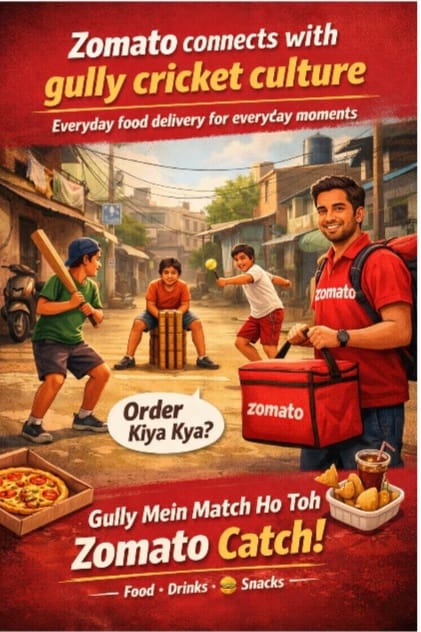
Zomato’s new campaign pivots to gully cricket—arguably India’s most democratised sporting format—to frame food delivery as part of spontaneous, everyday social rituals. By embedding itself in informal cricket settings, the brand moves away from functional messaging to situational relevance, where ordering food becomes a natural extension of shared, unplanned moments. This matters because food delivery platforms are increasingly competing on frequency, not just acquisition. Embedding into high-frequency cultural contexts like gully cricket helps drive habitual usage.
The strategic shift: From occasions to behaviours
The campaign signals a move from “big occasion” marketing (festivals, match days) to micro-behaviours. Gully cricket isn’t scheduled or premium—it’s impulsive, local and participation-led.
For Zomato, this aligns with:
• Increasing order frequency in non-peak occasions • Expanding relevance beyond urban, premium cohorts • Building cultural memory through everyday scenarios This reflects a broader industry pivot where brands are mining hyperlocal insights instead of relying solely on mass, broadcast-led narratives.
What it means for the market For the Indian advertising ecosystem, the campaign reinforces three shifts:
• Cultural specificity over scale: Relatable, local codes are becoming more effective than pan-India storytelling. • Contextual consumption cues: Brands are tying usage to behaviours, not just time-bound events. • Content modularity: Such ideas are inherently adaptable across short-video and social platforms.
Our insight
Gully cricket is not just nostalgia here—it’s a distribution strategy for attention in a fragmented media environment.