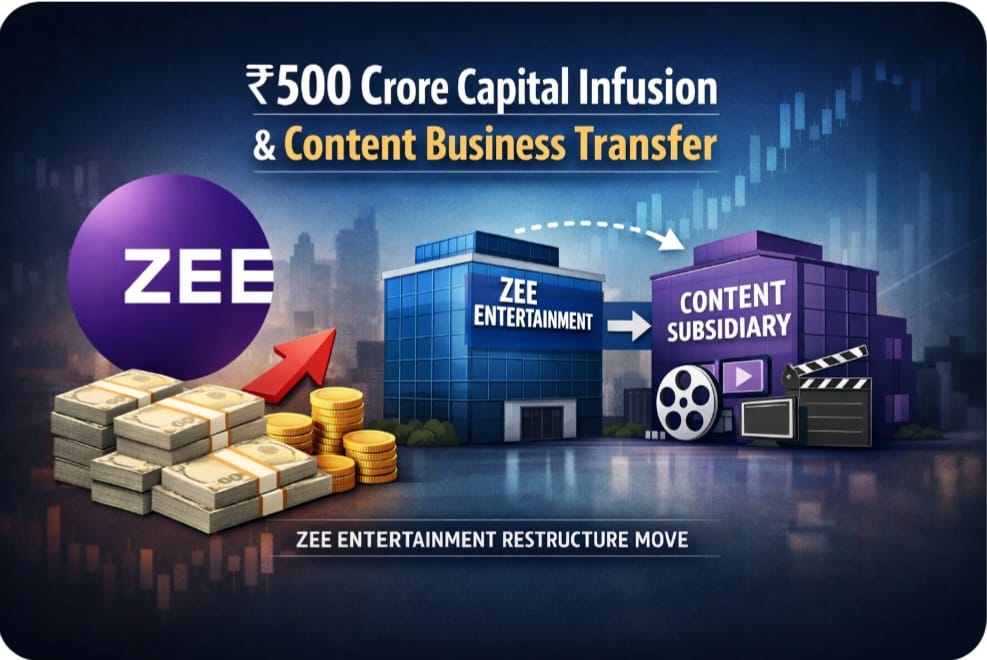
Zee Entertainment Enterprises Limited (ZEEL) has approved a ₹500 crore capital infusion alongside a strategic move to transfer its content business into a wholly-owned subsidiary. The decision signals a financial and operational recalibration at a time when broadcasters are under pressure from rising content costs and platform fragmentation. This isn’t just balance sheet housekeeping. It’s a structural shift in how legacy broadcasters are organising content creation, ownership, and monetisation.
The structural play: separating content from distribution
By moving content operations into a dedicated entity, ZEEL is effectively decoupling its creative engine from its broadcast and platform businesses. This enables: • Sharper cost tracking and capital allocation • Potential external fundraising or strategic partnerships at the content level • Greater flexibility in syndication across TV, OTT, and international markets For advertisers and agencies, this could translate into more modular content deals and platform-agnostic inventory.
Industry signal: content is now a standalone asset class
This move aligns with a broader industry pattern where content is being treated as an independent monetisable asset rather than a support function for channels. With streaming platforms recalibrating spends, broadcasters are under pressure to sweat content libraries harder. ZEEL’s restructuring hints at future scenarios: co-production models, IP-led monetisation, and possibly even content-led joint ventures.
The trade-off: control vs. agility
While the move improves financial clarity and strategic flexibility, execution will be key. Managing inter-company dependencies without slowing down commissioning and distribution cycles will define success.
One sharp observation
In India’s evolving media economy, owning content is no longer enough — structuring it right is becoming the real competitive advantage.