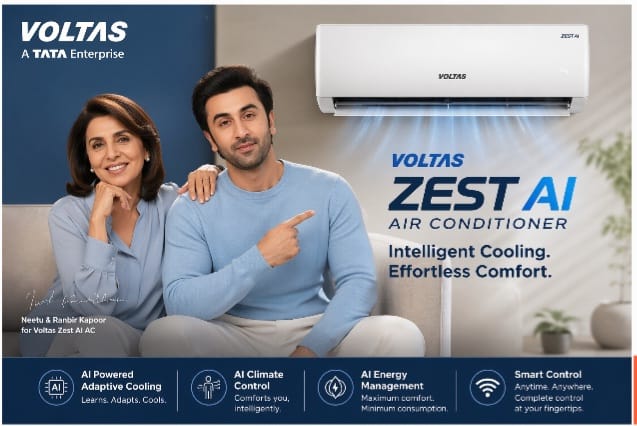
Voltas has introduced a campaign for its Zest AI air conditioners, leveraging the real-life mother-son duo of Neetu Kapoor and Ranbir Kapoor. The campaign centres on AI-powered cooling, positioning the product as adaptive, intuitive and aligned with evolving consumer expectations.
This matters because the AC category in India is shifting from pure price-performance messaging to feature-led differentiation. As penetration grows beyond metros, brands are reframing value through technology rather than just affordability.
The strategic read
Voltas’ casting choice does two things. First, it taps into familiarity and trust—particularly with Neetu Kapoor—while using Ranbir Kapoor to maintain relevance with younger, urban buyers. Second, it uses relationship storytelling to simplify what could otherwise be a complex AI proposition.
At a category level, AI is emerging as a shorthand for premiumisation. Brands are increasingly embedding “smart” narratives into core product communication, even when consumer understanding of the technology remains limited. The advertising, therefore, carries the burden of translation.
This also reflects a broader industry pattern: legacy brands borrowing the language of tech to stay competitive against newer, digital-first entrants and multinational players.
What this means for the industry
For marketers, the takeaway is clear—technology claims need cultural packaging. Celebrity-led storytelling is being used not just for reach, but to decode product benefits in relatable contexts.
Our insight
In India’s appliance market, AI isn’t just a feature—it’s fast becoming the new baseline for perceived value.