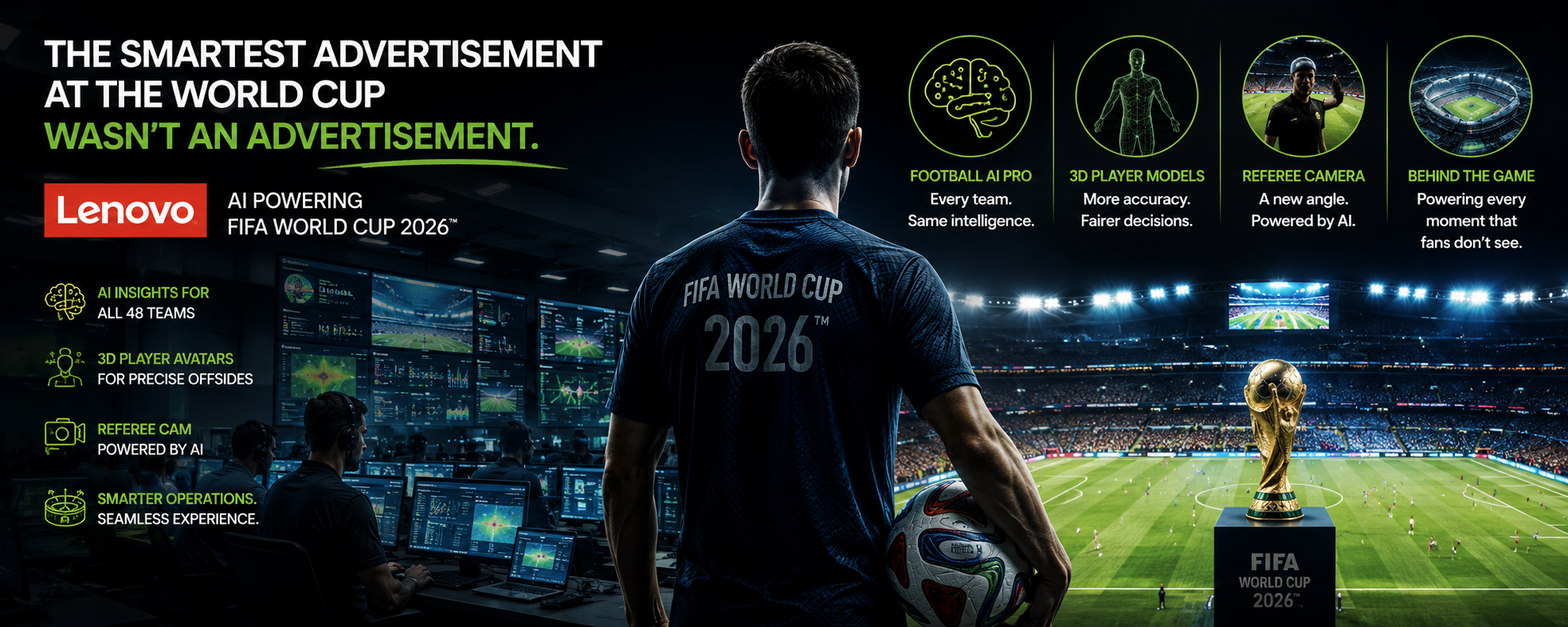
Lenovo powered 6 billion screens at the World Cup. And almost nobody knew it was them. That's not a failure of marketing. It might be the point.
Colombia vs Portugal. Group stage.
Davinson Sánchez reads the cross perfectly.
He gets to the far post.
Heads the ball into the net.
The stadium erupts.
Then the screens show something strange.
A 3D digital human. Floating on 6 billion television sets.
A recreation of Sánchez — down to the sinew, down to the stud marks — and the front of his boot. Millimetres past the line. Offside. By the tip of his toe.
Goal disallowed.
Lenovo × FIFA World Cup 2026 — AI technology powering the tournament
Millions of people argued about that call.
Almost none of them knew who built the technology behind it.
When did Lenovo become an AI company?
Most people couldn't tell you.
Ask ten people what Lenovo sells.
Nine say laptops. Maybe ThinkPad. Maybe some vague memory of a computer they used in an office somewhere.
That's a branding problem.
And branding problems are never solved by making another commercial.
They're solved by making people feel something different.
Which is exactly — and quietly — what Lenovo did at this World Cup.
Not one thing. Three. Each more quietly extraordinary than the last.
Millions of people will remember that offside call.
The 3D ghost of Sánchez.
The millimetre.
The disallowed goal.
They will tell that story for years.
Which sounds like failure.
Until you sit with it for a moment.
People don't remember electricity.
They remember what electricity made possible.
Lenovo didn't need the credit.
It needed the association.
The slow, deep rewiring of a perception.
From: "that laptop company."
To: "the company that ran the World Cup."
That shift doesn't happen in 30 seconds.
It happens over 39 matches. Across 3 countries. Watched by 6 billion people.
Lenovo also made something more visible.
"Maximum David."
A global campaign with David Beckham. Launched one month before the tournament. The hero film opens with Beckham being asked during a podcast: "Do you have a lot going on?"
What follows is a montage. Beckham on a motorbike. Stopping to check on his chicken Gary. Running Inter Miami CF. Designing. Travelling. Creating. All of it, somehow, powered by Lenovo AI.
It's a smart film. But the real genius isn't the film.
It's what the film points to.
Beckham isn't a footballer anymore. He's a businessman. A cultural institution. Someone who operates at maximum capacity across sport, entertainment, hospitality, and fashion simultaneously.
Lenovo isn't saying "we make laptops."
It's saying "we're what maximum performance looks like."
That's a completely different sentence.
Lenovo "Maximum David" · David Beckham · Official Campaign Film · May 2026
Brands love saying "We're innovative."
Three words. Printed on a billboard. Forgotten by the time the light turns green.
Customers have been immunised against it.
They've heard it from every software company, every bank, every airline, every appliance manufacturer since 1987.
The word "innovative" has been said so many times it has lost all meaning.
It built the innovation instead.
That's much harder.
And much more believable.
It's about what advertising can be when it's at its best.
Advertising usually interrupts the experience.
A logo on a jersey. A 30-second break before the penalty shootout. A banner behind the goal mouth.
Lenovo's strategy was different.
It didn't interrupt the experience.
It was the experience.
Every offside decision. Every 3D avatar. Every referee's eye view.
That is a completely different game.
And it has a different name.
Not sponsorship.
Infrastructure.
Because you can't fake it.
You either built it or you didn't.
Perception shift estimate based on Lenovo's strategic positioning campaign
What this means for Indian marketing. Right now.
Every IPL season, brands spend hundreds of crores to become Official Partner. Title Sponsor. Associate Sponsor. Boundary Sponsor. DRS Sponsor. Timeout Sponsor.
Each buys a logo. A placement. A moment of visibility between deliveries.
Lenovo didn't buy a logo.
It built something the tournament couldn't function without.
The question for every Indian CMO sitting across a ₹200 crore sports sponsorship brief this year:
Are we buying a logo that people tune out?
Or are we building something the sport needs to exist?
One rents visibility. The other earns belief.
There's a massive difference between the two. Lenovo just put that difference on a screen in front of 6 billion people.
Millions of people will remember Messi's last World Cup.
Millions will remember the controversial offside calls.
Millions will remember the 3D ghost of a player's boot.
Very few will remember the company behind it.
And that's the whole point.
The best positioning doesn't make the logo more famous.
It changes what people think the company is.
Slowly. Quietly. Without ever announcing it.
The smartest advertisement at the World Cup wasn't an advertisement.
It was a tournament.