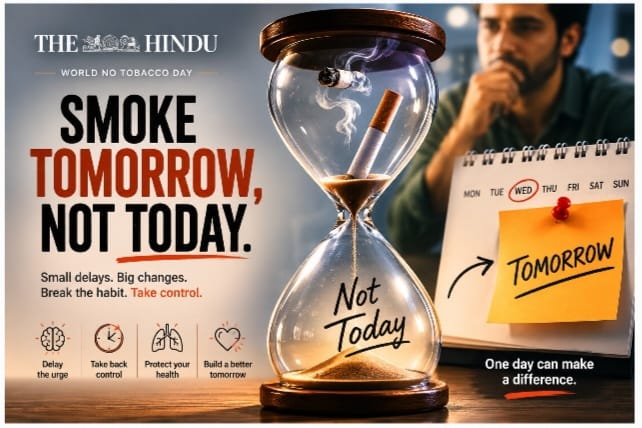
To mark World No Tobacco Day, The Hindu released an anti-smoking advertisement built around a counterintuitive proposition: smoke tomorrow, not today. Rather than asking smokers to quit immediately, the campaign encourages them to delay the act by a day, subtly challenging habitual behaviour patterns.
A Different Approach To Tobacco Awareness
The creative departs from traditional anti-tobacco communication, which often relies on graphic health warnings, fear appeals or moral messaging. Instead, it adopts a behavioural intervention approach, focusing on small decisions that can interrupt automatic consumption habits.
For a newspaper brand, the campaign also demonstrates how public-interest messaging can be delivered through simplicity and strategic framing rather than shock value.
What This Means For Advertising
The campaign reflects a broader shift in Indian advertising towards behavioural science-inspired communication. Brands and publishers are increasingly recognising that awareness alone does not necessarily drive action.
The challenge is changing behaviour, not merely informing audiences. This approach mirrors a growing global trend where marketers focus on reducing friction, nudging decisions and creating incremental behaviour shifts. For social-impact campaigns, this can often prove more effective than direct instruction.
For media brands, the work also reinforces an important point: editorial institutions can continue to play a meaningful role in public health conversations while showcasing creative effectiveness.
Our insight
The strongest anti-smoking campaigns may no longer be the ones that tell people to quit. They may be the ones that persuade people to postpone—because behaviour change often begins with delay before it becomes abandonment.