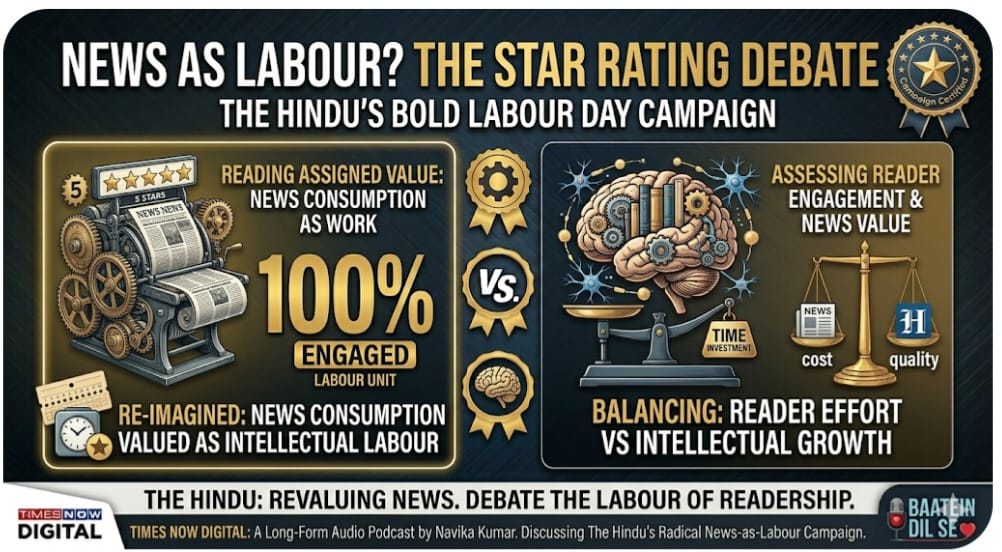
The Hindu rolled out a Labour Day campaign that reverses the familiar rating system—this time evaluating readers instead of services. By assigning star ratings based on reading behaviour, the initiative reframes news consumption as an active, effort-driven task. In a landscape where attention is often treated as passive, this shift positions readership itself as labour worth recognising.
The idea: from passive audience to active participant
The campaign taps into a simple cultural device—ratings—and subverts it. Instead of consumers reviewing products, the publication evaluates how readers engage with news: depth, consistency, and seriousness.
This is a strategic reframing. At a time when misinformation and low-attention scrolling dominate, the act of reading credible journalism is positioned as work—aligned with the spirit of Labour Day.
The strategic read for publishers and advertisers
For publishers, this signals a move towards valuing quality of attention over sheer reach. As subscription models grow, engagement depth becomes a more critical metric than impressions. Campaigns like this help build that narrative.
For advertisers, it reinforces the premium around environments where audiences are more invested. A reader who spends time and effort is inherently more valuable than a fleeting impression—especially for categories like finance, policy, and education.
Implications for the media ecosystem
Expect more campaigns that quantify and gamify engagement—not just to drive metrics, but to signal value to both readers and advertisers. Attention is being repositioned as effort, not inventory.
Our insight
By rating its readers, The Hindu is making a pointed claim: attention isn’t free—it’s work, and it has value.