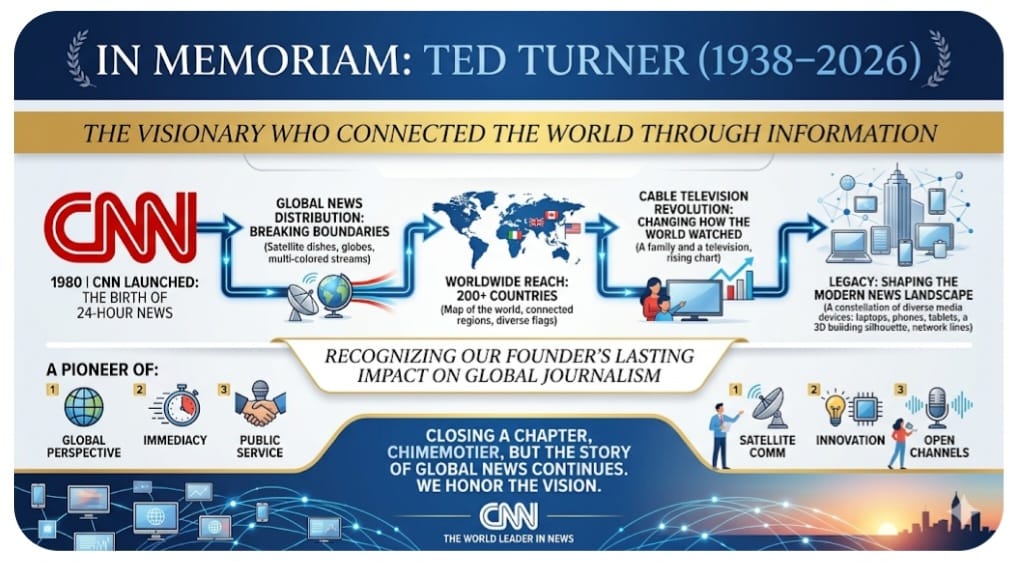
Ted Turner’s death marks more than the passing of a media entrepreneur. It represents the end of an era that fundamentally reshaped how television news was produced, distributed and monetised.
When Turner launched CNN in 1980, the idea of a 24-hour news channel was considered commercially risky. Until then, television news operated within scheduled bulletins. CNN changed that model by making news continuous, immediate and globally accessible — particularly during live geopolitical events such as the Gulf War.
That shift permanently altered audience behaviour, advertising cycles and newsroom economics.
Why This Matters to India’s Media Industry
For Indian broadcasters and media executives, Turner’s legacy remains highly relevant. India’s modern television news ecosystem — from rolling coverage formats to breaking-news competition — was heavily influenced by the CNN model introduced globally in the 1980s and 1990s.
The business implications were equally significant. Turner proved that news could function not only as public service programming, but also as a scalable advertising and subscription business. Indian networks later adapted that formula across English and regional news markets.
His influence also extended into media convergence. Turner understood early that distribution scale and audience attention would eventually become more valuable than single-format content ownership.
Our insight
The irony is difficult to miss: the 24-hour news cycle Turner pioneered is now being disrupted by algorithmic feeds, creators and platform-led video consumption. But the operating principle he introduced — owning audience attention in real time — still defines modern media economics.