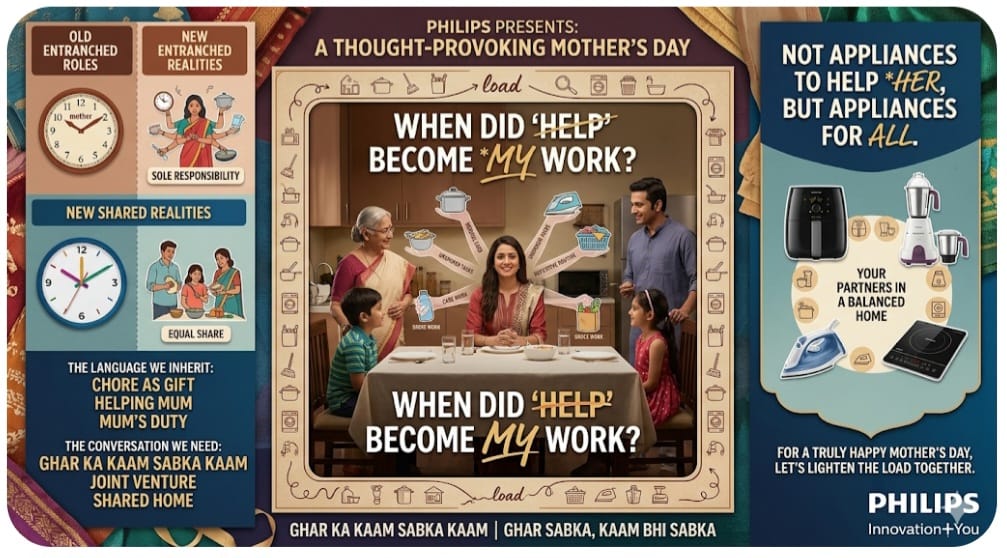
Philips’ new Mother’s Day campaign shifts the focus from celebratory messaging to the unequal distribution of domestic responsibilities in Indian households.
The campaign questions why caregiving and household management continue to default to women, even in increasingly modern urban homes.
The approach matters because festive and occasion-led advertising in India is undergoing a tonal shift. Instead of relying solely on emotional gratitude narratives, brands are using cultural moments to address behavioural and social tensions that audiences already recognise in daily life.
For Philips, the positioning aligns with its broader home appliances and lifestyle portfolio, where convenience, time-saving and shared domestic responsibility are becoming increasingly linked to product relevance.
The Strategic Read for Advertisers
For marketers, the campaign reflects the growing importance of socially aware storytelling in mainstream consumer categories. Urban Indian audiences — particularly younger consumers — are responding more strongly to advertising that mirrors lived realities rather than idealised family portrayals.
The campaign also highlights how appliance brands are reframing utility. Products are no longer marketed only as functional tools, but as enablers of lifestyle balance, efficiency and shared household participation.
This shift has implications for creative strategy across FMCG, appliances and homecare categories.
Gender representation is moving from symbolic inclusion toward behavioural realism — a more difficult but potentially more credible storytelling space.
Our insight
The larger challenge for brands will be avoiding performative messaging. Consumers increasingly expect campaigns discussing equality and domestic responsibility to be backed by consistent brand positioning, product innovation and long-term communication strategy — not just seasonal occasion marketing.