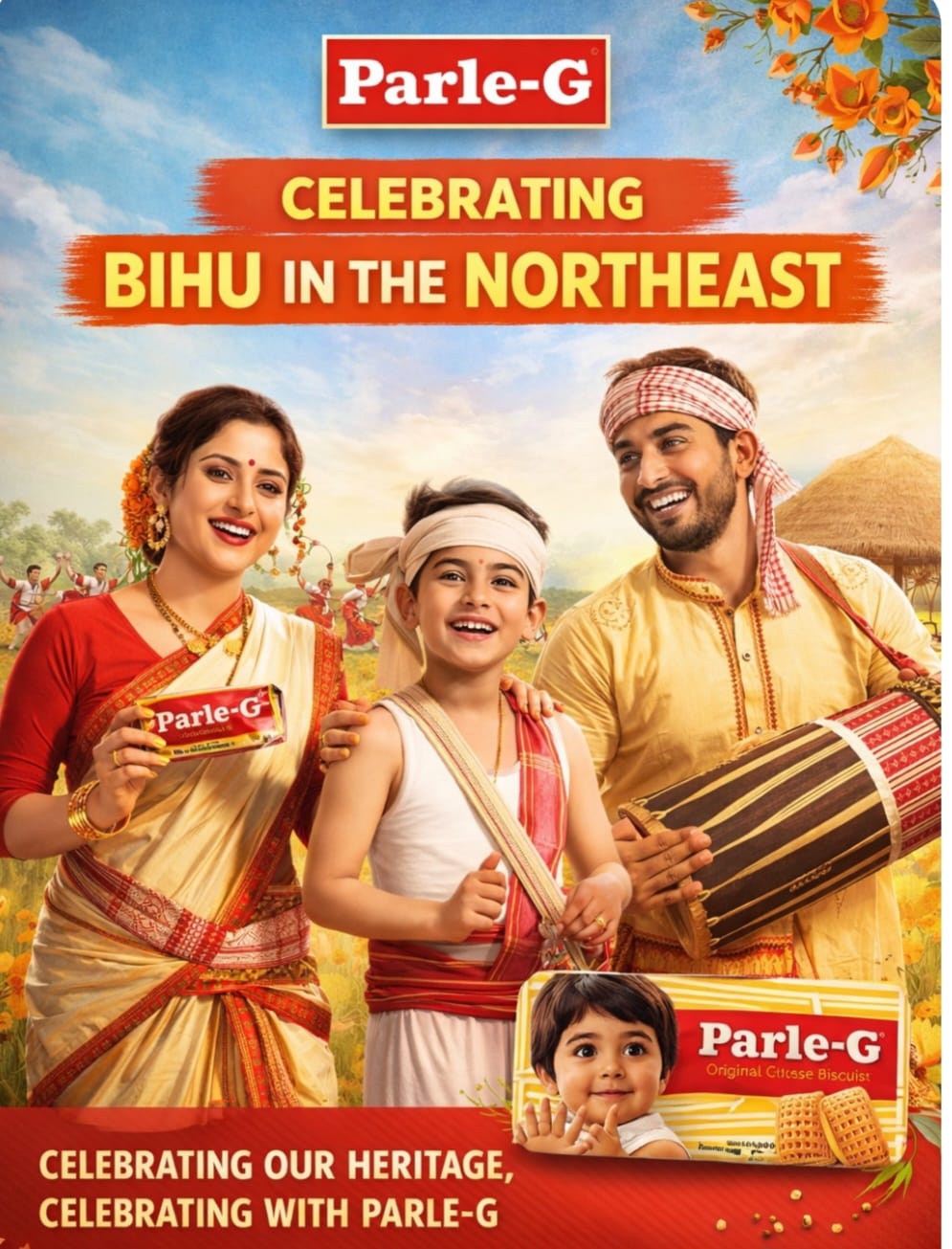
Parle-G has rolled out a campaign built around Bihu, aligning its communication with one of Assam’s most significant cultural festivals. The move reflects a deliberate push to localise messaging in a market often underserved by national advertising narratives. For a legacy brand with deep rural and semi-urban penetration, this signals a sharper focus on cultural relevance as a growth lever.
Creative approach and brand fit
The campaign draws on familiar Bihu motifs — community, celebration and shared rituals — to embed the brand within local context. Rather than repositioning the product, Parle-G integrates itself into existing cultural moments, reinforcing its identity as an everyday, accessible companion. This is consistent with the brand’s long-standing strategy: low-involvement product, high-frequency consumption, and communication built on emotional familiarity rather than product innovation. The cultural layer adds depth without altering the core proposition.
What this means for the segment
Regionalisation in Indian advertising is moving beyond language dubbing to culture-first storytelling. As media consumption fragments across geographies and platforms, brands are being pushed to invest in contextually relevant narratives that drive affinity, not just awareness. For legacy FMCG players, this offers a way to defend share against regional brands that already operate with cultural proximity. It also reflects the increasing importance of Tier 2 and Tier 3 markets in driving incremental growth.
Our insight
For mass brands like Parle-G, cultural specificity is becoming a scale strategy, not a niche play.