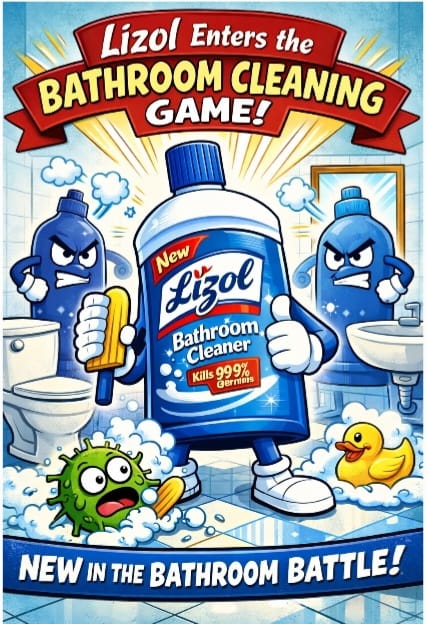
Lizol is going beyond the floor — and it is bigger than a product launch
The News — Lizol Enters Bathroom Cleaning
Reckitt's Lizol has launched Fresh & Clean Bathroom Cleaner — its first product built specifically for bathroom surfaces, marking a move beyond the floor and kitchen categories it has owned for nearly three decades. The product is available pan-India across general trade, modern retail, e-commerce and quick-commerce from launch day.
On paper, this is a product extension. In strategic terms, it is category creation — the same move Lizol made in 1997 when it entered India and displaced phenyl as the default floor cleaner for millions of homes. The bathroom surface cleaning space is currently fragmented: most Indian households use detergent, soap, or improvised phenyl solutions for tiles, basins and shower areas. No established brand owns this occasion at scale. That is the white space Lizol is stepping into.
The product itself delivers 10x better cleaning than detergents and phenyls, removes 99.9% bacteria, and offers a fragrance that lasts up to 12 hours — the same science-plus-fragrance formula that has defined the Lizol brand since its 2005 inflection point. It enters as Reckitt positions Lizol for the next decade of India's home hygiene market, projected to grow from USD 8.09 billion (2024) to USD 11.95 billion by 2033.
How Lizol Got Here — 29 Years of Category Building
Market Position — Where Lizol Stands Today
Lizol's journey from 39% value share at launch year to approximately 60% today is one of the more sustained category dominance stories in Indian FMCG. The brand did not just maintain leadership — it expanded the category definition multiple times, each time capturing the new ground it created.
The competitive landscape today is genuinely more complex than it was even five years ago. The floor cleaner space has seen new entrants from naturals-first brands, D2C challengers, and private label plays. HUL's Domex competes hard in the toilet cleaner adjacency. But in the core floor cleaner segment, no challenger has meaningfully dented Lizol's share.
Competitive landscape — floor and surface cleaners India
| Brand | Parent | Positioning | Key Threat to Lizol |
|---|---|---|---|
| Lizol | Reckitt | Science-led germ kill + fragrance. Market leader. | — |
| Domex | HUL | Bleach-based, toilet focus. Heavy TV spender. | Bathroom/toilet adjacency |
| Phenyl (unorganised) | Multiple | Price, habit. Sold in kirana stores. | Tier 3/rural penetration |
| Vim UltraPro Floor | HUL | Launched Dec 2024. UltraPro stain tech + freshness. | Direct floor cleaner challenge |
| Dettol Surface Cleaner | Reckitt | Sibling brand — anti-bacterial, surface focus. | Internal portfolio cannib. risk |
| Koparo Clean | D2C startup | Plant-based, eco-friendly. Premium urban niche. | Premiumisation/naturals shift |
| Nimyle (Godrej) | Godrej | Neem-based, mid-market. Regional strength. | Naturals positioning |
The most interesting competitive development to watch is not from the established FMCG players — it is from the D2C naturals brands riding India's post-pandemic shift toward ingredient transparency and sustainability. Brands like Koparo Clean have carved a premium niche. Lizol's Neem and Tulsi variants are its answer to this flank — but the challenge is executing "natural credibility" while maintaining the science-led, germ-kill core identity.
How Lizol Is Built — Product, Price, Distribution, Promotion and Consumer
Product
The core Lizol product is a multi-surface disinfectant floor cleaner available in eight fragrance variants — Pine, Citrus, Floral, Lavender, Jasmine, Sandal, Neem and Tulsi — and pack sizes from 200ml to 5L. The brand has extended progressively: a Kitchen Cleaner spray, a Cement Floor Cleaner built specifically for states like Tamil Nadu and West Bengal where cement flooring is prevalent (a global first from Reckitt), and now the Bathroom Cleaner launched this month. The core claim across everything: 99.9% germ kill, 10x better cleaning than phenyl, IMA-recommended.
Pricing
Lizol's pricing is built as a deliberate income pyramid. The 200ml pack at ~₹65–75 is a consumer acquisition tool — low enough to trial, high enough to carry the brand's premium signal. The 500ml at ~₹130–150 is the household standard. The 1L at ~₹220–250 is the loyalty anchor — the pack most regular buyers repurchase. The 2L and 5L packs serve value buyers and institutional customers at a lower cost per ml. The new Bathroom Cleaner enters at ~₹180–200 for 1L — competitive with Harpic and Domex, within Lizol's established price range.
Pricing ladder — Lizol SKUs vs. competition
| Product | Pack Size | Price (Est.) | Price/ml | Target Buyer |
|---|---|---|---|---|
| Phenyl (unbranded) | 500ml | ~₹30–40 | ~₹0.07 | Price-first, Tier 3+ |
| Lizol (200ml) | 200ml | ~₹65–75 | ~₹0.35 | Trial, lower SEC |
| Lizol (500ml) | 500ml | ~₹130–150 | ~₹0.28 | Standard household |
| Lizol (1L) — Core SKU | 1 Litre | ~₹220–250 | ~₹0.23 | Primary repeat buyer |
| Lizol (2L) | 2 Litre | ~₹380 | ~₹0.19 | Value seeker |
| Lizol (5L) | 5 Litre | ~₹750+ | ~₹0.15 | B2B/Institutional |
| Lizol Bathroom Cleaner (1L) | 1 Litre | ~₹180–200 | ~₹0.19 | Urban, premium household |
| Koparo Plant Cleaner | 500ml | ~₹299 | ~₹0.60 | Premium naturals buyer |
Distribution
Lizol's reach is genuinely pan-India — general trade (kirana and local stores) is still the backbone, but modern retail, e-commerce (Amazon, Flipkart) and quick-commerce (Blinkit, Zepto, Swiggy Instamart) are growing fast as household replenishment channels. Reckitt also runs a dedicated institutional channel (Reckitt Pro) serving hospitals, hotels and schools at bulk rates. The fact that the Bathroom Cleaner launched simultaneously across all these channels on day one is a statement of distribution muscle — not all FMCG brands can do that.
Who Lizol Is Talking To
The primary consumer has always been the Indian homemaker — urban and semi-urban, 25–45. But the brand's consumer depiction has evolved. Early campaigns featured the traditional household setup. Current communication increasingly addresses the younger, nuclear-family household where cleaning decisions are shared and aspirations for the home are higher. The bathroom cleaner campaign leans explicitly into this shift — positioning Lizol as the brand for an India that expects its living spaces to look, smell and feel clean, not just be disinfected.
Media Strategy and Creative — What the Brand Actually Does in Market
Lizol operates from one of the most media-heavy parent companies in India. Reckitt Benckiser is the second-largest television advertiser in India, ranked only behind Hindustan Unilever in TV ad volumes (TAM AdEx, 2024 and H1 2025). Within that portfolio, Lizol Shakti and Lizol All In 1 are consistently among the top 10 most advertised brands in the country.
The creative strategy for Lizol has historically operated on two tracks running in parallel:
Track 1 — Reason to believe (RTB). Every campaign anchors to a verifiable claim: 99.9% germ kill, 10x better than phenyl, IMA-recommended. The brand does not trade in vague "freshness" — it leads with science and backs it with institutional endorsement. This is what separates Lizol from the phenyl crowd in consumer perception, and what has held the position even as naturals brands try to claim "safer" territory.
Track 2 — Emotional aspiration. The home is not a clinical surface to be disinfected. It is where family lives. The brand has consistently used the lens of a mother's pride in her home, and increasingly, the aspirational Indian household that has higher expectations of what clean looks and smells like. The Sarla Deshpande films (an early brand vehicle that ran for years) made this emotional register work hard. The 2024 "Healthy Home Starts with Lizol" campaign extends that same idea to a modern nuclear family context.
Channel strategy
| Channel | Role | Weight | Key formats |
|---|---|---|---|
| GEC Television | Primary reach builder | High | 30-sec TVCs, brand integrations in prime-time fiction |
| News Channels | Frequency / top-of-mind | Medium | 15-sec spots, scrolling band |
| Regional TV | Depth in key markets | Medium-High | Localised language TVCs (Tamil, Telugu, Bengali, Kannada) |
| Digital Video | Younger audience, product demos | Growing | YouTube pre-roll, connected TV |
| Social Media | Challenge/community activation | Medium | #TestWhatYouTrust, influencer cleaning content |
| E-commerce | Conversion at point of purchase | Growing | Sponsored listings, A+ content, Prime Day participation |
| In-store / GT | Shelf visibility + trial | High | Shelf talkers, display stands, promo pack bundles |
What is notable about Lizol's media investment is its consistency across economic cycles. When Reckitt increased total India ad spend from ₹1,300–1,500 crore (2023) to ₹1,900–2,100 crore (2024), it did so against broader FMCG market softness. The brand treats advertising not as a discretionary cost but as the oxygen that sustains category creation and leadership. For a category that is still actively converting phenyl users, cutting spend has a disproportionate downside.
Why the Bathroom Move Is the Next Ten-Year Bet
The Indian bathroom cleaning category is currently split between toilet bowl cleaners (Harpic dominates here) and improvised solutions — detergent, soap, phenyl — for tiles, basins and surfaces. No brand has systematically owned the bathroom surface occasion. That is precisely the gap Lizol is entering, with the same category-creation ambition it applied to floors in 1997 and kitchens in 2008.
Reckitt's Gautam Rishi, Marketing Director Hygiene South Asia, put it plainly at launch: "Bathrooms are no longer just functional spaces — they influence how clean and fresh a home feels." That framing is not a product claim. It is a category positioning statement designed to make consumers feel their current bathroom cleaning routine is inadequate — the same strategic move that unseated phenyl.
The market numbers behind the move
| Metric | Number |
|---|---|
| Indian household cleaners market (2024) | USD 8.09 billion |
| Projected market size by 2033 | USD 11.95 billion |
| Surface cleaner market (2024) | USD 870 million |
| Surface cleaner market by 2033 | USD 1.56 billion |
| Bathroom cleaning (branded, dedicated) | Largely unowned — Lizol's entry point |
The Numbers — Market Share and Spend at a Glance
Our Take — For Marketers, Planners and Brand Builders
Four things the Lizol story teaches that are worth carrying into any brand strategy conversation:
- Category creation is the hardest and most valuable marketing job. Lizol did not enter a floor cleaner market. It created one — against twenty-five years of phenyl habit. That took consistent messaging, institutional endorsement (IMA), science-led claims, and a decade of TV spending. Brands that rush this process with two-year plans are measuring the wrong horizon.
- Fragrance was the real unlock. The 2005 Floral and Citrus launch — not the original product launch — is when Lizol's market share started growing dramatically. The lesson: functional claims get consumers to try. Sensory delight gets them to stay. The emotional payoff of a clean-smelling home matters as much as the germ count.
- Reckitt's spend discipline is a strategic weapon. Increasing from ₹1,300 Cr to ₹2,100 Cr in ad spend between 2023 and 2024 — during market softness — is a counter-cyclical move that most Indian FMCG companies pull back from. Seven of the top 10 most advertised TV brands in India are from Reckitt. That wall of voice protects market share better than any product innovation alone.
- The bathroom is the next ten-year bet — watch the media weights. The floor cleaner category was roughly ₹1,000 Cr when Lizol came to dominate it. The bathroom surface cleaner space is currently unclaimed at branded scale. If Lizol executes the same playbook — occasion education, science RTB, fragrance aspiration — it is building the next large revenue pool. The TVC weights on this launch over the next 12 months will tell you how seriously Reckitt is backing it.
One brand. Three decades. Three categories built from scratch. The bathroom is next.