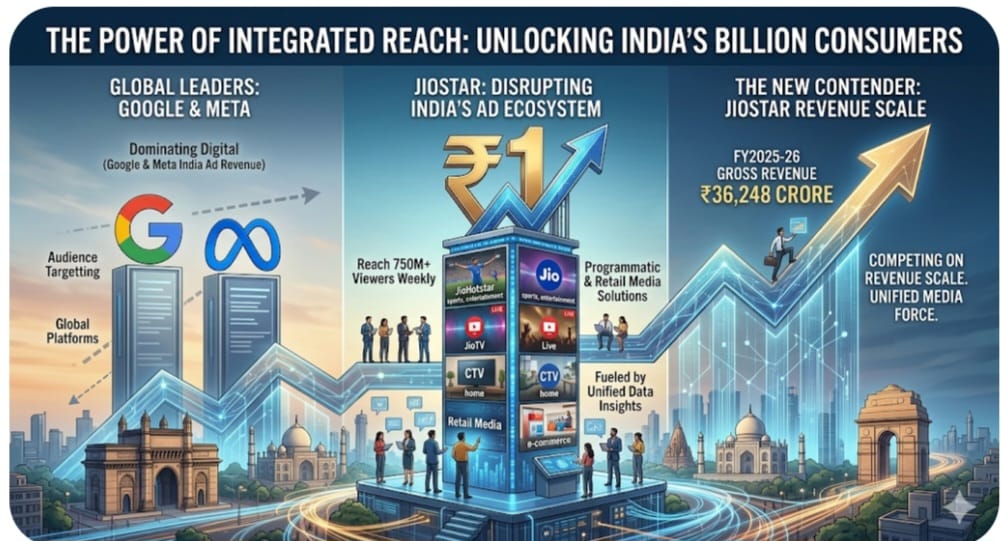
JioStar is being positioned as a third force in India’s advertising market, alongside Google and Meta. Backed by telecom scale and content distribution, the platform is aggregating inventory across digital, connected TV and telecom touchpoints.
This matters because India’s digital ad market has long been dominated by the duopoly, with a significant share of ad spends flowing to these global platforms.
Scale, data and distribution
JioStar’s proposition lies in its ability to combine first-party data from telecom users with content ecosystems and ad inventory. This creates a closed-loop system—distribution, data and monetisation—similar in structure to global walled gardens.
For advertisers, this could mean an alternative at scale, particularly for video and regional audiences where connected TV and mobile consumption are rising. Industry estimates suggest India’s digital ad market is growing at double-digit rates annually, intensifying the need for diversified media options.
Implications for the ad ecosystem
If JioStar sustains momentum, it could rebalance media planning in India. Agencies may increasingly allocate budgets across three large platforms instead of two, potentially improving pricing power and measurement transparency.
It also signals the growing importance of owned ecosystems—where telcos, broadcasters and platforms converge to control both audience access and monetisation.
Our insight
India’s ad market may finally be moving from a duopoly to a three-horse race—but scale alone won’t guarantee advertiser trust.