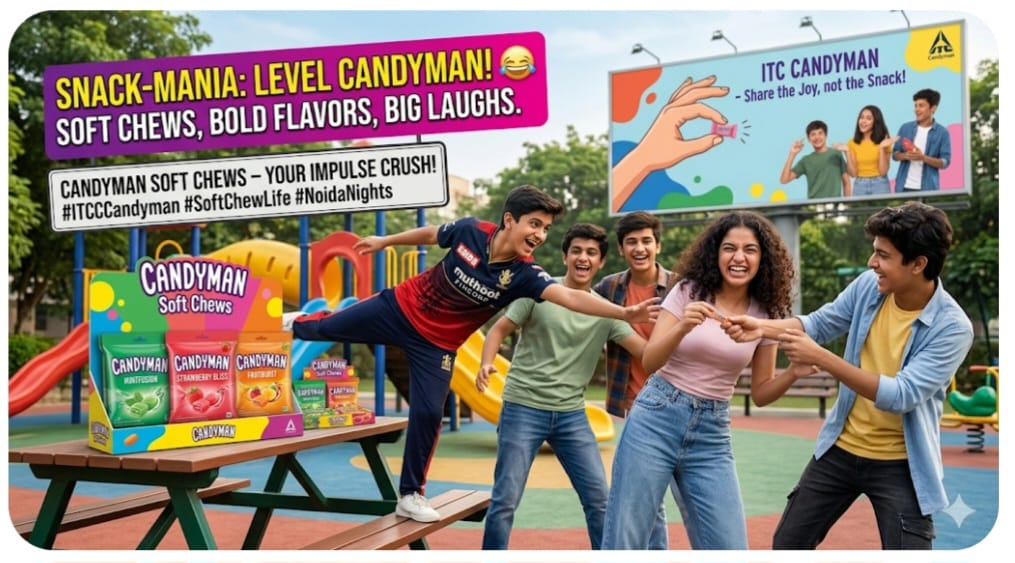
ITC Candyman has launched a new campaign for its soft chews range under the “Kuch Bhi Karega” platform, using exaggerated humour and youth-centric situations to reinforce the product’s playful, indulgent appeal.
The film positions the candy as a trigger for irrational but entertaining behaviour, continuing the confectionery category’s long-standing reliance on exaggerated emotional payoff.
Why this matters
The campaign arrives at a time when India’s confectionery market is becoming increasingly segmented, with brands competing not only on flavour and pricing, but also on format innovation and recall value in crowded retail environments.
Soft chews become a branding battleground
The strategic significance lies in ITC’s effort to build distinct brand properties around a relatively commoditised category. Soft chews, once treated as low-involvement impulse purchases, are now being marketed with sharper identity frameworks and recurring creative territories.
“Kuch Bhi Karega” works as a mnemonic device — simple, repeatable and adaptable across formats. That matters in a category where visibility spans kirana stores, quick-commerce platforms and modern trade shelves simultaneously.
The campaign also reflects a broader advertising trend: mass-market FMCG brands are increasingly adopting meme-like humour structures and short-attention storytelling styles influenced by internet culture.
What this signals for the industry
Confectionery advertising in India is shifting from product demonstration to behavioural branding. Instead of selling taste alone, brands are selling attitude, spontaneity and social shareability.
For marketers, the larger takeaway is that even low-ticket FMCG categories now require strong entertainment value to sustain recall across fragmented media consumption environments.
Our insight
As attention spans shrink, India’s impulse-buy categories are increasingly being built like content brands rather than traditional FMCG products.