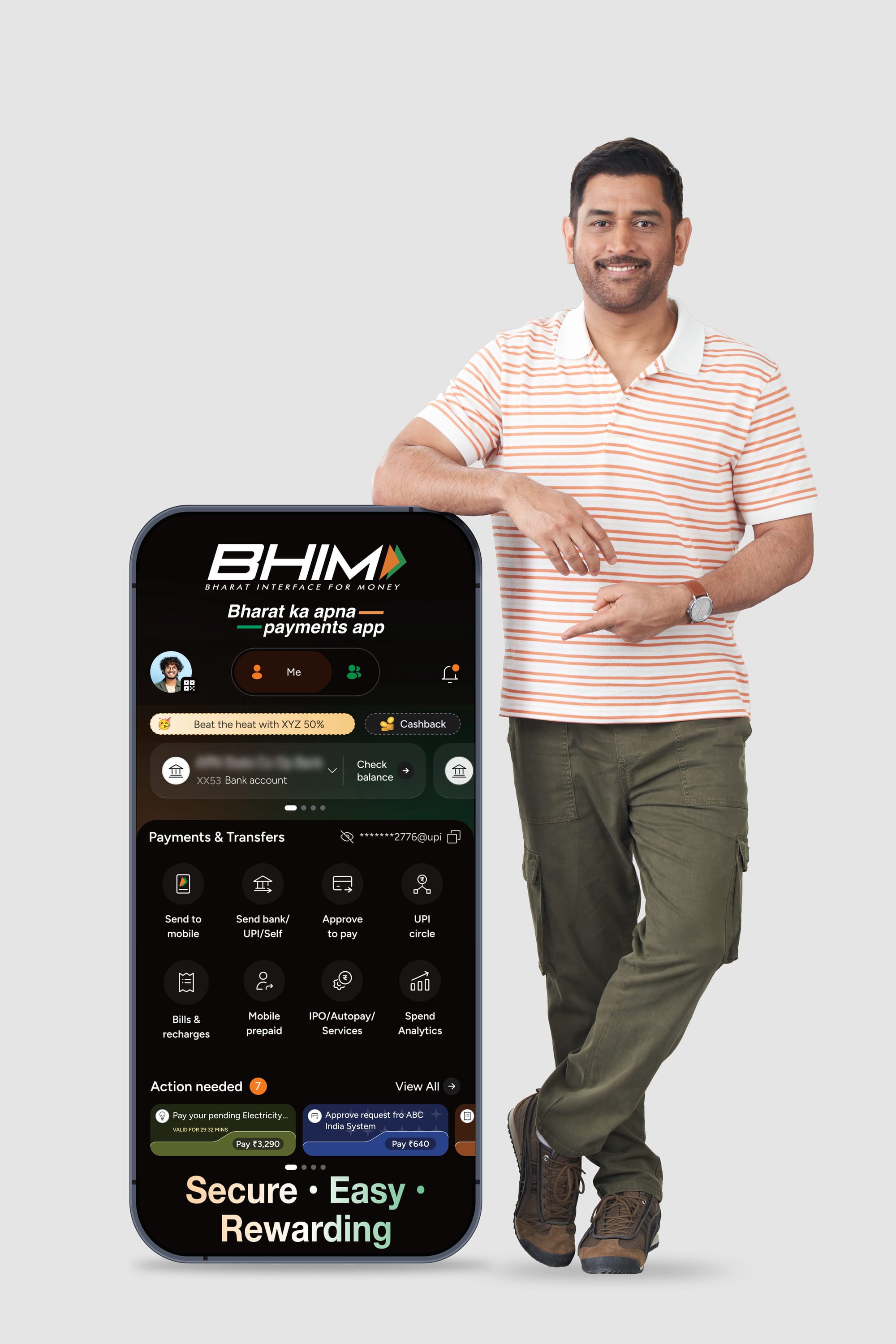
India's most trusted man just signed up to sell India's most underused app
The News — What Happened
NPCI BHIM Services Limited (NBSL) announced on March 17, 2026, the appointment of MS Dhoni — World Cup-winning former captain of the Indian cricket team — as brand ambassador for the BHIM Payments App. The tagline is already set: Bharat Ka Apna Payments App.
The announcement comes exactly as BHIM approaches a decade of existence, and exactly as the app embarks on the most aggressive growth phase in its history. In 2025, BHIM's monthly transactions grew 323% — from 38.97 million in January to 165.1 million in December. The app now targets a 5% UPI market share over the next three years, up from under 1% today. To put that ambition in context: PhonePe and Google Pay together own 78.8% of the market as of February 2026.
Lalitha Nataraj, MD & CEO, NBSL, said it plainly: "Trust remains at the centre of everything we do. Dhoni represents that same trust, built over time. That is why this partnership feels inevitable."
Dhoni, characteristically understated: "I have always believed in keeping things simple and staying clear in approach. What stood out to me about BHIM is its focus on making digital payments straightforward and accessible."
IPL 2026 season starts in days. The timing, for those who know how brand deals work, is not accidental.
The UPI Battlefield — Why BHIM Needs This Fight
To understand why BHIM is swinging for a Dhoni deal, you need to understand how broken the UPI market structure is for NPCI's own app.
UPI is India's most successful financial infrastructure project. In December 2025, UPI processed 21.63 billion transactions — the highest monthly volume on record. Annual UPI volume reached 228.3 billion transactions in 2025, surging from 172.2 billion in 2024. The total value of UPI transactions in 2025: ₹299.7 lakh crore. India has built one of the most sophisticated real-time payments networks in the world, and nearly everyone is using it daily.
Here is the uncomfortable irony: NPCI built UPI, but does not significantly benefit from the transactions on it. PhonePe (Walmart-backed) and Google Pay (Alphabet-backed) collectively own approximately 79% of the market. Every time an Indian sends ₹500 via UPI, there is an 8 in 10 chance they are doing it on an American company's app. NPCI, the Indian sovereign infrastructure behind the rails, watches two foreign-controlled entities dominate the consumer layer it created.
NPCI has tried to address this with a 30% market share cap per app — a cap that both PhonePe and Google Pay currently exceed, with the enforcement deadline now extended to December 2026. The structural problem remains: without a compelling consumer alternative, capping the leaders does not automatically create a third player. It just creates frustrated leaders and a vacuum.
That vacuum is what BHIM is being positioned to fill. BHIM has been restructured — hived off into NBSL as a wholly owned subsidiary in August 2024, given a CEO from IDFC First Bank and ICICI Bank, and given a mandate to become a genuine consumer product rather than a government-adjacent utility. The Dhoni deal is the first big public signal of that intent.
The Fitment Question — Genius Move or Borrowed Trust?
When a brand announces a celebrity ambassador, the first question every marketer should ask is not "is this celebrity popular?" but "does this celebrity's persona solve a specific brand problem?" Dhoni's appointment to BHIM passes that test more convincingly than most celebrity deals do — but not without complications.
- Trust architecture — Dhoni is India's most trusted public figure, and BHIM's core problem is user confidence vs established apps
- Geographic alignment — Dhoni's Ranchi roots and rural-familiar image maps exactly to BHIM's Tier 2/3 expansion strategy
- Demo crossover — 72% of BHIM transactions come from Tier 2 and 3 cities; Dhoni over-indexes in precisely those markets
- Generational depth — Dhoni is trusted by 25-year-olds and 55-year-olds simultaneously; BHIM needs both
- Scandal-free record — BHIM cannot afford a brand ambassador controversy; Dhoni has none in 20+ years
- Fintech credibility — Dhoni already endorses Mastercard and AMFI's Mutual Funds Sahi Hai — finance is not a stretch
- IPL timing — announcement days before CSK season means free media amplification
- Overexposure risk — Dhoni endorses 20–25 brands simultaneously; BHIM competes for his association in a crowded portfolio
- Dream11 conflict — Dhoni endorses Dream11, which has its own UPI integration; sending users through one Dhoni-endorsed gateway to pay on another feels circular
- The trust isn't the barrier — BHIM's problem is not that people distrust it; it is that PhonePe and GPay are frictionlessly embedded in daily life
- Celebrity endorsements don't fix UX — if the app experience is inferior, Dhoni's face on it changes nothing for retention
- Mastercard conflict? — Dhoni also endorses Mastercard, a global payments brand; explaining BHIM's sovereign Indian positioning alongside that association requires careful communication
The Dhoni Endorsement Philosophy — What Makes Him Different
In a country where celebrities queue up to endorse anything from gutka to cryptocurrency, MS Dhoni has built something rare: a brand portfolio that has not materially damaged his core image in over two decades of commercial activity. Understanding why requires understanding his endorsement philosophy — and what it teaches about how brand association actually works.
Dhoni reportedly charges approximately ₹5–8 crore per shoot day and ₹8–20 crore per year in brand retention fees, depending on exclusivity and commitment. His estimated annual brand income is ₹200 crore. His brand value is estimated at $100 million. He has endorsed 70+ brands across his career. By any measure, he is one of India's most commercially active celebrities.
And yet his trust index has not eroded. Why?
The five rules of the Dhoni endorsement model
| Rule | What Dhoni does | Why it works |
|---|---|---|
| Long-term over short-term | Prefers multi-year deals over one-off campaigns | Consistency signals belief; consumers interpret longevity as genuine endorsement |
| Category coherence | Endorses within a believable matrix — financial services, consumer durables, sports, infrastructure | No category stretches that make the audience doubt the association |
| Values alignment | Consistently aligns with reliability, simplicity, performance under pressure | Each endorsement reinforces the same core persona rather than diluting it |
| Personal narrative fit | Small-town boy made good; relates to upwardly mobile India | Aspirational but not alien — consumers see themselves in his journey |
| Scandal zero policy | No controversies, no political missteps, no public feuds in 20+ years | Brands that want long-term brand safety pay a premium for this; Dhoni charges it |
The BHIM deal fits the Dhoni model almost exactly. Financial services — check. Simplicity messaging — check. Rural and small-town aspiration — check. Long-term strategic association with a national institution — check. The question is whether the fit is bidirectional: Dhoni's credibility is clear; does BHIM's credibility benefit him in return?
There is a case that it does. Dhoni is at a point in his career where his brand is transitioning from active-sportsman to national-institution. His AMFI campaign (Mutual Funds Sahi Hai), his Swaraj Tractors association (farmers and reliability), his SBI campaign — these position him as a figure of financial and institutional reliability, not just a cricketing hero. BHIM, as India's sovereign payments app backed by NPCI, sits in exactly that institutional register. This is not just a brand endorsement. It is a positioning statement about which India Dhoni wants to be associated with in the next chapter of his public life.
The Dhoni Effect Has a Time Limit — What BHIM Must Do Now
Here is the strategic reality that no press release will say out loud: celebrity endorsement buys attention, not retention. Dhoni can get first-time downloads. He can get trial transactions. He can get the hesitant Tier 2 user to try BHIM for the first time because "Dhoni uses it." He cannot fix a bad onboarding flow, a slow transaction, a limited merchant acceptance network, or a fragmented feature set.
The brands that have used Dhoni most effectively — AMFI's Mutual Funds Sahi Hai, Swaraj Tractors — are brands that had a product-market fit story to tell and used Dhoni to amplify it. AMFI was not trying to create awareness for mutual funds; it was trying to normalise the behaviour of investing. Dhoni made the conversation accessible. The product did the rest.
BHIM's challenge is harder: it is fighting deeply entrenched UX habits. The average PhonePe user has a QR code saved, merchant contacts synced, and transaction history they rely on. Switching friction is real. Dhoni addresses none of that.
BHIM's Dhoni dividend — what works, what won't
| Objective | Will Dhoni help? | What else is needed |
|---|---|---|
| Top-of-mind awareness in Tier 2/3 | Yes — significantly | Distribution push, merchant onboarding |
| First-time downloads | Yes — strongly | Frictionless onboarding, regional language flow |
| Trial transactions | Yes — moderate effect | Cashback incentives, reward stickiness |
| Retention and daily use | No — not directly | Superior UX, merchant acceptance, unique features |
| Trust vs PhonePe/GPay | Partially — shifts perception | Sustained performance, no downtime |
| Fighting the duopoly structurally | No | NPCI market cap enforcement + product excellence |
The most honest reading of this deal: BHIM has done the right thing by getting the right ambassador. It now needs to do the harder thing, which is build a product that earns the association. Dhoni's trust is real. Borrowed trust only converts when the product deserves it.
Our Take — For Marketers and Brand Strategists
Three things this deal teaches that go beyond BHIM and Dhoni:
- The best endorsements solve a specific problem, not a general one. BHIM's problem is not awareness — it is credibility and preference. Dhoni addresses credibility directly. That specificity is what separates a strategic endorsement from a vanity one. Before signing any celebrity, define the exact problem you are asking them to solve. If you cannot define it, you are buying media, not strategy.
- Trust is the scarcest resource in fintech — and it cannot be manufactured, only borrowed or built. PhonePe and Google Pay built their trust through billions of successful transactions. BHIM is trying to borrow Dhoni's accumulated trust to accelerate its own. This works — but only as a bridge, not a destination. Every brand that relies on celebrity-borrowed trust has a clock running. The product must earn its own trust before the celebrity's effectiveness decays.
- Overexposure is the silent killer of endorsement value. Dhoni endorses 20–25 brands simultaneously. The question every brand in his portfolio should be asking is: are we differentiated within his portfolio, or are we just another logo in his carousel? BHIM's answer is that it is the only sovereign Indian payments platform in his portfolio — that specificity protects it. Brands that do not have that distinction need to either negotiate exclusivity or reconsider whether the endorsement delivers the differentiation they are paying for.
Captain Cool endorsing Bharat Ka Apna Payments App. The fit is real. The ambition is bold. Now BHIM has to play the innings that matters — not the press release, but the product.