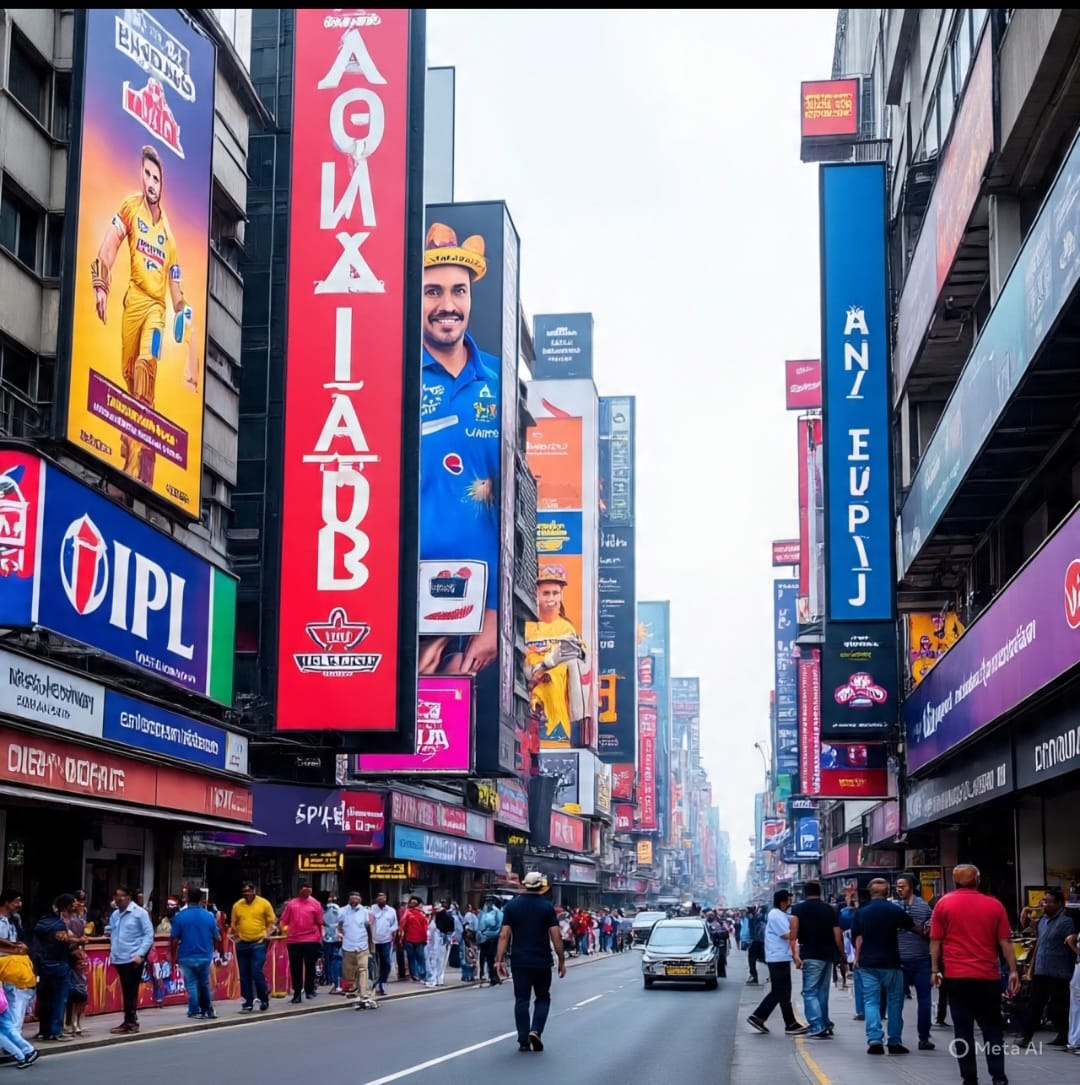
From a ₹1,100 crore side-show in 2008 to an ₹18.5 billion media juggernaut in 2026, the Indian Premier League has become the single most commercially powerful event in Indian sport — and possibly the most concentrated advertising blitzkrieg in the world. This is the story of how cricket became commerce.
The Day Indian Advertising Stopped for Cricket
It is Saturday across India in late March, a ritual plays out simultaneously in 700 million homes, on smartphones in auto-rickshaws, on massive screens in dhabas from Dibrugarh to Dwarka. The Indian Premier League has returned. And with it, the most concentrated advertising blitzkrieg that any market in the world sees within a two-month window.
You cannot look away. Not from the cricket — but more pointedly, not from the brands. Every powerplay brings a fresh ad carousel. Every wicket triggers a sponsor message. Every DRS review is time-bought and sold to the highest bidder. Google's AI Mode presents the Match Centre Live. Amul anchors the Cricket Live studio. Gillette owns the close shaves. Mondelez wants you to celebrate every six. The IPL in 2026 is not a sporting tournament with advertising attached — it is an advertising festival with cricket providing the excuse to gather.
This is the story of how that happened: the numbers, the inflection points, the brands that bet big, the strategy shifts, and what it all portends for the future of Indian advertising, media, and consumer culture.
From ₹1,100 Crore Side-Show to ₹1.65 Lakh Crore Ecosystem
The IPL launched in 2008 as what many called a gamble — a Twenty20 franchise league grafted onto a country that worshipped Test cricket. The first season's total commercial value was approximately $1.1 billion. By 2025, the league had been revalued at $18.5 billion — a 16-fold increase in under two decades. Across 18 seasons, cumulative investment into the IPL ecosystem has crossed ₹1.65 lakh crore, according to the "Advertising on Cricket" report by Synchronize India and Unomer.
The trajectory of advertising revenue tells an even more dramatic story. Media rights alone have grown sixfold since the inaugural season. The 2022 auction — where Viacom18 paid approximately $3 billion for digital rights and Disney retained television for $3.01 billion — was the commercial apotheosis: two giants bidding against each other in a war that drove prices to unprecedented heights.
IPL Advertising Revenue & Key Metrics — Year on Year
| Season | Est. Total Ad Revenue | Digital Share | Key Shift |
|---|---|---|---|
| 2008–2012 | ₹200–600 cr/season | Negligible | Television dominance; DLF title sponsor |
| 2013–2016 | ₹800–1,200 cr/season | ~5–8% | Mobile data beginnings; Hotstar emerges |
| 2017–2019 | ₹1,500–2,200 cr/season | ~15–20% | Star Sports consolidation; T20 premium rises |
| 2020–2022 | ₹2,500–3,800 cr/season | ~30–35% | COVID bubble; Jio economy; gaming brands surge |
| 2023–2024 | ₹4,500–5,500 cr/season | ~50–55% | JioCinema free streaming; 620M digital viewers |
| 2025 | ₹6,000 cr | ~55–60% | JioHotstar merger; 450M+ viewers; 425 brands |
| 2026 (Projected) | ₹5,200+ cr | ~60–65% | CTV explosion; 400+ brands; gaming ban reshuffles deck |
The apparent dip from 2025's ₹6,000 crore to a projected ₹5,200 crore in 2026 is not a contraction — it is a correction, and a structurally healthy one. The outsized revenue of 2025 was heavily padded by real-money gaming brands, which occupied the most premium slots and contributed nearly ₹2,000 crore alone. The Indian government's ban on RMG advertising, effective September 2025, removed that entire category in a single regulatory stroke. That advertisers have more than partially bridged the gap with FMCG, fintech, consumer electronics, and EV brands is a testament to the IPL's irreplaceable commercial position.
What Makes This Season Structurally Different
Every IPL season is described as a watershed moment by someone in the industry. But IPL 2026, which kicks off today — March 28 — has several genuinely distinct structural features that separate it from its predecessors.
The JioStar Monopoly Effect. For the first time in IPL's history, a single entity — JioStar, born from the merger of Reliance's Viacom18 and Disney's Indian operations — controls both television and digital streaming rights. In previous seasons, Star Sports (TV) and JioCinema (digital) competed not just for viewership but for advertiser rupees, which was ultimately good for brand choice and pricing competition. Today, JioStar offers what it calls "cross-screen packages" — a bundled reach across Star Sports' linear television and JioHotstar's streaming platform — targeting a combined weekly potential reach of over 700 million viewers. This is unprecedented in any advertising market in the world for a single sporting league.
The CTV Revolution. The real pricing action in 2026 is happening in Connected Television. While base TV spot rates for 10-second SD+HD slots have held relatively stable at ₹18 lakh, CTV rates saw a 30% surge year-on-year in 2025, and premium final-match slots have touched a record ₹50 lakh per 10 seconds. Industry experts note that CTV delivers 8–10x higher ad recall compared to mobile, as it replicates the lean-back, immersive television experience but with digital-grade targeting precision.
The Influencer Economy Comes of Age. In 2023, brands spent approximately ₹250 crore on influencer-led IPL campaigns. By 2025, that figure had more than doubled to ₹550 crore. For 2026, it is projected to cross ₹700 crore — a 40% compound annual growth rate. Nearly 1.5 million creators are expected to post IPL-related content this season. Instagram commands 52% of this activity, YouTube 28%, and X (Twitter) 12%.
The 400-Brand Democracy. In 2025, over 425 brands — including 270 first-time advertisers across 40 categories — partnered with JioStar for IPL coverage. This democratisation of IPL advertising, once the exclusive preserve of Unilever, Pepsi, and Vodafone, now extends to regional startups, D2C brands, and small-to-medium businesses running precision-targeted mobile campaigns at ₹250 per thousand impressions.
The Global & Domestic Brands Betting Everything on Cricket
The IPL 2026 sponsor roster assembled by JioStar is the most diverse in the tournament's history. The league title is held by the Tata Group under a five-year deal worth ₹2,500 crore (approximately $379 million) — the largest sponsorship deal in IPL history, confirming that India's most storied industrial conglomerate views this not merely as cricket but as the single most powerful vehicle for domestic brand prestige.
At the broadcasting level, JioStar has confirmed 27 sponsors for IPL 2026 — with Google's Search AI Mode presenting the Match Centre Live show, and Amul presenting Cricket Live. The co-presenting tier includes Campa Energy (the nationalist soft drink challenger) and Havells & Lloyd (consumer durables). The co-powered tier includes Birla Opus, Hero MotoCorp, and Amazon — a remarkable trinity of Indian manufacturing heritage, Indian mobility, and global e-commerce.
At the franchise level, the international brand penetration is notable. Mumbai Indians carry DHL — the global logistics giant — as a principal sponsor. Chennai Super Kings have Etihad Airways on their jersey front, an international airline's most prominent Indian association. Royal Challengers Bengaluru have Nothing (the British-Chinese consumer electronics brand co-founded by Carl Pei) as title sponsor, replacing fantasy gaming brands in a move that signals both the brand's ambition in India and the IPL's pull on aspirational global consumer electronics. Lauritz Knudsen — a Schneider Electric brand — is MI's title sponsor, bringing European electrical infrastructure capital into Indian cricket.
The category spread is revelatory: paints (Asian Paints vs Birla Opus are literally competing across platforms in the same season), EV mobility (TVS EV, VIDA by Hero), quick commerce (Flipkart Minutes, Rapido), mutual funds (AMFI, Groww, Angel One), and FMCG giants (Mondelez, Amul, Sunfeast YiPPee!, Mother Dairy). In just about two months, IPL will account for an estimated 15–20% of India's entire annual outdoor advertising revenue. No other event, domestic or global, achieves this compression.
Why ₹50 Lakh for 10 Seconds Still Makes Sense
The numbers, stripped of context, seem absurd. Fifty lakh rupees — ₹5 million — for ten seconds of television airtime during an IPL final. Digital CPM rates for India matches surging to ₹500 per thousand impressions, double the off-season rate. TV package deals ranging from ₹40 crore to ₹240 crore for the season. And yet, every single premium slot sells out.
The logic is one of concentration and simultaneity. Broadcast platforms across television and digital are targeting over 700 million viewers every evening during the IPL window. No single media event in India — not a film release, not a music drop, not a news event — delivers the simultaneous, high-engagement attention of a live IPL match. Brand recall studies consistently show 30–40% higher aided recall for brands that invest across TV, digital, and on-ground assets during IPL compared to equivalent spends outside the tournament window. For premium placements, e-commerce apps have historically seen session increases of 231% during IPL, and install rates surge 130%.
The economic logic is further amplified by cricket's unique attention mechanics. Unlike a film — where audiences can pause, scroll, or skip ads — live cricket creates mandatory dwell time. The pause between deliveries, the review, the strategic timeout, the innings break: these are all guaranteed attention windows that no other content format replicates at scale.
Furthermore, approximately 34% of social creator engagement around IPL happens before matches even begin — in the hype cycle. Another 50% occurs in the post-match discussion window, where brand messaging embedded in content gets recycled organically across platforms. The match itself — live, real-time — accounts for only 16% of the creator economy around each game day. For advertisers, the IPL is not a two-hour event. It is a 24-hour daily brand environment sustained across 84 match days.
What This Blitzkrieg Augurs for Indian Advertising
IPL 2026 is a preview of where Indian advertising is headed — and it is a landscape simultaneously thrilling and sobering for brands.
AI-Personalised Advertising at Scale. JioHotstar's 2026 platform technically allows two viewers watching the same match to be served entirely different advertisements — personalised by demographics, geography, language, viewing history, and consumer behaviour. This is the "1-to-many becomes 1-to-1" promise of digital advertising finally arriving at mass scale within a single marquee sporting property. Google Search AI Mode's presence as a co-presenting sponsor is not incidental — it is a signal of where the industry is headed.
The Influencer Layer Becomes Structural. With projected influencer spending crossing ₹700 crore in 2026 at a 40% CAGR, creator-driven IPL content is no longer a supplementary activation — it is a primary channel. FMCG brands lead with 32% of creator collaborations, reflecting that the fastest-moving consumer goods companies now regard nano and micro creators as essential distribution for brand messaging, not mere amplification.
The Advertiser Base Will Continue Diversifying. The exit of real-money gaming brands — a category that contributed nearly ₹2,000 crore to IPL 2025 revenue — was feared to leave a catastrophic gap. Instead, it has triggered a healthy rebalancing toward FMCG, infrastructure, EV mobility, fintech, and consumer electronics. Apollo Tyres has already signed a ₹2,579 crore, three-year deal as lead sponsor of Team India. The IPL's advertiser base is becoming more like the Indian economy itself: broad, diversified, and less dependent on speculative sectors.
The Regional Dimension Will Explode. JioStar serves IPL in 12+ language feeds. As Bharat — the non-metro, vernacular-first India — comes online in greater numbers, and as CTV penetrates Tier 2 and Tier 3 cities, regional brands will increasingly find the IPL accessible and ROI-positive. The tournament is no longer just a platform for national brands performing national launches. It is becoming the infrastructure for India's vernacular consumer economy.
The Media Rights Question Looms. The current media rights cycle runs through 2027. Media Partners Asia projects that the next cycle may plateau at $5.4 billion — flat compared to the current deal — as the JioStar merger has eliminated the competitive bidding tension that drove the 2022 price spike. Total advertising revenue has grown at a 7% CAGR over the last three seasons, against an 18% CAGR in the prior cycle. The monetisation gap — where streaming platforms earn less than they spend on rights — remains the dominant financial constraint on the ecosystem. How this resolves will shape Indian sports media for the next decade.
Lessons from the Blitzkrieg
For brand strategists, media planners, and business leaders watching this season unfold, IPL 2026 distils several hard-earned lessons from 18 years of commercial cricket.
Omnichannel or Nothing. Brands that commit to TV-only or digital-only strategies are being outperformed by omnichannel players. The data from 2025 is unambiguous: omnichannel execution delivered up to 50% higher brand recall. JioStar's cross-screen packages exist precisely because the most valuable consumer is the one who watches IPL on TV at home, tracks scores on mobile during the commute, consumes creator content on Instagram after the match, and discusses it on X at midnight. Brands that follow this consumer across all those touchpoints win.
Real-Time Agility is a Competitive Moat. The brands that extracted the most value from IPL 2025 — despite a mid-season pause caused by national security disruptions — were those that could pivot in real time: re-routing budgets to OTT and social, creating moment-based content within minutes of match events, and treating media planning as a live operation rather than a quarterly exercise.
Scale Has a New Address. The conventional wisdom that IPL advertising is only for large-cap brands with nine-figure budgets is obsolete. At ₹250 CPM for mobile impressions, a regional D2C brand can reach a precisely targeted IPL audience at a scale previously unavailable to it. The tournament's democratisation of advertising access is one of its most consequential and underreported stories.
Cricket is India's Connective Tissue. No other medium — not cinema, not news, not music — cuts across India's extraordinary social, linguistic, and economic heterogeneity the way live cricket does. Brands that align with cricket are not simply buying media impressions; they are embedding themselves in India's deepest cultural ritual. The international brands that have recognised this — Etihad, DHL, Nothing, Mondelez, Gillette — are not advertising in India. They are becoming Indian.
Our insight:
- IPL is not a media buy — it is a cultural tax targeting Indian consumers between 18 and 45, absence from the IPL is increasingly read as a signal of irrelevance, not just missed reach. The tournament has become so embedded in the national cultural calendar that non-participation carries its own brand cost.
- The gaming ban was a stress test that IPL passed. The ₹2,000 crore hole left by RMG brands was feared to be catastrophic. That JioStar signed 27 sponsors — from Google to Mondelez to Apollo — signals that the IPL's commercial gravity can attract replacement capital from structurally healthier sectors. This resilience makes it a safer long-term advertising bet.
- The JioStar monopoly is a double-edged sword. The elimination of bidding competition between Star and JioCinema removed advertiser negotiating leverage. Brands now deal with a single entity that controls India's entire premium sports inventory. This concentration will shape — and constrain — how sports advertising evolves in India through the next rights cycle.
- India's cricket economy is decoupling from its viewing economy. Advertising revenue grows at 7% CAGR while rights costs remain stratospheric, creating a structural gap that media partners are absorbing at a loss. The industry must either monetise its audience more aggressively — through subscriptions, interactive commerce, or data licensing — or accept that IPL rights are priced beyond commercial rationality.
- The creator economy is the dark horse of IPL advertising. With ₹700 crore projected in influencer spend and 1.5 million creators participating, the influencer layer has reached a scale where it functions as a parallel broadcast network — unregulated, vernacular, hyper-local, and often more trusted than formal advertising by younger consumers.
- IPL 2026 is the first true proof-of-concept for AI-personalised mass advertising in India. The capacity to serve different ads to different viewers within the same live broadcast — at 700 million viewer scale — is a capability that no other market in the world is demonstrating in real time. What India figures out over the next 84 matches will inform global sports advertising strategy for the decade ahead.