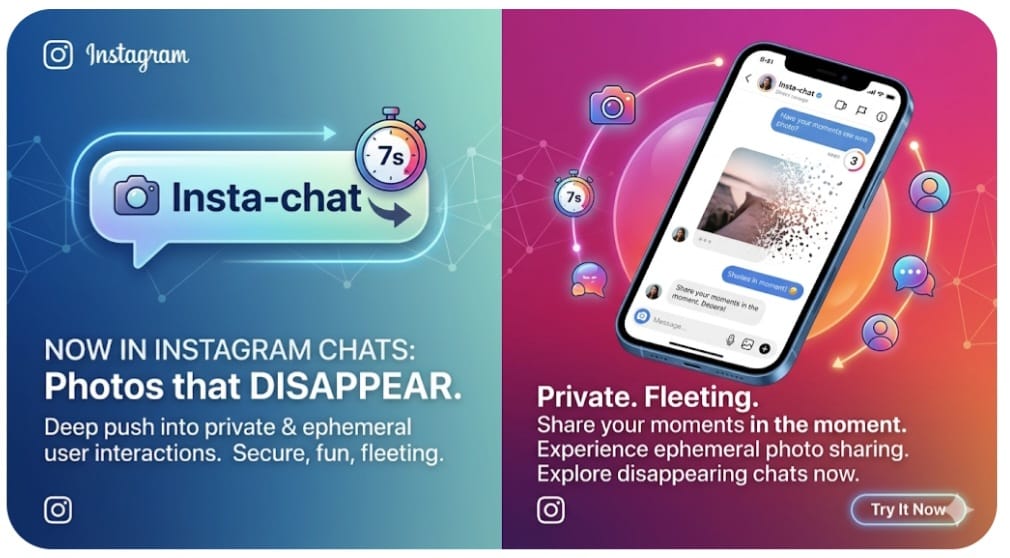
Instagram has introduced disappearing photo chats, a feature that mirrors the temporary messaging mechanics popularised by Snapchat.
The update reflects a broader platform strategy underway across social media: shifting user engagement from public feeds to private, short-lived conversations. The move matters because audience behaviour — particularly among younger users — is increasingly tilting toward closed sharing environments over permanent public posting.
For platforms dependent on engagement metrics and creator activity, retaining those interactions within their own ecosystems has become critical.
The Shift From Public Feeds to Private Behaviour
For years, Instagram’s advertising model was built around highly visible social activity — posts, Stories, Reels and creator-led discovery. But digital behaviour is evolving. Users are now spending more time in DMs, group chats and temporary sharing formats that reduce social pressure and permanence. Disappearing photo chats are designed to capture exactly that usage pattern. This also indicates how aggressively large platforms are converging on feature parity. The distinction between social, messaging and creator apps continues to narrow as platforms compete for time spent rather than category ownership.
Why This Matters for Advertisers and Media Planners
For Indian marketers, the development reinforces a growing challenge: measurable attention is moving into less visible environments. Brands can dominate feed inventory, but cultural influence is increasingly shaped in private recommendation loops — shared memes, screenshots, closed communities and peer-to-peer interactions. This has implications for campaign planning. Creative now needs “shareability” more than simple reach. Messaging must travel naturally through private conversations, not just perform in public feeds. It also strengthens the role of creators as distribution engines because creator content often acts as the trigger for private sharing behaviour.
Our insight
The future battle for social platforms is no longer about who owns the timeline. It is about who owns private attention.