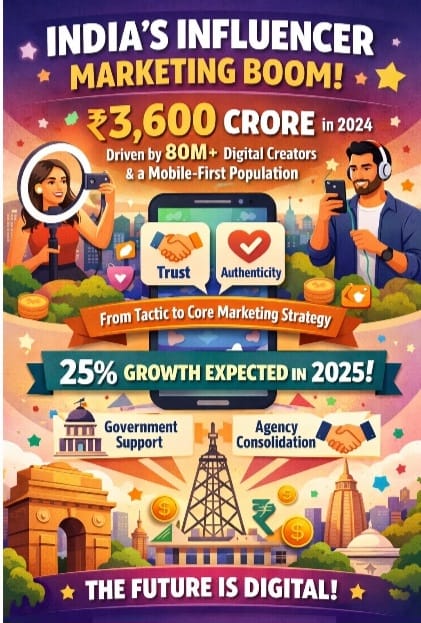
If there is one marketing story defining India's digital decade, it is this: the systematic and strategic rise of the social media influencer as a brand-building engine. India's influencer marketing industry was valued at Rs 3,600 crore (approximately $432 million) in 2024, according to the India Influencer Marketing Report 2025 by The Goat Agency (WPP Media) and Kantar. More strikingly, it is projected to grow by 25% in 2025 at a rate that significantly outpaces the global influencer marketing growth rate of 17% CAGR projected by Statista, which places the global market at $28.3 billion by end of 2025. By 2027, India's influencer marketing sector is projected to reach $107.5 billion, a figure that would have seemed extraordinary even five years ago. Powering this growth is a creator ecosystem of staggering scale. According to NITI Aayog, India had over 8 crore (80 million) digital creators as of 2024 at making it one of the largest and most diverse creator populations in the world. Meanwhile, the Indian government has put its weight behind this economy with a $1 billion fund to support content creators, boost production quality, and expand their reach. For marketers, these are not just feel-good metrics. They signal a structural reorientation of how brands in India acquire customers, build equity, and scale revenue. From Endorsement to Ecosystem: How the Model Has Evolved Influencer marketing in India has a longer history than most people credit it with. As far back as 1922, Godrej secured endorsements from luminaries including Rabindranath Tagore for its iconic No.1 soap. Bollywood celebrities and cricketers have long been the default choice for brand associations with Virat Kohli and Ranveer Singh still rank among the most sought-after brand endorsers in the country. But the model has fundamentally changed. The traditional celebrity endorsement was a one-way broadcast with a famous face holding a product, speaking scripted lines, reaching mass audiences. The modern influencer relationship is something altogether different: it is multi-directional, community-embedded, and driven by perceived authenticity. A fitness influencer recommending a protein brand on YouTube Shorts, a tech creator unboxing earphones on Instagram Reels, a parenting blogger sharing a baby skincare routine on her channel, these are conversations, not advertisements. The data reflects this shift. According to the EY 'State of Influencer Marketing in India' report, 75% of brands now view influencer marketing as integral to their overall marketing strategy. The same report found that influencer marketing is expected to be embedded in three out of every four brand strategies going forward. EY also projects the Indian influencer marketing sector to reach Rs. 3,375 crore by 2026, with an 18% CAGR. Critically, the India Influencer Marketing Report 2025 notes that one of the most significant shifts is the move beyond follower count to content quality and creator relevance. Among manufacturing brands, 85% now prioritise content quality when selecting influencers as a departure from the vanity-metric obsession that characterised the industry's earlier years. The D2C Revolution: Brands That Scaled on the Back of Creators
No sector illustrates the power of influencer-led growth more vividly than India's Direct-to-Consumer (D2C) segment. Brands that leaned into influencer-led campaigns scaled three times faster than those relying on conventional advertising alone as a statistic that has been validated repeatedly across case studies and funding announcements.
“Mamaearth” is the standard-bearer. Founded in 2016, it reached unicorn status within five years, not through television advertising, but by building trust with mom-influencers, eco-conscious creators, and parenting voices across Instagram and YouTube. Campaigns like #GoodnessInside went viral because real parents and not paid actors were sharing authentic UGC videos. By 2024, Mamaearth's parent company Honasa Consumer reported revenues exceeding Rs.1,500 crore, making it India's largest D2C beauty brand and the first in the segment to go public.
“SUGAR Cosmetics” took a community-first approach. The brand built a network of over 20,000 influencer partners from mega to nano, to what it calls the "Sugar Tribe." Its landmark #BeYourOwnMuse campaign during Women's Day 2023 deployed over 1,200 influencers simultaneously across Instagram and YouTube, generating a viral challenge-format wave that no conventional media buy could have replicated at comparable cost or authenticity. boAt, India's largest audio accessories brand, used influencer marketing to transform headphones from a utility product into a cultural identity. By partnering with musicians, cricketers, and lifestyle creators, who are not just product reviewers as the brand turned its audience into a community called #Boatheads. The result: boAt became India's number one wearable brand by 2022. These are not outliers. They are the template. The Micro-Influencer Moment: Why Smaller Is Becoming Smarter
If 2020-2022 was the era of the macro-influencer, those with millions of followers commanding six-figure campaign fees in 2024 and beyond is increasingly the era of the micro and nano-influencer. Micro-influencers (10,000 to 100,000 followers) and nano-influencers (under 10,000 followers) are gaining significant traction, particularly in high-consideration categories such as automotive, consumer durables, and BFSI. According to the India Influencer Marketing Report 2025, 85% of marketers in the automotive and consumer durables segments plan to increase investments in niche micro-influencer campaigns. The logic is straightforward: smaller creators tend to have more engaged, loyal communities, and their recommendations carry the weight of personal relationships rather than aspirational spectacle. Short-form video content, the dominant format on Instagram Reels and YouTube Shorts, further amplifies this dynamic with platforms that algorithmically reward engagement over follower size have levelled the field considerably.
Rakuten Advertising's 2024 global survey found that short-form video content delivers engagement rates up to three times higher than static posts. This is a data that Indian marketers cannot afford to ignore, given that the country has an internet user base projected to exceed 900 million. Interestingly, 50% of Indian consumers' time on mobile phones is spent on social media platforms, according to EY's survey. This staggering figure alone explains why every brand category from FMCG and fashion to BFSI and automobiles are recalibrating its media mix toward influencer-led content.
Trust as the New Currency: What Brands Are Really Buying
When 70% of Indian brands cite trust and credibility as the primary reasons for engaging influencers, as the WPP Media/Kantar report reveals they are admitting something profound: traditional advertising has a credibility problem. Indian consumers, especially millennials and Gen Z, are increasingly sceptical of polished brand communications. They are also increasingly influential in household purchase decisions across categories from electronics to insurance. Over two-thirds of Indian users now turn to influencers for product discovery (63%), product information (69%), and purchase decisions (60%). These are not passive viewers but are buyers. The trust dynamic is especially pronounced in sectors with high consumer anxiety. In BFSI, 77% of brands cite credibility as the top reason for engaging influencers. In FMCG, 76% report the same. These are not lifestyle categories where aspiration drives purchase and these are categories where consumers want reassurance. Influencers provide that reassurance at scale, in a register that feels personal. Authenticity, however, is fragile. A 2024 Rakuten Advertising study found that 85% of followers are willing to unfollow influencers they perceive as inauthentic. The Advertising Standards Council of India (ASCI) has responded with stricter disclosure guidelines, mandating clearer labelling of paid partnerships is a development that is accelerating the industry's shift toward long-term, genuinely aligned collaborations rather than transactional one-off posts.
The Agency Consolidation Signal: What M&A Tells Marketers
The corporate activity around influencer marketing is itself a bellwether worth studying. The past 12 months have seen over 20 mergers and acquisitions in India's media and marketing sector, with traditional and digital-first agencies actively bolstering their influencer marketing capabilities, according to the WPP Media/Kantar report. This consolidation signals that the industry is moving from fragmented experimentation to institutionalised practice. Additionally, 56% of brands have already allocated over 2% of their marketing budgets to influencer marketing initiatives, according to EY surveys. Meanwhile, 70% of surveyed brands intend to maintain or increase their influencer marketing spend, with half of those planning budget increases of up to 10%. For media planners and advertising professionals, the key strategic implication is this: influencer marketing is no longer a digital add-on to be carved out of the social media budget. It is a standalone line item and is increasingly measured on its own ROI metrics that needs to be planned at the outset of the campaign architecture, not retrofitted at the end.
The Challenges That Still Need Solving
Maturity brings its own complications. Despite the optimism, the India Influencer Marketing Report 2025 highlights persistent structural challenges that marketers must navigate. “Influencer discovery” remains the most acute pain point, with 83% of marketers struggling to find suitable talent. In BFSI, this figure rises to a staggering 95%. The challenge is both qualitative (finding creators who genuinely align with brand values) and quantitative (identifying performance signals beyond follower count). “ROI measurement” continues to vex CMOs. Marketers are increasingly moving toward engagement rates (prioritised by 39% of respondents) and content quality (36%) as primary success metrics, but standardised measurement frameworks are still nascent. The disconnect between influencer expectations and brand budgets is real: 57% of influencers report budget misalignment with brand partners. “Brand safety” is a growing concern, particularly as 95% of brands report favouring macro-influencers partly due to concerns about content control. The risk of brand association with creators who generate controversy is an ever-present consideration in an era of viral cancel culture. Finally, ”short-termism” continues to undermine effectiveness. While 72% of brands express preference for long-term influencer partnerships, many campaigns are still structured as tactical, campaign-specific executions rather than sustained collaborative relationships. Looking Ahead
The trajectory points in one direction: upward, but with increasing sophistication. AI is already reshaping the creator economy. Fifty percent of Indian influencers now utilise AI for content ideation, and 33% use it for engagement and writing assistance, according to industry data. Brands like boAt are using AI-assisted tools to generate multiple creative hooks from the same video, combating creative fatigue in performance campaigns. This AI-creator convergence will produce more personalised, faster, and better-performing content at scale. Furthermore, “Vernacular content” will unlock the next 300 million consumers. With Tier 2 and Tier 3 cities increasingly online and digitally active, brands that invest in regional language creators like Hindi, Tamil, Telugu, Kannada, Bengali will be able to build brand equity in markets that conventional digital advertising has never efficiently reached.