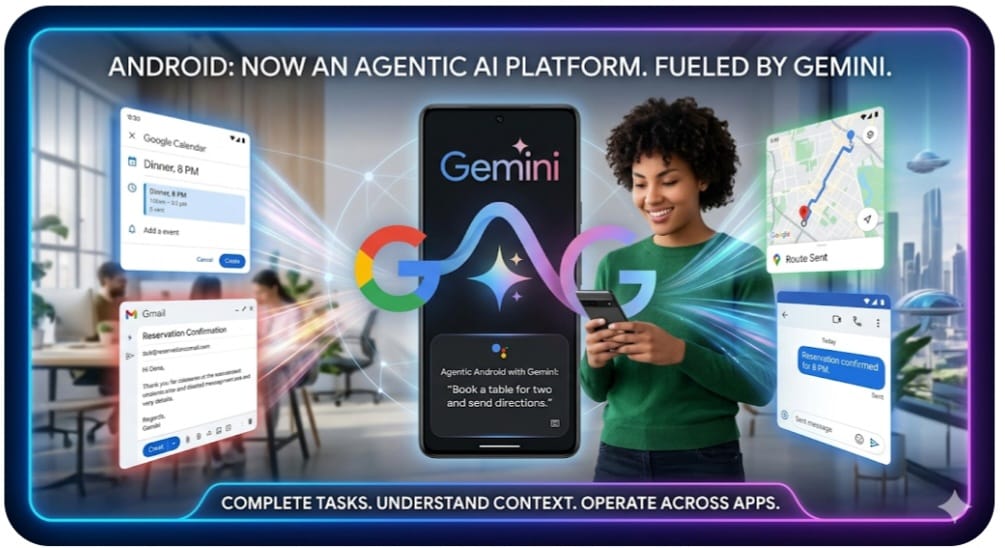
Google’s latest Android update is less about a software refresh and more about redefining how users interact with devices. By embedding Gemini deeper into Android, Google is moving the smartphone interface from app-led navigation to AI-led assistance — where the operating system increasingly acts on behalf of the user.
Consumer tech looking at a changeover
The significance extends beyond consumer tech. For marketers, publishers and ad-tech players, this marks the next stage of platform dependency. If AI agents begin mediating discovery, commerce and content consumption, brands may no longer compete only for screen space or search rankings — they will compete for AI visibility and recommendation logic.
Android becomes the interface, Gemini becomes the decision layer Google’s pitch is clear: Gemini will move from being a chatbot to becoming an operating layer across Android. The company demonstrated AI agents capable of summarising information, handling multitasking and executing commands across apps with contextual awareness. This effectively positions Android against Apple’s AI-led ecosystem ambitions and OpenAI’s growing device partnerships. But unlike standalone AI apps, Google controls both the operating system and the distribution layer through Android, Search, Maps, YouTube and Play Store infrastructure. For India — one of Android’s largest markets — the implications are immediate.
What this means for brands and advertisers
AI-led interfaces could compress the traditional digital funnel. Search queries, app browsing and even commerce discovery may increasingly happen through conversational prompts instead of clicks. This creates three industry shifts:
• SEO evolves into AI optimisation, where structured data and machine-readable brand information become critical. • App-based engagement weakens if AI agents complete tasks without users opening multiple platforms. • Media measurement becomes more opaque as AI intermediates discovery journeys.
For agencies, this could accelerate demand for AI-native creative systems, conversational commerce design and multimodal content strategies optimised for machine interpretation — not just human attention.
India’s advertising industry may face a distribution reset India’s digital economy has largely been built on performance marketing efficiency across Google and Meta ecosystems. But agentic AI changes the economics of engagement.
If Gemini becomes the default decision-making layer on Android devices, Google gains stronger control over consumer intent, recommendations and transaction pathways. That could further consolidate platform power at a time when publishers are already facing traffic volatility from AI summaries and zero-click search behaviour. Our insight The larger question is whether brands remain visible when AI becomes the interface. Because in an agentic ecosystem, the winner may not be the loudest advertiser — but the platform the AI trusts most.