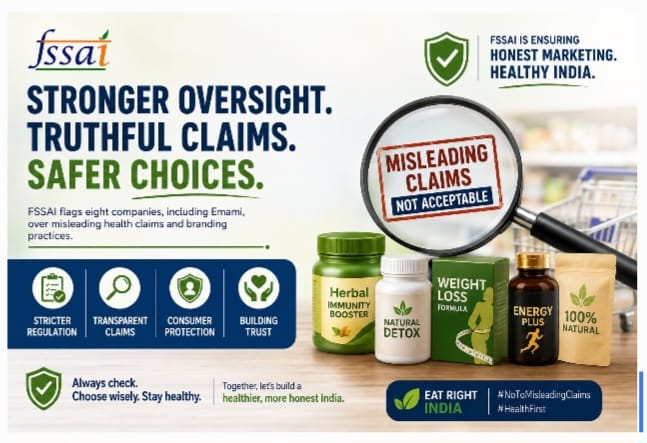
The Food Safety and Standards Authority of India (FSSAI) has reportedly raised concerns over health claims, product positioning and branding practices by eight companies, including Emami. Regulators tighten focus on health-led brand messaging The regulator's intervention centres on whether certain marketing communications and product representations could mislead consumers regarding health benefits. While enforcement actions around food labelling are not new, the latest scrutiny arrives at a time when wellness, immunity, nutrition and functional-benefit claims have become central to brand communication across FMCG categories. For marketers, the message is straightforward: regulatory attention is increasingly extending beyond packaging compliance into the broader territory of consumer perception. Why this matters for advertisers Over the past few years, health and wellness have emerged as some of the most powerful demand drivers in consumer marketing. Brands across food, beverages, personal care and nutraceuticals have leaned heavily on claims around immunity, energy, nutrition and preventive health. The challenge is that marketing narratives are often moving faster than regulatory frameworks and scientific substantiation. As regulators increase scrutiny, legal, compliance and marketing teams are likely to work more closely on claim validation, packaging language and advertising copy. Agencies, too, may face greater responsibility in evaluating health-related messaging before campaigns reach consumers. The strategic read The era of broad wellness positioning is giving way to an era of evidence-based marketing. Claims that cannot be substantiated may increasingly become reputational and regulatory risks. Our insight In today's marketplace, "healthy" is no longer just a marketing proposition. It is a claim that regulators increasingly expect brands to prove.
Agency News
FSSAI action on eight brands puts health-claim marketing under sharper scrutiny