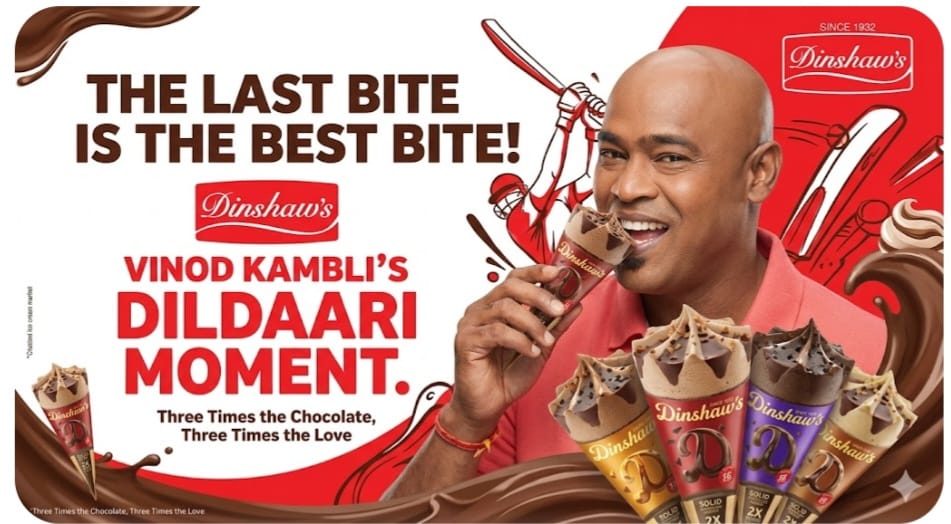
Dinshaw’s has rolled out a new campaign anchored in a simple but underleveraged consumer truth: the last bite is often the most satisfying. By bringing in Vinod Kambli, the brand ties nostalgia with a relatable consumption moment to drive recall.
In a category dominated by seasonal spikes and impulse buying, this matters. Ice cream brands are not just competing on taste or price—but on memory structures that trigger purchase at the point of sale.
A sharp observation, owning a moment, not a product
The ‘last bite’ positioning shifts focus from product attributes to consumption experience. This is a notable move in a segment where most communication still revolves around flavour innovation or indulgence cues.
By dramatizing a universal behaviour, Dinshaw’s attempts to create a distinctive mental shortcut—something that can be recalled in-store or during quick commerce browsing.
Strategic read for the industry
• Micro-insights over macro narratives: Indian FMCG advertising is moving toward sharply defined behavioural cues rather than broad emotional storytelling. • Nostalgia casting as a device: Kambli’s presence signals a continued reliance on familiar faces—not necessarily for scale, but for cultural resonance. • Category maturity signals: As ice cream brands crowd media channels, differentiation is shifting to mnemonic devices rather than product superiority.
What this means going forward
Expect more brands—especially in impulse-led categories—to mine “consumption moments” as creative territory, particularly in short-format digital video where quick recall is critical.
Our insight
In a low-involvement category, the brand that owns a moment—not a message—usually wins the shelf.