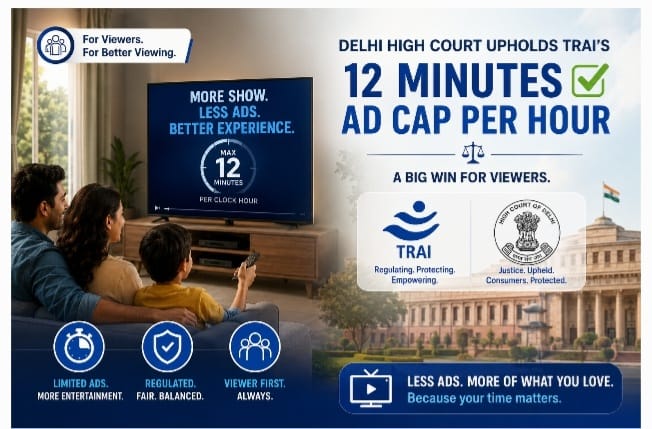
In a significant ruling for India's television industry, the Delhi High Court has upheld the Telecom Regulatory Authority of India's (TRAI) regulation limiting television advertising to 12 minutes per clock hour. The judgment dismisses multiple petitions filed by leading broadcasters that had challenged the rule on constitutional grounds, providing long-awaited regulatory clarity for broadcasters, advertisers and distribution platforms.
The court's decision reinforces TRAI's authority to regulate broadcasting standards while prioritising viewer experience through controlled advertising loads.
A Shift in Television Economics
For broadcasters, the ruling extends beyond compliance. With commercial inventory capped, networks will have to maximise the value of fewer advertising slots through stronger audience delivery, premium programming and improved pricing strategies. The decision is also expected to encourage greater focus on content quality, as sustained viewership becomes increasingly important for maintaining advertising yields.
For advertisers, a lower ad load could improve attention, recall and campaign effectiveness by reducing commercial clutter, potentially increasing the value of premium television inventory.
An Effort Augment Viewing Experience
The judgment arrives as television competes with digital and connected TV platforms for advertising budgets. By standardising commercial breaks, the ruling could improve viewing experiences while encouraging broadcasters to diversify revenues through branded content, sponsorships, subscription models and cross-platform advertising solutions.
It also reinforces the broader industry trend towards balancing monetisation with consumer experience—a principle increasingly shaping media regulation worldwide.
The Last Word
The ruling is not simply about limiting advertisements; it is about redefining the economics of television. As inventory becomes scarcer, competitive advantage will increasingly belong to broadcasters that can deliver higher-quality audiences, stronger engagement and measurable advertising outcomes rather than greater advertising volume.