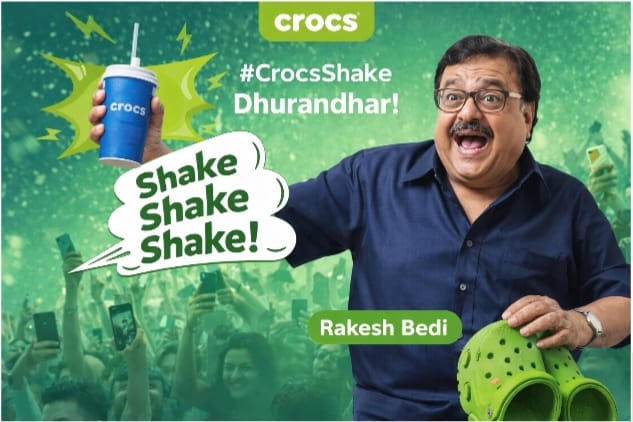
Crocs India has rolled out the ‘Crocs Shake’ campaign featuring Rakesh Bedi, capitalising on the viral popularity of his dialogue from Dhurandhar. The campaign translates an internet meme into a branded movement, aiming to drive engagement across social platforms. This matters because brands are increasingly moving at meme-speed—plugging into cultural moments while they are still peaking, rather than building long-tail narratives.
The Strategic Play — Meme to Market
The campaign reflects a shift from traditional celebrity endorsements to contextual celebrity usage. Here, Bedi is not the face of authority but of recall—his viral moment becomes the entry point. By gamifying the ‘Crocs Shake’, the brand creates a participatory layer, encouraging user-generated content. This reduces media dependency while amplifying organic reach. It also signals Crocs’ continued reliance on youth culture and digital-first storytelling rather than conventional ATL routes.
What This Means for India’s Marketing Ecosystem
For Indian marketers, three clear signals emerge:
• Virality is now a media channel: Memes are not just content—they are distribution systems. • Speed over polish: Brands that respond within the lifecycle of a trend capture disproportionate attention. • Celebrities as cultural carriers: The value lies in context, not star power alone. However, this approach requires calibrated risk—misreading internet culture can lead to rapid backlash or irrelevance.
Our insight
Crocs India’s ‘Crocs Shake’ shows that in today’s attention economy, timing and cultural fluency matter more than campaign scale.