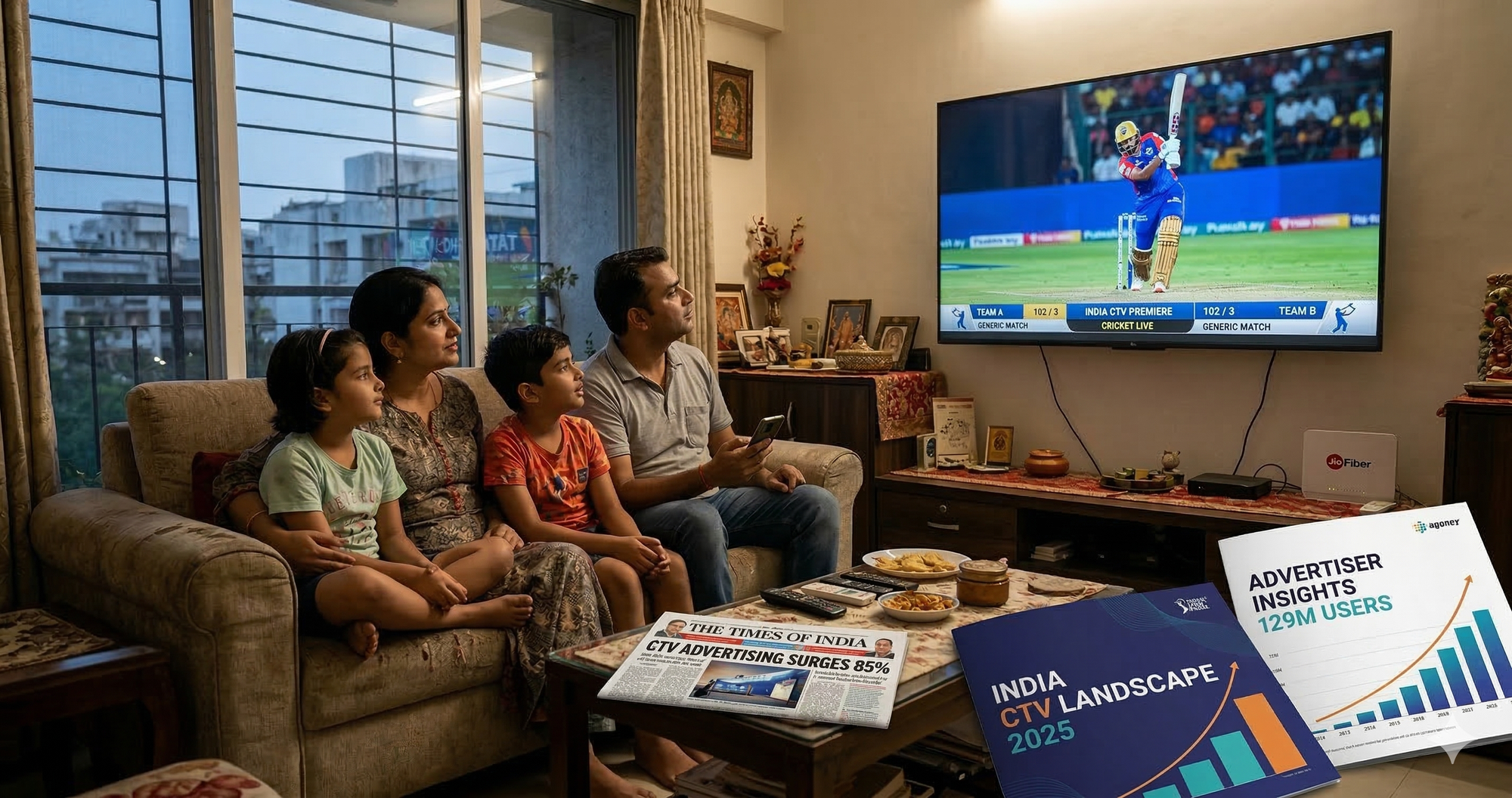
India has always been described as a mobile-first market. That description is still technically accurate. But it is becoming less useful by the day.
India's active Connected TV base surged 85% year-on-year in 2025, reaching 129.2 million users across 60 to 70 million CTV homes. What was once a premium urban accessory — the smart TV with a streaming subscription — has become a mass medium. And advertising money, which follows attention with the reliability of a compass finding north, is moving accordingly.
The numbers that matter
The Ormax OTT Audience Report 2025 puts India's total digital video audience at 601 million users — 41% of the country's population. Within that universe, Connected TV has become the second most-used device for streaming, overtaking laptops and tablets for the first time. Delhi NCT, Karnataka, and Maharashtra lead in CTV penetration as a share of their OTT populations.
The viewing behaviour is also changing in ways that matter for advertisers. More than half of YouTube's watch time in India is now spent on content longer than 21 minutes, signalling a shift from short-form scrolling to scheduled, immersive viewing — the kind of attention that television used to own.
Where the ad money is going
CTV ad spends in India have more than tripled since 2022, reaching ₹1,500 crore in 2024. Independent projections suggest the number could reach ₹3,500 crore by 2027. For brands that have been running TV campaigns for decades, this creates a genuine dilemma: the audiences they used to reach through linear television are migrating to CTV, but the planning, buying, and measurement frameworks for that migration are still being built.
The automotive sector illustrates this vividly. Car brands that once anchored their media plans around appointment TV — news bulletins, cricket, prime time serials — are now finding their target audiences in evening streaming sessions on YouTube CTV and JioHotstar, watching the same content but through a different pipe, with different data attached to it.
The attention quality advantage
What makes CTV particularly interesting for advertisers is not just the scale. It is the engagement. 91% of Indian viewers engage with ads while watching CTV content, often triggering immediate second-screen behaviour such as browsing, shopping or adding products to wishlists. The living room screen is delivering television's emotional weight with digital's measurability — a combination that no other medium currently offers.
Indians now spend 2.8 hours daily across OTT and linear TV, with 67% planning to increase their streaming subscriptions. This is no longer a market in transition. It is a market that has transitioned.
What this means for media planners
The implication for agencies and brand teams is straightforward, even if the execution is not: a media plan that does not account for CTV is a media plan built on an outdated map. The audiences have moved. The inventory exists. The data is superior to linear TV. The only thing lagging is the industry's willingness to fully restructure its planning models around where attention actually lives.
That restructuring is now underway. The question for 2026 is how fast.