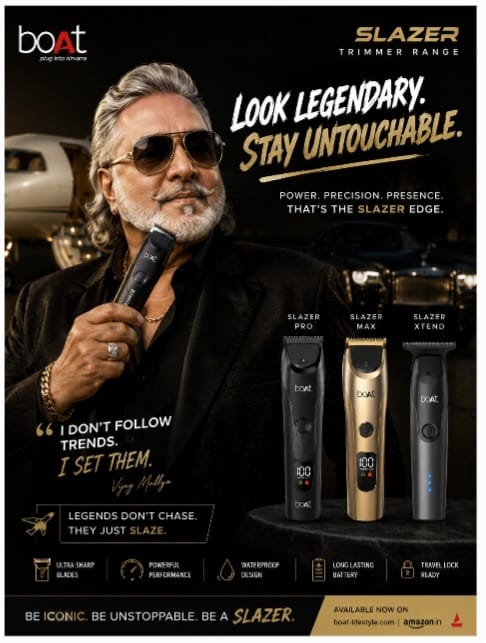
boAt has launched a new campaign for its Slazer trimmer range that revolves around a character bearing a striking resemblance to fugitive businessman Vijay Mallya—without explicitly identifying him. The creative leans on audience familiarity and visual cues, allowing viewers to make the connection themselves. The approach reflects a growing trend in Indian advertising where brands use cultural references, internet humour and recognisable archetypes to capture attention in increasingly crowded digital environments. For boAt, the campaign extends its established playbook of creating social-first content designed to generate conversation beyond paid media placements. The strategic read: attention through inference The campaign is notable because it relies on implication rather than direct endorsement. By avoiding explicit references while leaning into public memory, boAt creates a piece of communication that invites audience participation and interpretation. This approach aligns with broader shifts in advertising where brands are increasingly designing campaigns for shareability and discussion rather than one-way messaging. In a social media ecosystem driven by reactions, memes and commentary, recognisable cultural references can often outperform traditional product-focused advertising. For marketers, the campaign also highlights the continued value of humour as an attention mechanism, particularly in categories where functional differentiation is limited. What it means for the industry As consumer attention becomes harder to secure, creative risk-taking is increasingly becoming a media strategy in itself. Brands are looking for ideas that travel organically through social feeds rather than relying solely on media weight. Our insight In today's attention economy, the most effective advertising often isn't the message consumers are told—it is the reference they instantly recognise without being told at all.
Agency News
boAt Uses Lookalike Humour and Cultural Recall to Launch Slazer Grooming Range