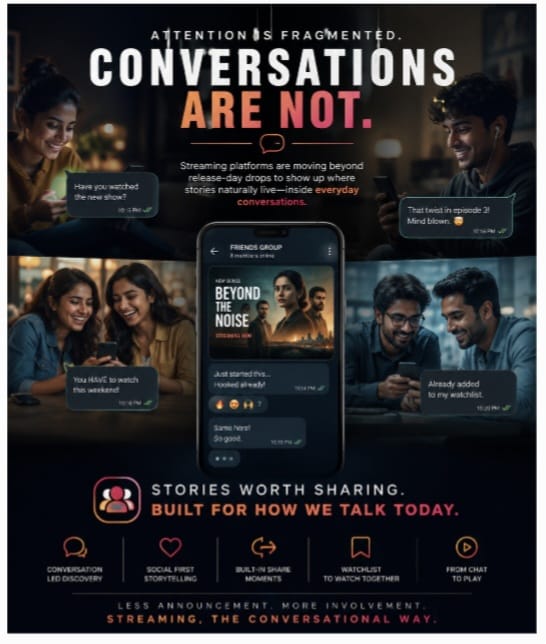
For decades, entertainment marketing ran on a predictable rhythm: drop a trailer, plaster posters across cities, send stars on a press tour, and let the campaign crescendo on release day. It worked when audiences had fewer places to look. It works less well now.
The Old Playbook Is Losing Its Grip
Attention today is scattered across group chats, short-form feeds, Discords, and fan communities that move faster than any studio calendar. Industry trackers now put U.S. digital video ad spend past $80 billion in 2026, growing 11% year-over-year and accounting for more than 60% of total TV/video ad spend for the first time a clear signal that the old linear-first, single-moment campaign has been structurally displaced. Meanwhile, connected TV upfront spending is on track to exceed primetime linear upfront spending this year, confirming that streaming has moved from experiment to default.
From Broadcasting a Moment to Seeding a Conversation
The sharper shift is behavioral, not just budgetary. Studios and platforms increasingly treat trailers as the first chapter of a story rather than an advertisement for one releasing them earlier, feeding "second-screen" audiences a steady drip of stills and clips, and letting fandoms do the organizing. Netflix, for instance, now leans on talent partnerships and creator collaborations to push releases into the feeds where audiences already spend their time, treating promotion as participation rather than broadcast. Some of the loudest fan-driven marketing today isn't studio-made at all it runs through Discord servers, fan-led streaming trackers, and creator networks that move a title from launch to cultural moment faster than any official campaign can.
Why This Matters Beyond Release Week
Subscriber growth is no longer the industry's north star; profitability, advertising expansion, and retention now dominate strategy, with cancellation rates hovering above 22% through much of the past year. That pressure makes every marketing dollar accountable to engagement, not just awareness pushing platforms toward always-on cultural presence over one-time spectacle.
The Last Word
The real competitive edge isn't a bigger trailer it's owning the conversation before the audience knows there's a title to discuss. Platforms that seed culture early will outperform those still waiting for release day to make noise.