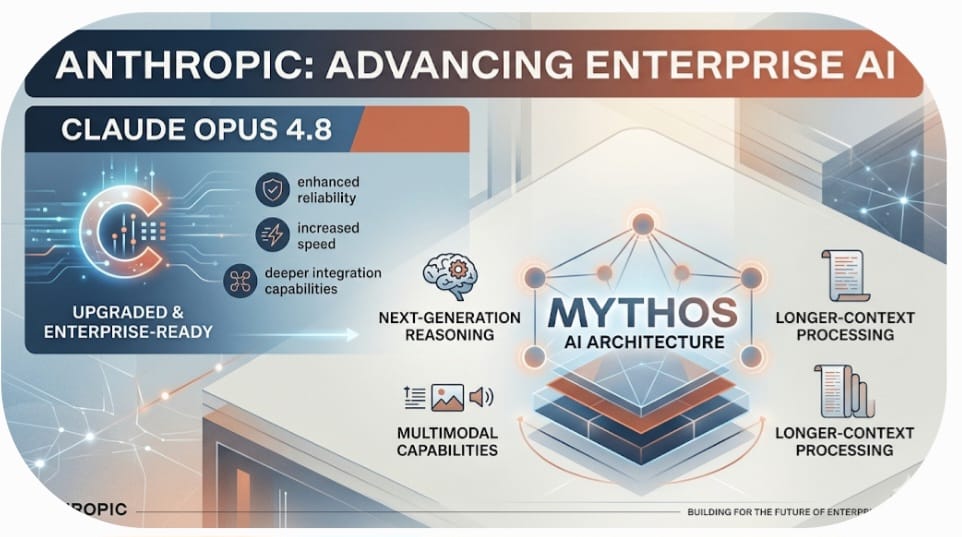
AI company Anthropic has introduced an upgraded version of Claude Opus 4.8, signalling a deeper push into enterprise-grade generative AI as competition intensifies across foundational model providers. The move comes alongside preparations for a wider rollout of its upcoming Mythos AI model architecture, which is expected to support more advanced reasoning, multimodal capabilities and longer-context processing.
The timing matters. OpenAI, Google and Meta are accelerating enterprise integrations, while brands, publishers and agencies are increasingly evaluating AI infrastructure decisions beyond experimental deployments. Anthropic’s latest update positions the company less as a chatbot provider and more as a long-term enterprise AI platform.
Why this matters for marketers and agencies
For the advertising and media ecosystem, the upgrade reflects a larger shift underway: AI vendors are now competing on reliability, workflow integration and commercial scalability rather than novelty alone.
It will reduce reliance on fragmented tools
Indian agencies and martech firms are already using large language models for media planning, automated reporting, creative testing and multilingual adaptation. Improved reasoning and contextual memory in models like Claude Opus 4.8 could reduce dependence on fragmented tool stacks and manual verification layers.
The larger implication is economic. As AI models become more capable of handling strategy support, research synthesis and content adaptation, agencies may increasingly restructure teams around AI-assisted operations instead of siloed execution functions.
Our insight
Anthropic’s roadmap suggests the next AI battleground will not be consumer chat interfaces. It will be enterprise trust, compliance and workflow ownership — areas where advertising holding companies, publishers and media-tech platforms are now under pressure to move faster.