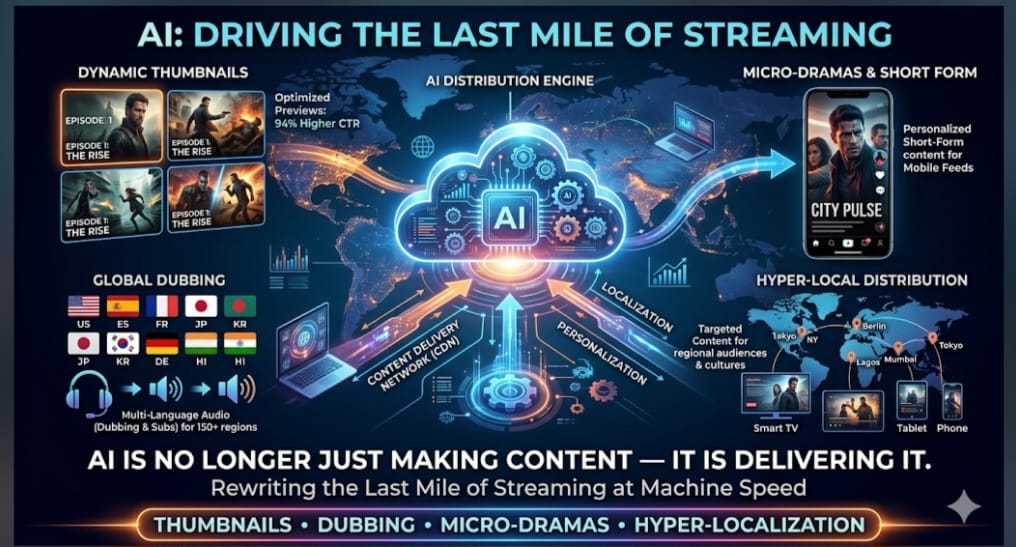
From thumbnails to local-language dubbing, AI is reshaping the invisible creative layer between a finished show and a viewer's click — transforming how content is localised, packaged, and discovered across every screen, language, and audience.
The streaming economy is vast — and the AI layer powering its final delivery is growing faster than the content itself. Here is a factual snapshot of the key segments redefining this space.
Segment 2024 Market Size Projection (2029–30) CAGR
Global OTT / Streaming $544B $1.69T (2030) ~20.4%
AI in Media & Entertainment $28.6B $99.5B (2029) ~28.4%
AI Dubbing & Localisation $3.2B $12.8B (2030) ~26%
AI Thumbnails & Metadata $1.1B $5.4B (2030) ~30%
Short-form / Micro-drama $5.8B $24B (2029) ~33%
India OTT Market $4.1B $12.5B (2030) ~20%
Indian-language AI Dubbing <$200M $1.2B+ (2030) ~35–40%
THUMBNAILS: THE AI-OPTIMISED CLICK
Before a viewer watches a second of content, an algorithm has already decided what they see. Netflix, Amazon Prime, and Disney+ now deploy AI-driven dynamic thumbnails — personalised per viewer segment, tested in real time. Thumbnail A/B testing powered by AI runs thousands of creative variants simultaneously. Studies indicate a well-optimised thumbnail can lift click-through rates by 20–35%. For a platform with 270 million subscribers, that compounds into an enormous viewership delta.
LOCAL INDIAN LANGUAGES: AI DUBBING'S BIGGEST FRONTIER
India's 22 official languages and hundreds of dialects represent the most linguistically complex streaming market on earth. Traditional dubbing for a Bhojpuri or Odia audience was commercially unviable at scale. AI voice synthesis and lip-sync models are now making 22-language dubbing economically feasible in weeks, not months. Streaming platforms targeting Tier 2 and Tier 3 Indian cities are reporting 40–60% higher retention when content is available in the viewer's mother tongue.
BRAND STORYTELLING IS EVOLVING: ENTER THE MICRO-DRAMA
Advertisers and brand studios are no longer buying pre-roll or banner space — they are producing it. The micro-drama format (60-second to 8-minute episodic narratives embedded in or adjacent to streaming content) is the fastest-growing brand content format globally. China pioneered this with ReelShort and DramaBox; India and Southeast Asia are now following. AI enables brands to produce micro-drama scripts, voiced characters, and edited cuts at a fraction of traditional production cost.
Brand Format Status in 2024 AI Role Key Metric
Traditional TVC (30–60 sec) Declining as primary format AI post-production, editing Viewability dropping ~4% YoY
Mid-roll streaming ads Growing but skipped AI personalisation of creative Skip rate: 75–80%
Branded micro-dramas (1–8 min) Fastest-growing format Script gen, voice, cut-down Completion rate: 60–70%
AI-native vertical short content Emerging (India, SEA, MENA) Full AI production pipeline 3x lower CPM vs. linear TV
DISCOVERY: AI IS THE NEW PROGRAMMING CHIEF
Recommendation engines — once just collaborative filters — are now multimodal AI systems that read audio mood, scene pacing, dialogue sentiment, and viewer micro-behaviours to serve content. Spotify's AI DJ, Netflix's 'Because you watched,' and YouTube's next-play system are all iterations of the same principle: AI as editorial director. The platform that controls discovery controls what gets watched, what trends, and what earns a second season.
OUR SHARP INSIGHT
The last creative mile is no longer a logistics problem — it is a data problem. The brands and platforms that will win the next decade of streaming are not those who produce the most content, but those who deploy AI to make every piece of content feel as if it was made specifically for one viewer, in their language, on their screen, at their moment of attention. The creative director of the future is not a person — it is a model fine-tuned on cultural nuance.