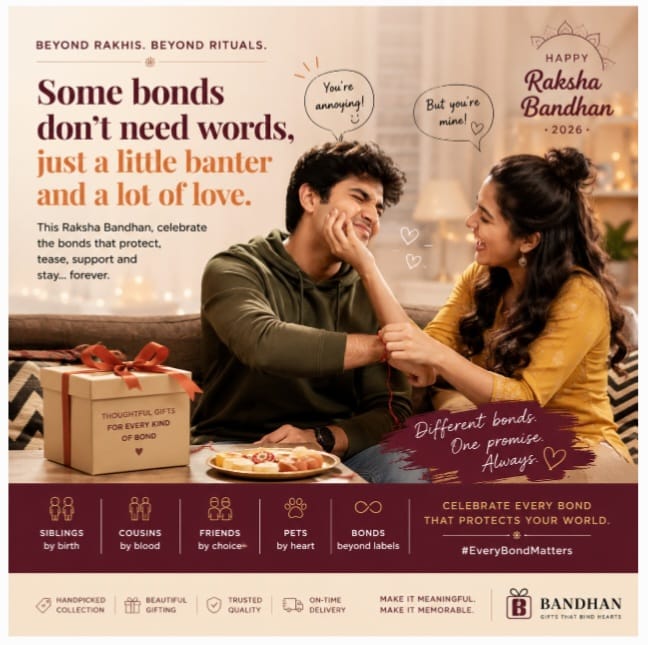
Raksha Bandhan, celebrated this year on 28 August 2026, has long been advertising's most dependable emotional shorthand a brother's promise, a sister's rakhi, a tear-jerking reunion. But 2026's crop of campaigns suggests the category has outgrown its own cliche.
Brands across FMCG, quick commerce, D2C, jewellery, beauty, fintech and logistics are treating sibling relationships not as a single sentiment to milk, but as a spectrum teasing, competitive, wordless, digital-first, even interspecies to build distinct brand narratives around. The stakes are considerable. Trade bodies estimate India's "rakhi trade alone will touch Rs. 25,000 crore this year", with the broader festive economy sweets, apparel, electronics, dry fruits and gifting projected to "cross Rs. 30,000 crore", according to Confederation of All India Traders (CAIT) estimates cited by PTI. That scale explains why so many categories beyond traditional gifting skincare, jewellery, quick commerce, fintech, logistics are now buying into the occasion.
From Silence to Storytelling
"Haldiram's" '"Keh Do Dil Ki Baat, Haldiram's Ke Saath" leans into what siblings rarely articulate. The film moves through teasing, arguments and food-sharing to surface affection that stays unspoken using snacking as the emotional connector rather than the message itself. "Mondelez India's Cadbury Celebrations", meanwhile, is betting on unfiltered chaos with "#ThisTakraarIsSweet". Marketing director Parul Gulia frames sibling bonds as "wonderfully unfiltered full of teasing, pranks, arguments and, underneath it all, unconditional love," backing the campaign with a redesigned Celebrations portfolio, new gifting formats and wider price-point coverage signalling that narrative and commercial strategy are now tightly stitched together.
Redefining Who Counts as a Sibling
The most structurally distinctive play comes from "Top 'N Town's 'Ankahe Rishte''", conceptualised by Meraqi Digital, which drops blood relation altogether. Its film follows a woman and a stray dog whose wary encounters turn into trust culminating in a rakhi tied around a paw. Notably, the film was "produced entirely using AI", while the idea and storytelling remained human-led an early signal of AI-assisted festive production entering mainstream Indian advertising.
Cross-Category and Category-Adjacent Plays
"The Face Shop x Palmonas'", '"A Bond That Glows Forever"' fuses skincare and jewellery into a single gifting proposition, reflecting a broader shift toward co-branded, cross-category hampers. On the financial side, "Tata Capital's" campaign built around trust and "small gestures," per marketing head Kaushik Chakraborty extends sibling bonding into financial planning and support, a category previously absent from Rakhi conversations.
"Trackon", a logistics brand, reframed delivery itself as an emotional touchpoint, with CEO Rajesh Kapase noting that "every package is an emotion." Consumer data backs the shift toward personalisation: GiftstoIndia24x7 reports "68% of consumers now prefer personalised rakhis and gifts" over generic options, while "78% favour platforms letting them customise combinations".
Separately, Rakhi Bazaar's shopper survey found demand for "tech gifts, wellness hampers and personalised hampers up 65% year-on-year". Quick-commerce platform Instamart reported "premium rakhi demand rising 20x" compared to last year.
The Last Word
The throughline across 2026's campaigns isn't a bigger emotional swing it's precision. Brands are no longer asking "how do we tell a sibling story," but "which specific sliver of that relationship is ours to own." For marketers, the lesson is structural: festive relevance increasingly comes from category logic (skincare + jewellery, delivery + emotion, AI + storytelling) rather than sentiment alone and with festive gifting spend nearing Rs. 30,000 crore, the brands claiming a distinct emotional register today are the ones building recall for next year's Rs. 25,000-crore-plus rakhi season.