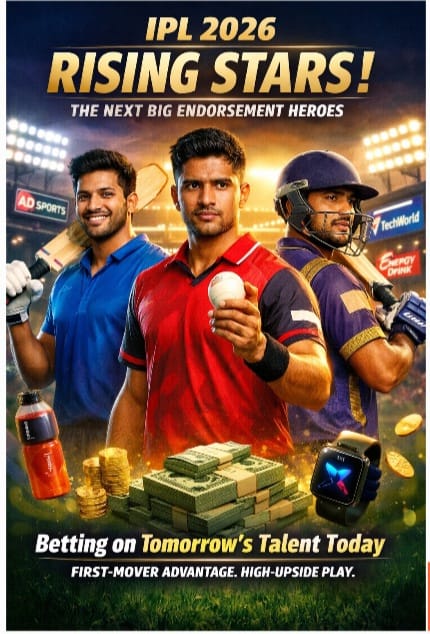
The Indian Premier League has long been a launchpad for cricketing careers. In 2026, it's becoming something else entirely—a proving ground for a fundamental shift in how brands approach athlete endorsements. The stars of yesterday still command the spotlight, but the smart money is increasingly flowing toward cricket's next generation.
The Numbers Behind the Pivot The endorsement hierarchy in IPL 2026 tells a compelling story. Legends like Virat Kohli, MS Dhoni, and Rohit Sharma continue to dominate the top tier, commanding Rs 6–8 crore per endorsement deal. The established middle rung—Hardik Pandya, Jasprit Bumrah, Shubman Gill—typically earns Rs 3–5 crore per partnership.
But the real action is happening a tier below. Emerging players like Tilak Varma and Abhishek Sharma are now attracting deals in the Rs 50 lakh to Rs 1.5 crore range, a bracket that barely existed three seasons ago. More significantly, the volume of these deals is accelerating. Brands are looking beyond performance metrics. Younger players bring relatability, youth appeal, and long-term value.
The budget reallocation reflects this strategic shift. According to TAM Media Research, earlier IPL cycles saw 70–80% of sponsorship budgets concentrated on a handful of marquee names. That ratio has now compressed to 50–60%, with the remainder distributed across emerging talent.
Case Studies: D2C Brands Lead the Charge
The profile of brands pursuing young cricketers is as telling as the deals themselves. This isn't legacy consumer goods companies hedging their bets—it's a new generation of direct-to-consumer brands making calculated plays for cultural relevance.
Tilak Varma and Foxtale represent one of the season's most watched partnerships. The Mumbai Indians batter, just 23, has become the face of the skincare brand's IPL campaign. For Foxtale, the association signals credibility with Gen Z consumers who view traditional celebrity endorsements with scepticism. Varma's on-field aggression and off-field authenticity on social media create a narrative arc that resonates with audiences who grew up on Instagram rather than television.
Abhishek Sharma and DP World illustrate how even global enterprise brands are recalibrating. The Sunrisers Hyderabad opener's partnership with the logistics giant might seem incongruous at first glance—until you consider that DP World is building brand awareness among India's young professionals and entrepreneurs. Sharma's explosive batting style and rapid rise from domestic cricket provide exactly the "breakthrough" narrative that aligns with a company positioning itself around global trade and ambition.
Vaibhav Suryavanshi and Complan offers perhaps the clearest signal of where this trend is heading. The Rajasthan Royals teenager—one of the youngest players in IPL history—linking up with a nutrition brand targeting young athletes creates a multi-year storyline that no established player can replicate.
The Strategic Logic: Risk, Reach, and Relatability
Three factors are driving this recalibration, and understanding them is essential for any marketer evaluating cricket sponsorship.
1. Digital Traction Outweighs Traditional Metrics Younger players often bring stronger engagement rates on social media than their more famous counterparts. Their audiences skew younger, more active, and more likely to interact with branded content. In an era where second-screen engagement increasingly determines campaign success, a player with 2 million highly engaged followers can deliver better returns than one with 20 million passive ones.
2. Risk Diversification in a Fragmented Landscape Concentrating endorsement spend on two or three superstars creates concentration risk—an injury, controversy, or retirement can derail an entire campaign. Spreading investments across multiple emerging faces provides insurance while maintaining aggregate visibility. Breakout stars like Rinku Singh and Yashasvi Jaiswal highlight how consistent performances can translate into endorsements, social media outreach, and horizontal recognition. The velocity of a young player's rise creates urgency that established names cannot match.
3. Authenticity Over Aspiration Consumer psychology is shifting, particularly among younger demographics. The aspirational appeal of a Kohli or Dhoni remains powerful, but relatability increasingly drives purchase intent.
A 22-year-old cricketer still figuring out his career feels more accessible—and more credible—as a brand ambassador to audiences navigating similar life stages.
Franchise Investment Signals Market Confidence
The enthusiasm extends beyond brand deals. IPL franchises themselves are betting heavily on youth, validating the commercial logic. Teams like Kolkata Knight Riders and Chennai Super Kings reportedly invested Rs 14.20 crore in players including Matheesha Pathirana, Kartik Sharma, and Prashant Veer during the 2026 auction cycle.
This franchise-level investment creates a multiplier effect. As teams build marketing campaigns around their young acquisitions, those players gain visibility that further enhances their endorsement value—a virtuous cycle that benefits both sporting and commercial stakeholders. Will This Trend Sustain? The short answer is yes, with caveats.
Several structural factors suggest the pivot toward emerging talent will accelerate: • Audience fragmentation will continue pushing brands toward niche, high-engagement partnerships rather than mass-reach plays. • The influencer economy's maturation has normalised the idea that smaller, authentic voices can outperform celebrity megaphones. • Category expansion means more brands—from fintech to electric vehicles to skincare—are entering sports sponsorship, creating demand that established stars alone cannot fulfil.
However, the economics of superstar endorsements aren't disappearing. Kohli and Dhoni will continue commanding premium deals because their reach and trust remain unmatched for certain brand objectives—particularly mass-market consumer goods and high-stakes launches.
What's emerging is a more sophisticated, layered approach to cricket endorsements. The wisest brands will maintain anchor partnerships with established names while building portfolios of emerging talent that offer growth potential, digital engagement, and risk diversification.
The Marketer's Takeaway
For marketing professionals evaluating IPL sponsorship, the 2026 season offers a clear lesson: the old playbook of chasing the biggest name is giving way to a more nuanced strategy.
The questions worth asking have changed. Not "who has the most followers?" but "who has the most engaged community?" Not "who won last season?" but "whose story is still being written?" Not "who guarantees visibility?" but "who creates conversation?"
Our insight
The cricketers emerging from IPL 2026 as endorsement stars may not yet be household names. But the brands partnering with them are betting—with increasing confidence—that they soon will be. And in a market where first-mover advantage can define category leadership, that bet is looking smarter by the match.