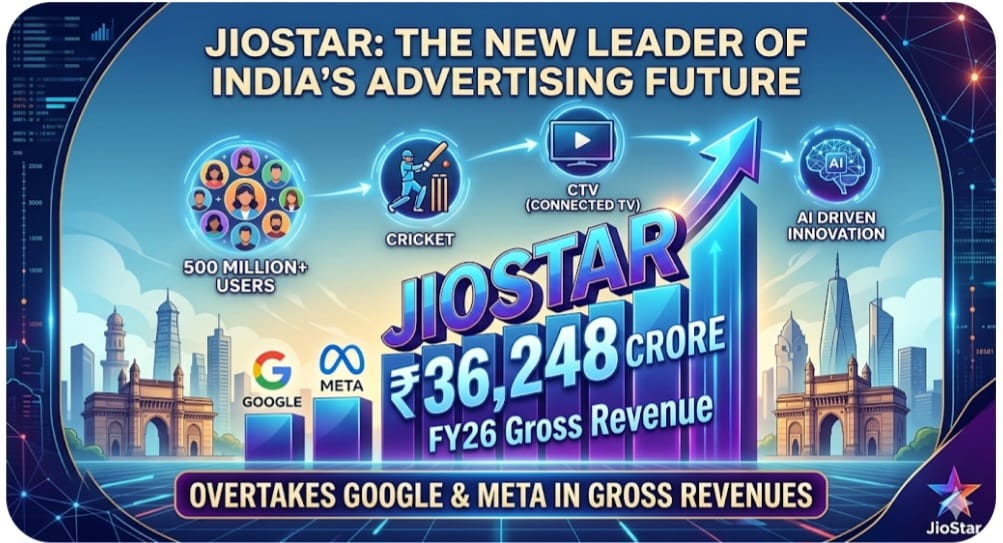
For nearly two decades, advertising dominance in India started and ended with two names: Google and Meta. But FY2025–26 has delivered a seismic plot twist. JioStar has reported gross revenue of ₹36,248 crore for FY2025–26, surpassing Google India's ₹34,742 crore and Meta India's estimated ₹28,000 crore — a milestone that signals not just one company's success, but a fundamental restructuring of India's ₹1.5 lakh crore advertising industry. The age of unchallenged Silicon Valley supremacy in Indian media is, quite simply, over. What's Actually Driving the Numbers JioStar's ascent is not a lucky sprint — it is the result of structural advantages layered over years. The platform benefited from an integrated business model encompassing subscription income, linear TV advertising, and digital advertising, contrasting sharply with Google and Meta's advertising reseller models. The numbers behind JioHotstar, its digital flagship, are staggering. The platform averaged roughly 500 million monthly active users in the March quarter, having crossed the 100-million paid subscriber mark within just five weeks of its February 2025 launch. During the ICC Men's T20 World Cup, the platform recorded a peak concurrency of 72.5 million — the highest ever globally for any streaming service. That is not a streaming record; that is a cultural statement. Cricket, of course, remains the rocket fuel. JioStar targeted ₹4,500–₹5,000 crore in ad revenue for IPL 2025, signing on 1,100 advertisers — including many small and medium businesses that typically advertise on Google and Meta. The competitive implication of that last detail cannot be overstated: JioStar is no longer just competing for premium brand budgets; it is pulling the long tail of digital advertisers away from Big Tech. The Business Model Nuance Context matters. Google India and Meta India operate as advertising resellers, booking gross revenues that represent the full value of ad inventory sold to Indian clients before remitting the bulk back to their global parent entities. For Google India specifically, net advertising revenue — what it actually retains after paying ₹32,047.6 crore to Google Asia Pacific — declined 2% to ₹2,694.4 crore. JioStar's revenue, by contrast, stays onshore, flows into an integrated enterprise, and generates real EBITDA. JioStar reported EBITDA of ₹4,885 crore and profit after tax of ₹3,210 crore for FY26 — figures that compare favourably with established Indian blue-chip companies. The Road to FY27 and Beyond The trajectory points firmly upward. Digital ad revenue in India is projected to reach ₹52,992 crore in 2025, growing at a compound annual rate of 15.3% through 2030 — and the race for that market is now effectively a three-horse contest.
JioStar's forward pipeline is loaded. Revenue in FY27 is expected to be bolstered by the Champions Trophy 2026, additional ICC bilateral cricket series, and an expanding AI-led advertising infrastructure, with the company's EBITDA margin of 15.7% projected to expand as the subscription base scales toward 150 million paid users. Technology investment is a key differentiator.
JioStar has made foundational bets on AI, including a deep product integration with OpenAI's ChatGPT that has transformed the search functionality within the JioHotstar app, now switched to voice, and an in-app commerce integration with Swiggy. These are not cosmetic upgrades; they are structural moats. India's Living Rooms Become Prime Media Real Estate One of the most consequential shifts underpinning JioStar's rise is the explosion of Connected TV (CTV). India added 35 million new CTV viewers in just the first quarter of 2025, and active smart TVs grew 27% to 30 million sets in 2024, with these devices clocking over 40 hours of content per month. JioStar has moved decisively to monetise this shift. CTV viewers on JioHotstar spend over 100 minutes daily — 1.5 times that of mobile viewers — with 90% of audiences classified as affluent and co-viewing occurring at 3.1 times the rate of solo viewing. For brand advertisers who have long sought premium, high-attention environments, this is an irresistible proposition. A landmark cross-screen study with Nielsen during IPL 2025 revealed less than 5% audience overlap across CTV, linear TV, and mobile for ad views, meaning cross-screen media plans added 20–40% incremental reach across all analysed categories. Implications for Advertisers, Marketers, and Media Professionals For advertisers, the most immediate impact is the arrival of genuine choice. For years, performance marketing budgets defaulted to Google and brand budgets defaulted to Meta. JioStar now competes for both — offering the precision of digital targeting with the emotional resonance of live sports and premium storytelling. For media professionals, the implications are structural. JioStar runs over 90 channels in 10 languages with around 35% market share, reaching more than 760 million viewers monthly. Careers in media planning, content strategy, and ad tech will increasingly be defined by fluency in integrated cross-screen storytelling — not siloed platform expertise. For marketers, the era of two-platform digital strategy is ending. The rise of JioStar means budgets will need to be reimagined across a three-ecosystem model. The platform's R.A.C.E. framework — Reach, Attention, Connection, and Effectiveness — offers a new vocabulary for full-funnel brand building, digital performance and television storytelling. Our Insight: India's Media Sovereignty Moment JioStar's rise represents the emergence of a domestically integrated media enterprise, capable of competing with global tech giants on their own terms — without selling India's advertising inventory overseas. As India's digital economy accelerates, the question is no longer whether JioStar can hold its ground against Google and Meta. The question is how far ahead it can pull. In essence, the third force has arrived.