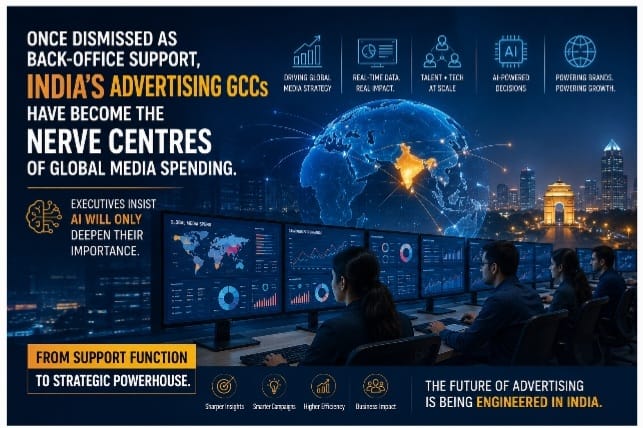
For years, India's role in global advertising was seen as operational, not strategic a place to run reports, fix broken campaigns overnight, and manage QA while the "real" thinking happened in New York, London, or San Francisco. That perception no longer holds. Teams based in Bengaluru, Hyderabad, Gurugram, Chennai and Pune are now building audience models, engineering ad-tech platforms, running media mix modelling, and directly shaping how global brands allocate marketing budgets worth billions of dollars. What began as a cost play has evolved into a genuine strategic function one that touches nearly every major holding company's global operations.
The Numbers Behind the Shift
The scale is significant. Industry estimates suggest Omnicom and IPG together employ roughly 7,000 people in India following their merger, while Publicis Groupe has crossed 10,000 employees in the country. WPP's India footprint is larger still its Global Delivery Centre has surpassed 10,000 skilled professionals, well beyond an initial target of 4,000. Across the major holding companies, India-based GCC headcount is now estimated at 40,000 to 50,000. The broader GCC ecosystem underlines this momentum. India hosted over 2,100 GCCs employing roughly 2.36 million people and generating close to $98 billion in revenue as of FY26, according to the Zinnov-Nasscom GCC Landscape report. Within retail and CPG alone, more than 70 global companies now run marketing-linked GCCs employing over 85,000 professionals.
AI Is Removing Tasks, Not Teams
A recurring theme among industry leaders is a firm rejection of the idea that artificial intelligence will shrink the relevance of these centres. Instead, executives argue AI is eliminating repetitive, execution-heavy work freeing GCC talent to move into higher-value areas like audience modelling, media investment optimisation, and consulting-style advisory work once dominated by firms such as Accenture, Deloitte and PwC. Generative AI tools are already cutting content-production timelines by up to 95% in some categories, accelerating output without reducing headcount needs. The consensus: strategic judgment can't be outsourced to a machine, even a highly capable one.
From Dashboards to Decision-Making
As GCCs take ownership of product roadmaps rather than just executing against them, demand is shifting toward specialised skills data science, media technology architecture, AI governance, and measurement expertise rather than generalist execution talent.
The Last Word
The real transformation isn't that India is doing more advertising work it's that India is increasingly deciding how advertising work gets done, turning GCCs from cost centres into the de facto operating system of global ad spend.