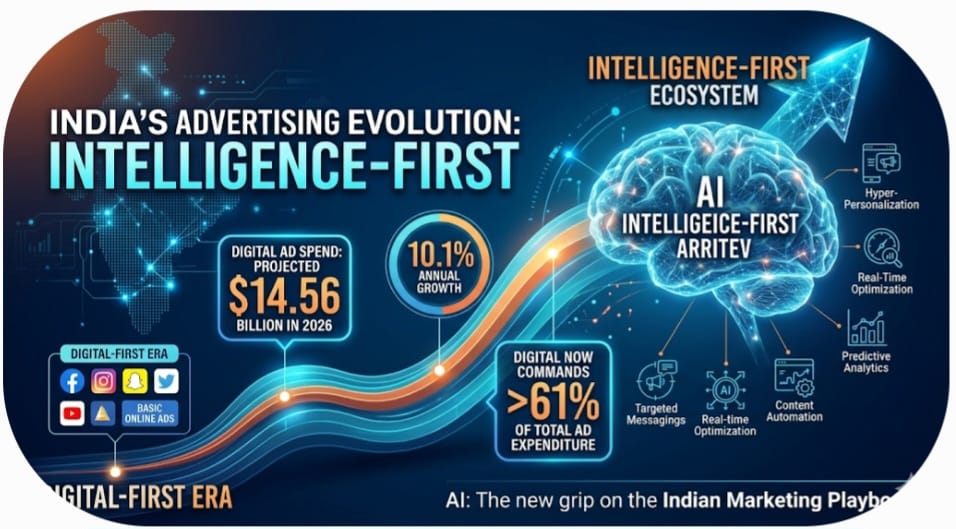
India's advertising ecosystem is no longer just digital-first, it is intelligence-first. With digital ad spend projected to hit $14.56 billion in 2026, growing at 10.1% annually, and digital now commanding over 61% of total advertising expenditure, the market has reached an inflection point. The force reshaping every rupee of that spend is artificial intelligence and its grip on the Indian marketing playbook is tightening fast. The Numbers That Demand Attention The scale of AI's penetration is striking. India leads global AI adoption at 30% outpacing the world average of 26%. The country's AI market has surged from $3.2 billion in 2020 to $6.05 billion in 2024, and analysts project it will cross $31.94 billion by 2031. For marketers, the implications are immediate: a Cloud9 Digital survey of over 500 Indian businesses found that 78% now use AI for marketing in some form. On the campaign floor, the shift is even sharper. 88% of marketers now use generative AI tools daily, yet only 10% can deploy AI across a full marketing funnel a gap that is simultaneously the industry's biggest challenge and its most compelling opportunity. Programmatic Gets Smarter and Faster Programmatic advertising, now AI's primary battlefield in India, is evolving from automation to autonomous decision-making. AI systems can analyse vast datasets, identify micro-audience segments, and reallocate budgets across channels in real time with no manual intervention. Globally, programmatic is expected to account for 90% of all display ad budgets by 2026, and India's mobile-first landscape of over "900 million smartphone users" makes this transition especially potent. The performance dividends are measurable: AI-driven campaigns deliver 22% higher ROI, 32% more conversions, and 29% lower customer acquisition costs compared to traditional methods. Google's Performance Max campaigns report 10% higher ROAS versus manual management. Marketing teams using AI-powered optimisation consistently show 30% higher ROI on ad spend. Campaigns also launch 75% faster and generate 47% better click-through rates. - -Generative AI: From Copy Tool to Creative Director In 2025, Indian brands used GenAI primarily for copy and creative variants. In 2026, the function has expanded dramatically. AI is now being used for creative generation (54% of advertisers globally), audience targeting (51%), predictive analytics (49%), and full media strategy and bidding optimisation (46%). The era of briefing an AI agent, letting it generate creatives, run multivariate tests, and optimise spend in real time all overnight has arrived. WhatsApp AI chatbots have emerged as a distinctly Indian high-value application, enabling brands to qualify leads, serve personalised product recommendations, and provide 24/7 support at scale. For FMCG, BFSI, and D2C brands navigating India's vast Tier-2 and Tier-3 markets, conversational AI is proving to be a critical last-mile tool. - The Skill Gap: Marketing's New Fault Line Despite the momentum, a structural gap is forming. 74% of CMOs now list GenAI fluency as a minimum requirement for new marketing hires (LinkedIn Marketing Survey, 2025), yet fewer than one in ten marketers can execute AI-led, full-funnel campaigns. NASSCOM data shows that traditional digital marketers earn 60% less than AI-skilled peers. Businesses deploying AI in at least three core marketing functions report a 32% average increase in ROI. The skill divide is no longer theoretical it is showing up directly in performance benchmarks and salary bands. The Road Ahead: Agents, Attention, and Accountability The next frontier is autonomous AI agents systems that manage campaigns end-to-end, from creative generation to real-time budget reallocation, operating like self-optimising investment portfolios. Generative Engine Optimisation (GEO) is already reshaping SEO strategy, as brands compete to appear in AI-powered search results and ChatGPT recommendations, not just Google rankings. AI advertising spend is predicted to rise by more than 60% through 2026. - Sharp Insight The brands winning in India's AI-powered ad landscape are not those with the biggest budgets they are those with the tightest feedback loops. AI has commoditised content production and flattened creative execution costs. The new moat is data quality, audience granularity, and the speed at which brands can learn, iterate, adapt and convert its output into proprietary competitive advantage.
Opinion
Ad this week: India's Ad Market Has Algorithms as its New Architect