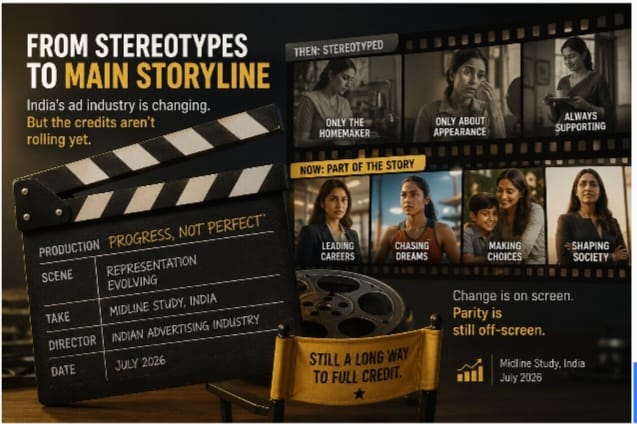
For decades, the Indian ad break ran on a script: women in the kitchen, men in the boardroom. That script is being rewritten. The "India Advertising Midline Study: Gender Representation and Inclusion Trends", unveiled on July 7 by the IAA India Chapter and UNICEF, with research led by the Geena Davis Institute, analysed the 1,000 most-viewed multilingual Indian ads on TV and digital, benchmarked against a 2021 baseline. Its finding: gender gaps have genuinely narrowed.
From Prop to Protagonist
Women now appear more often in professional and skilled roles rather than purely domestic ones, the study found a shift from decorative casting to earned agency. Sexualised portrayals have declined, and household duties are being split more evenly on screen between men and women, moving Indian advertising closer to how households actually function today.
The Gap That Remains
The progress isn't uniform. Leadership roles, workplace seniority, and the representation of diverse identities still lag women are visible, but not always in charge. This tracks with India's broader story: the WEF's 2025 Global Gender Gap Report ranked India 131st of 148 countries, with female labour-force participation still hovering near 46%. Though advertising is outpacing policy in some respects, but is lagging behind lived reality in others.
For the Industry: A Business Case, Not Just a Cause
The study finds inclusive media shapes how children see their own possibilities and that's "increasingly good for business." For CMOs, this is a cue to audit casting briefs, not just campaign messaging. Consumers, especially Gen Z, are pattern-matching your ads against reality faster than your research department is.
The Last Word
The next competitive edge isn't diversity in ads it's authority. Brands that show women "deciding", not just "doing", will own the credibility gap competitors haven't noticed yet.