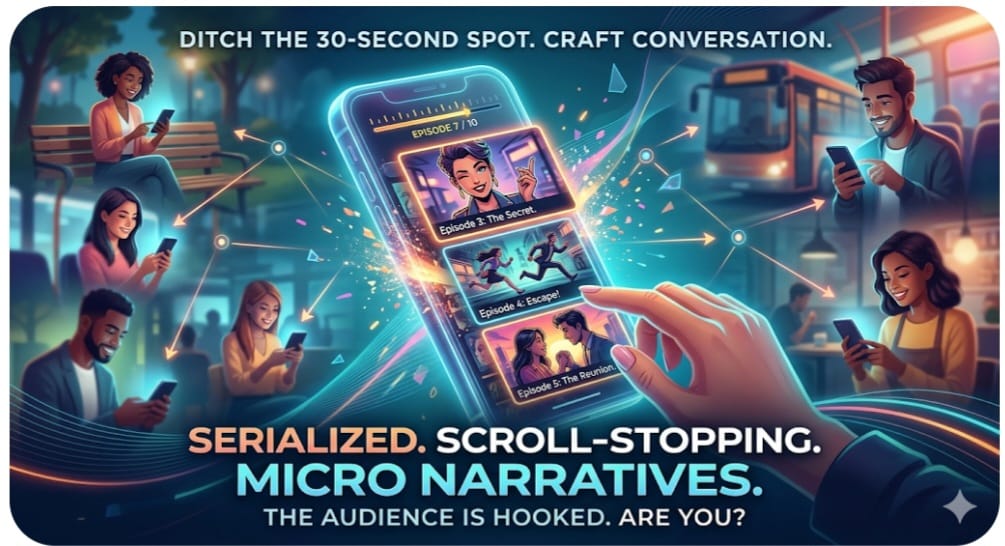
The 30-second television commercial — once the apex of brand communication — is losing its crown. In its place rises something faster, more intimate, and far more addictive: the micro drama. Serialised, character-driven, platform-native storytelling is rapidly becoming the dominant creative currency for brands competing in an era of fractured attention.
8.25s - Average human attention span in 2025
2.3x - Higher brand recall with episodic content vs one-off ads
US$14.9B - Short drama app market projected by 2027
The Death of the One-and-Done Ad
Traditional advertising operated on a simple logic: interrupt, impress, and sell. But the algorithm-driven media landscape has dismantled that equation. In 2024, scroll-skipping rates on pre-roll video ads reached 78% globally (IAB), while branded content that told ongoing stories averaged a 67% longer dwell time compared to static campaign posts.
Brands have taken notice. From Duolingo's chaotic TikTok universe to IKEA's serialised "The Wonderful Everyday" short films, marketers are beginning to write characters and cliffhangers — not just taglines.
BY THE NUMBERS
Brands using serialised content formats see an average 43% increase in repeat audience visits and a 29% lift in purchase intent compared to single-format campaigns — Edelman Brand Storytelling Report 2025.
What Is a Micro Drama, Exactly?
A micro drama is a short-form, episodic narrative — typically between 60 seconds and 5 minutes per episode — designed for platform-native consumption on TikTok, Instagram Reels, YouTube Shorts, or streaming apps. Unlike branded content of the past, micro dramas prioritise narrative tension, recurring characters, and emotional arcs over direct product messaging.
China pioneered this format at scale. In 2023, over 400,000 micro drama titles were registered in China alone, with top series clocking more than 100 million views within 72 hours of release. Western brands are now racing to adapt the model.
- ReelShorts and Watcho reported a combined 18M monthly active users as of Q1 2026, driven almost entirely by brand-funded serialised content.
- Amazon's sponsored drama integrations on Prime drove a 34% higher click-through to product pages versus standard display advertising in 2025 A/B tests.
- L'Oreal Paris launched a 12-episode micro drama on TikTok in partnership with creator studios, achieving 92M views and a 3.1x uplift in Gen Z brand favourability scores.
Why the Format Works: The Psychology of the Serial
The power of the micro drama lies in what psychologists call the Zeigarnik Effect — the brain's tendency to remember unfinished tasks more vividly than completed ones. An unresolved plot hook at the end of a 90-second episode is cognitively stickier than the most polished product demo.
Combine this with platform mechanics — autoplay, comment communities, shared reactions — and brands effectively create audience ecosystems rather than passive viewerships.
According to Sprout Social's 2025 Index, branded episodic content generates 4.7x more comments than standard posts, transforming audiences into invested participants who speculate, debate, and share episode-by-episode.
Platform Economics Are Shifting the Budget
Media dollars are moving. GroupM's 2025 Global Media Investment Report noted a 22% year-on-year increase in brand spend on creator-led serialised content, while traditional linear TV ad spend fell 11% in the same period. Production costs for a 10-episode micro drama series now range between $80,000-$400,000 — a fraction of a single primetime commercial.
The ROI calculus is reshaping agency briefs. Brands like Dove (Unilever), Old Spice, and Spotify have embedded micro drama thinking into their always-on content strategy rather than treating it as a campaign experiment.
The Future: AI-Personalised Drama at Scale
The next frontier is adaptive storytelling. AI-driven content engines are beginning to enable brands to serve dynamically personalised narrative branches based on viewer behaviour — different episode outcomes for different audience segments. Pilot programmes by Mondelez and Unilever in 2025 showed that personalised narrative ads held 2.8x longer average view durations than standard video assets.
By 2028, analysts at Forrester project that over 30% of all digital brand content spend will be allocated to some form of serialised or episodic storytelling format — making the transition from campaign thinking to showrunner thinking not a trend, but an industry imperative.
Our sharp observation
The brands winning the next decade will not think in campaigns — they will think in seasons. The question is no longer 'what is our message?' but 'what happens next?' Every episode is a touchpoint. Every cliffhanger is a retention mechanic. In the attention economy, the most powerful media property a brand can own is one the audience returns to voluntarily — and micro dramas are the architecture for that loyalty.