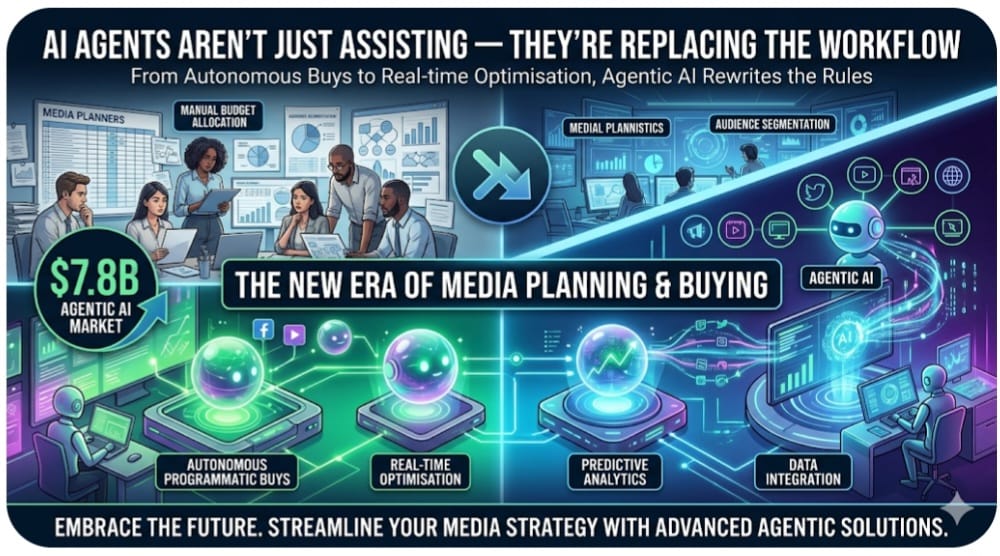
The year is 2026, and a campaign brief submitted to a media agency no longer needs a team of planners poring over spreadsheets, negotiating inventory, and manually adjusting bid strategies. Instead, an AI agent reads the brief, builds the media strategy, selects inventory, executes buys, and optimises performance — all before a human has had their morning coffee.
This is not science fiction. It is happening right now, and it is reshaping the $900 billion global advertising industry at a pace that is leaving many marketers scrambling to keep up. AI agents — autonomous software systems capable of independent decision-making, multi-step task execution, and real-time adaptation — are the single most transformative force in media planning and buying today.
BY THE NUMBERS
$7.8B - AI Agents Market Size 2025 Projected to hit $52.6B by 2030
46.3% - projected CAGR between 2025-30
81% - Martech Execs Piloting AI Agents (Gartner Survey)
171% - Average ROI
From Assistance to Autonomy: The Agent Revolution
For most of the past decade, AI in advertising meant recommendation engines and automated bidding tools — useful, but fundamentally advisory. A human still made the final call. The shift to agentic AI changes that relationship entirely.
AI agents differ from traditional automation in three critical ways: they perceive their environment, reason through goals, and act autonomously across complex, multi-step workflows. In a media buying context, this means an agent can interpret a campaign brief in natural language, evaluate audience data across thousands of variables, generate a media strategy, initiate transactions, monitor delivery, and re-optimise — all without human intervention at each step.
The scale of enterprise adoption reflects this shift. According to a Gartner survey of 400 marketing technology executives conducted in late 2025, 81% reported being engaged in a pilot or full rollout of an AI agent at their company. A Google Cloud study found that 52% of enterprises had already deployed AI agents in production during 2025. Among Fortune 500 companies, 45% are actively piloting agentic systems.
How Agents Are Changing the Planning Process
Traditional media planning follows a largely linear path: receive brief → research audiences → model reach and frequency → build a media mix → present to client → execute. Each step is human-intensive, time-consuming, and prone to the cognitive bottlenecks of any large organisation. AI agents collapse this process dramatically.
Equativ's Maestro platform, being tested by buyers at Omnicom and Kinesso, demonstrates the power of agentic planning. The system evaluates campaign briefs, makes strategic planning recommendations, generates private marketplace (PMP) deals, and bundles different campaign packages — all within a buyer's chosen DSP. The result: planning time cut by up to 40%, with deal execution that would previously require days of back-and-forth compressed into minutes.
Meanwhile, indie agencies are using proprietary AI agents to handle audience-segment discovery, competitor analysis, and keyword recommendations — tasks that once required dedicated research analysts. The efficiency gains are compounding: what once took a team of planners a week now takes an agent a few hours.
Real-World Case Study:
Butler/Till × PubMatic AgenticOS: The First Fully Autonomous Campaign
In December 2025, independent media agency Butler/Till executed what is widely considered the first fully autonomous programmatic campaign, using no DSP and no manual trading desk. The client was Geloso Beverages — the maker of Clubtails and Johnny Bootlegger — and the vehicle was PubMatic's AgenticOS platform. The workflow was deceptively simple on the surface: Butler/Till submitted a natural-language campaign brief through Anthropic's Claude platform. PubMatic's AI agents then interpreted that brief, generated a media strategy, initiated campaign setup, and continuously optimised pacing, targeting, and performance across premium programmatic supply — entirely without human involvement in the execution phase.
The implications of this campaign extend far beyond a single advertiser. PubMatic launched AgenticOS in January 2026 with WPP Media, MiQ, and Wpromote as additional launch partners, signalling that fully autonomous media execution is moving from pilot to standard practice.
The Infrastructure Shift: Protocols, Platforms and Partnerships
AI agents cannot operate in isolation. For them to buy and sell media autonomously, the entire industry infrastructure needs to evolve. In 2025 and 2026, several foundational moves set the stage for a fully agentic advertising ecosystem.
The Ad Context Protocol (AdCP) — backed by Yahoo, PubMatic, Scope3, Triton Digital, Optable, and Swivel — is designed to do for AI media agents what OpenRTB did for programmatic bidding: create a shared language through which buyer and seller agents can communicate, negotiate, and transact at machine speed.
NBCUniversal and FreeWheel completed the first AI-agent-led programmatic guaranteed deal, with AI systems automating the most manual operations in live sports advertising — beginning with the NFL playoffs in Q1 2026. Viant Technology's Lattice Brain has taken perhaps the boldest stance, operating on an explicitly 'no-human-in-the-loop' principle. In a test campaign for craft-ware brand MacKenzie-Childs, Viant's AI achieved a cost per action of $15 — compared to $45 delivered by human traders, representing a 67% cost reduction.
Our deep insight
The transformation of media planning and buying by AI agents is not a gradual evolution — it is an architectural replacement. The question facing every marketer, agency leader, and media owner today is not whether to adopt agentic AI, but how fast and how responsibly to do so.