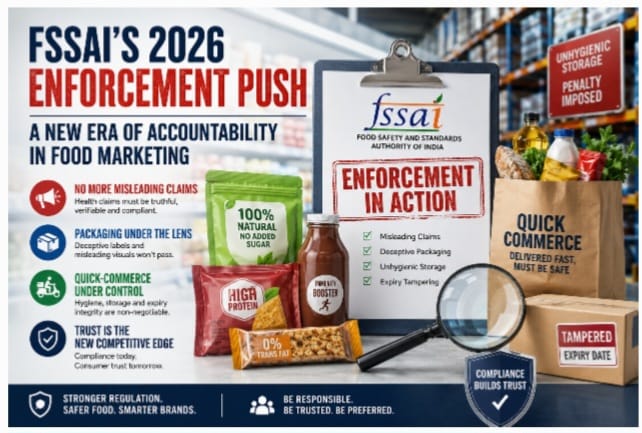
The Food Safety and Standards Authority of India (FSSAI) is widening its scrutiny of India’s packaged-food ecosystem, moving beyond product safety to examine how food is "named, packaged, marketed, stored and delivered".
In June, FSSAI issued notices to 14 food business operators over allegedly misleading use of terms such as “healthy” and “organic” in product names and claims. The list included Emami Healthy & Tasty, Health Aid, Troovy, The Health Factory, Healthy Master, Healthy Choice, Plan B, Neuherbs, Organic Wisdom, Shine Organic, Two Brothers Organic Farms, World of Organic, Storia and Iota Water.
The action is significant for marketers because health positioning has become a major differentiator in India’s crowded packaged-food market. FSSAI’s intervention suggests that words such as “healthy”, “organic”, “natural”, “zero maida” and “100%” can no longer be treated simply as creative territory without adequate substantiation.
Brands and businesses facing regulatory action
Brand / Action / issue flagged | Regulatory significance
Emami Healthy & Tasty| ‘Healthy’ positioning Product brand-name claim / scrutiny
Troovy | ‘Healthy’ claims | Claim substantiation |
The Health Factory | Health-oriented claims Labelling /branding scrutiny
Healthy Master | Misleading-claim concerns
Plan B
Health/ingredient claims | Product-name scrutiny
Neuherbs | Health-related claims | Claim compliance
Two Brothers Organic Farms | ‘Organic’ positioning Organic-claim scrutiny
Storia | Health/natural claims | Product and advertising scrutiny
Iota Water | Product claims | Labelling compliance
Lotte India | ‘100% natural/vegetarian’ claims | Show-cause notice |
Ferns N Petals | ‘100% natural/vegetarian’ claims | Show-cause notice |
Kubera Foods | Chocolate/quality claims | Show-cause notice
Dabur India| ‘100% pure/natural’ claims | FSSAI directed stoppage of specified claims |
Swiggy Instamart | Expired/spoiled food, licensing and compliance concerns | 9 notices issued
"The above information reflects reported notices, directions and enforcement actions; a notice does not by itself establish final liability."
Quick commerce becomes the next compliance frontier
The crackdown is also exposing a different vulnerability: the last mile of food safety. FSSAI issued nine notices to Swiggy Instamart following complaints involving expired, spoiled, rotten and contaminated food. The regulator also flagged discrepancies involving food-business licences and product listings.
For quick-commerce platforms, this changes the compliance equation. A brand can manufacture a compliant product, but poor dark-store inventory management, inadequate storage or weak expiry controls can still damage consumer trust.
The scale of enforcement is underscored by FSSAI’s July action against Westend Corporation in Delhi. More than 50,000 pieces were seized following alleged fraudulent re-labelling and substandard storage, with an FIR registered.
The immediate impact will be felt in packaging, performance advertising, influencer marketing and e-commerce listings. According to data cited by local media reports from the Advertising Standards Council of India (ASCI), around 85% of digital advertisements by food and beverage brands were found to violate advertising norms.
That creates a clear warning for marketers: the regulatory risk is no longer restricted to a product’s ingredients. A headline, pack descriptor, influencer script or marketplace listing can become a compliance issue if the underlying claim cannot be demonstrated.
The emerging marketing model will therefore favour evidence-led communication over broad health halos. Claims will increasingly need scientific substantiation, consistent packaging across channels and traceability through the supply chain.
The bigger shift: trust becomes a measurable brand asset
FSSAI’s recent actions indicate a structural change in Indian food marketing. Regulation is increasingly following the consumer journey—from front-of-pack promise to warehouse shelf to doorstep. For brands, compliance may consequently move from a legal back-office function to a marketing and reputation function. Agencies, platforms and brand teams will need stronger claim audits before campaigns go live, while quick-commerce companies may have to invest more heavily in inventory traceability and expiry management.
The Last Word
The next competitive advantage in food marketing may not be who makes the boldest health claim, but who can prove every claim from factory to final delivery.