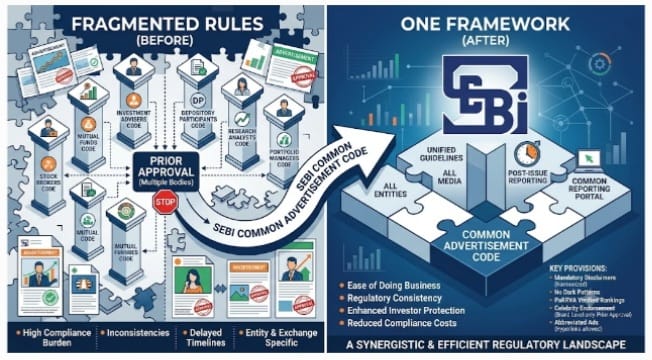
India's financial marketing landscape is entering a defining shift. The Securities and Exchange Board of India (SEBI) proposed a Common Advertisement Code for specified regulated entities, replacing the existing entity-specific advertisement frameworks, in a consultation paper released on June 23, 2026. The framework applies to stock brokers, depository participants, investment advisers, research analysts, online bond platform providers, portfolio managers, and mutual funds and asset management companies, and is proposed to be folded into the SEBI (Intermediaries) Regulations, 2008.
From Gatekeeping to Speed
For marketers, the headline change is procedural liberation. Instead of securing prior clearance before publishing, regulated entities would only need to report advertisements within 24 hours of issuance. Prior approval, however, would continue specifically for celebrity endorsements. This single shift compresses campaign timelines dramatically — a brand launch that once waited weeks for sign-off could go live almost immediately, provided compliance documentation follows fast.
Celebrities and Creators Enter the Frame
At present, celebrity endorsements are permitted only at the mutual fund industry level, subject to prior approval from the regulator. The CAC widens that door considerably: brokers, fund houses, portfolio managers, advisers and research analysts may now be allowed to engage celebrities for brand promotion, though limited to entity or corporate-identity promotion rather than endorsing specific products or schemes. Notably, SEBI has proposed a broadened definition of "celebrity" that includes social media influencers with over 5 lakh followers, athletes, TV anchors, and even virtual avatars. For agencies building influencer strategy, this formally brings finfluencers into regulated territory for the first time.
Guardrails That Remain Firm
Speed doesn't mean laxity. Where past performance is presented, disclosures must clarify that past performance does not guarantee future returns, and information must not create unrealistic expectations among investors. The code also bans manipulative marketing tactics like dark patterns while simplifying digital disclaimers. Entities may also advertise PaRRVA-verified ratings and rankings under prescribed conditions.
From Proposal to Policy — Fast
This isn't a slow-moving draft. SEBI's board approved the Common Advertisement Code at its 215th meeting in Mumbai on September 24 — barely three months after the consultation opened, with the final framework shaped through deliberation with the Industry Standards Forum, stock exchanges and bodies like the Association of Mutual Funds in India. Agencies that build robust internal review workflows now will out-pace competitors once the rule takes effect; those that treat 24-hour reporting as a formality risk becoming SEBI's first enforcement examples.
The Last Word
For marketing and advertising professionals in financial services, the CAC marks a structural pivot: compliance moves from pre-launch gatekeeping to post-launch accountability. Speed-to-market improves sharply, but the burden shifts onto in-house legal and creative teams to self-police claims, disclosures and celebrity use before publishing — not after.