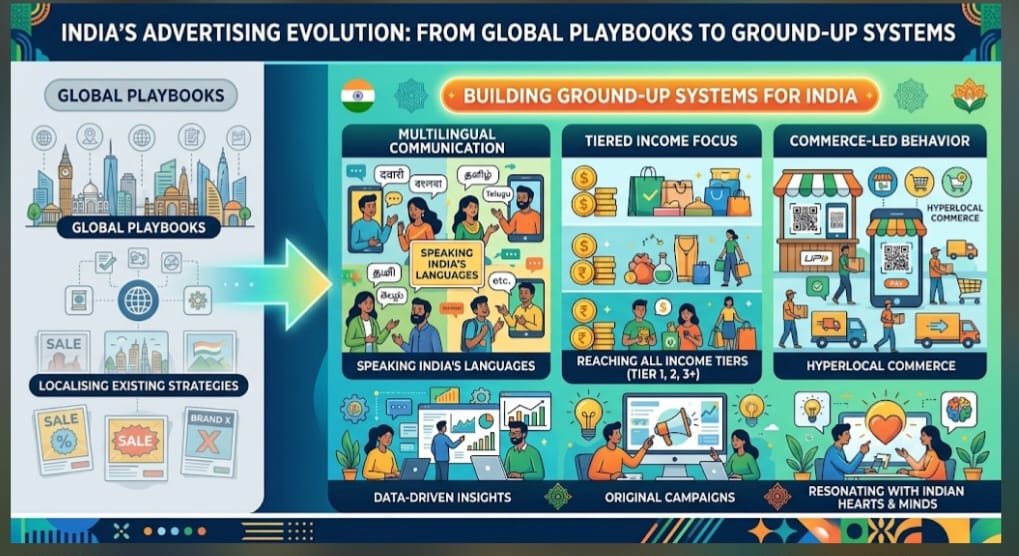
For two decades, disruption in Indian advertising has arrived the same way: a global model programmatic, influencer marketing, retail media lands in the West, gets tested, then gets "Indianised" for local rollout. Agency leaders now say that sequence is breaking down.
The next wave, they argue, will be engineered in India first, for a market too large, too vernacular and too fast-moving to wait for someone else's blueprint.
The Numbers Behind the Shift
India's ad market is projected to touch Rs. 2.01 lakh crore in 2026, growing 9.7 percent over the previous year, digital already commanding 68.1 percent of total ad revenue. More tellingly, commerce-led advertising retail media, quick commerce and social commerce combined is the fastest-growing segment, expanding at 24.2 percent. This is not a category that existed in any Western agency playbook a few years ago; it is a distinctly Indian consumption pattern, born of app-based grocery delivery and vernacular social commerce, now forcing agencies to build measurement and creative systems from scratch. Meanwhile, 45 to 55 percent of Indian corporate firms now prefer digital as their primary advertising medium even as overall industry growth is expected to slow to low-to-mid single digits in 2026 a squeeze that is pushing agencies to seek differentiation through proprietary systems rather than adapted ones.
Why Localisation Alone No Longer Works
Global frameworks assume broadband-grade connectivity, English-first content and card-based payments assumptions that collapse across India's Tier-II and Tier-III markets, where regional language content and mobile-first, often voice- and video-led discovery dominate. Agencies report that campaigns designed abroad and translated later consistently underperform those built natively around Indian identity data, UPI-linked commerce signals and multilingual creative from day one.
The Last Word
The real disruption isn't AI or automation it's data sovereignty. Agencies that own India-specific consumer graphs (language, income tier, payment behaviour) will out-target global networks running borrowed models, turning data infrastructure not creative flair into India's next agency battleground.