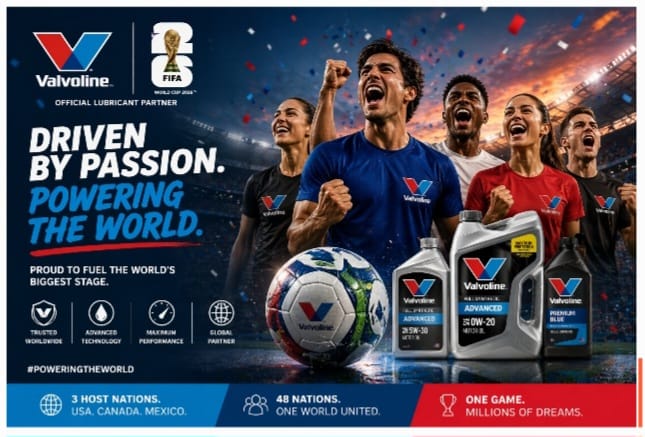
Valvoline Global Operations has debuted a global campaign aligned with the FIFA World Cup 2026, leveraging one of the world’s largest sporting platforms to scale brand visibility. For a category like automotive lubricants—where differentiation is often functional—this marks a clear attempt to build emotional and cultural relevance through sport.
The timing is strategic: with the World Cup expanding to 48 teams and multiple host nations, the media footprint is expected to be significantly larger, offering brands extended reach across geographies.
The strategy: from performance to participation
Valvoline’s campaign signals a shift from purely performance-led messaging to participation in global cultural moments. By associating with football—a sport with deep penetration across emerging and developed markets—the brand is aiming to build familiarity beyond core automotive audiences.
This also allows Valvoline to localise storytelling across markets while retaining a unified global narrative—an increasingly important play in multinational brand building. The World Cup platform offers high-frequency visibility, but more importantly, it enables contextual storytelling across digital, broadcast, and on-ground activations.
Industry lens: sports marketing scales beyond FMCG
Valvoline’s move underscores how non-traditional advertisers are investing in marquee sports properties to drive top-of-funnel awareness. Categories like lubricants, cement, and industrial goods are increasingly adopting mass media strategies once dominated by FMCG and telecom.
For Indian agencies, this expands opportunities in global campaign adaptation, cross-market storytelling, and sports-led brand building.
Our insight
As media fragmentation grows, global sporting events remain one of the few platforms capable of delivering both scale and shared attention—making them hard to ignore, even for utilitarian brands.