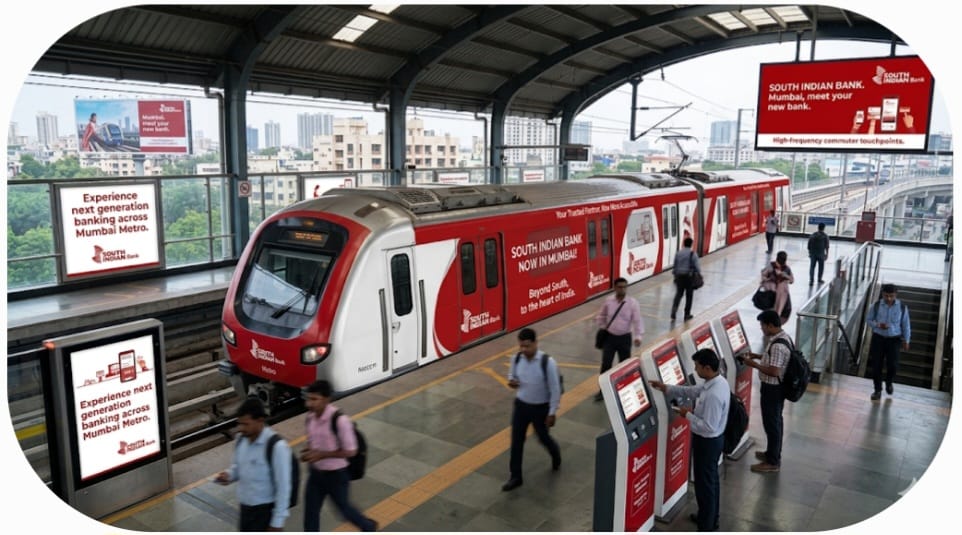
South Indian Bank has launched a Mumbai Metro branding campaign spanning station media, train wraps and high-visibility commuter touchpoints, marking another regional banking player using transit media to drive national-scale recall. The campaign signals the bank’s intent to sharpen urban visibility in one of India’s most competitive financial services markets.
Why Mumbai Metro Matters for BFSI Brands For banks, metro advertising is no longer just an awareness play. Mumbai Metro offers sustained frequency among office-goers, affluent commuters and digitally active consumers — a segment increasingly central to retail banking, credit products and SME acquisition. The move also reflects how out-of-home (OOH) media is regaining strategic relevance for BFSI marketers. After years of performance-heavy digital spends, financial brands are returning to large-format visibility assets that deliver credibility alongside reach. Metro environments, particularly in Mumbai and Delhi, now function as premium attention zones rather than traditional transit inventory.
A Broader Shift in Indian Media Planning South Indian Bank’s campaign fits into a wider trend where legacy institutions are modernising perception through contextual media rather than celebrity-led advertising. Regional banks, insurance firms and fintech players are increasingly competing for the same urban consumer, making physical visibility critical in high-density cities. The banking category has also become more aggressive in hybrid media planning — combining digital acquisition with OOH-led trust building. Transit branding delivers scale while reinforcing legitimacy, especially for institutions expanding beyond legacy geographic markets.
The Sharp Insight
For India’s financial brands, metro media is becoming less about outdoor advertising and more about owning everyday consumer attention at scale.