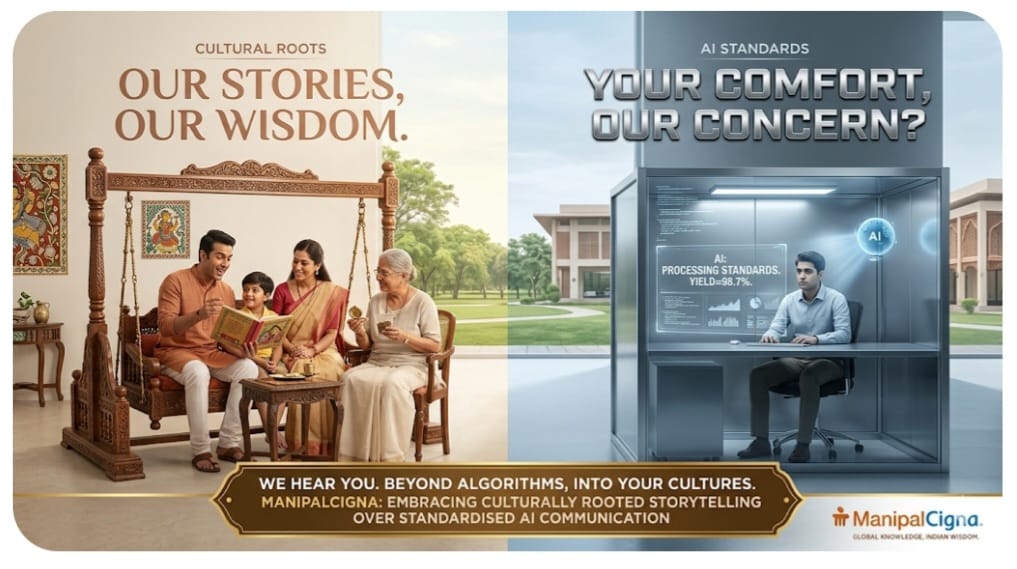
ManipalCigna Health Insurance is doubling down on “cultural intelligence” as a core marketing lever, choosing contextually nuanced storytelling over templatised, AI-generated messaging. At a time when generative AI is flattening creative outputs across categories, the brand’s stance signals a deliberate move to differentiate through cultural specificity—particularly relevant in a market as diverse as India.
The strategic read
Health insurance remains a low-engagement, trust-deficit category where awareness doesn’t always translate into conversion.
Standardised communication—often driven by efficiency-led AI tools—risks further distancing consumers by sounding generic.
ManipalCigna’s approach acknowledges that India’s insurance uptake (still underpenetrated, with health insurance penetration below 40% of the population) is as much a cultural challenge as it is a distribution one. Beliefs around health, family decision-making, and risk vary sharply across regions and socio-economic segments.
By leaning into cultural nuance, the brand is effectively localising trust-building. This also reflects a broader shift: as AI scales content production, the competitive edge is moving upstream to insight quality, not output volume. Agencies and brands will need to invest more in cultural decoding, not just creative automation.
What this means for the industry
Expect a recalibration where AI becomes a production layer, while human insight—especially cultural fluency—drives strategy and differentiation.
Our insight
In a market flooded with AI-generated sameness, cultural specificity isn’t just creative nuance—it’s becoming a business advantage.