Field Guide
Kenya's Advertising Market in 2026: What Every Brand Should Know Before Spending a Single Shilling
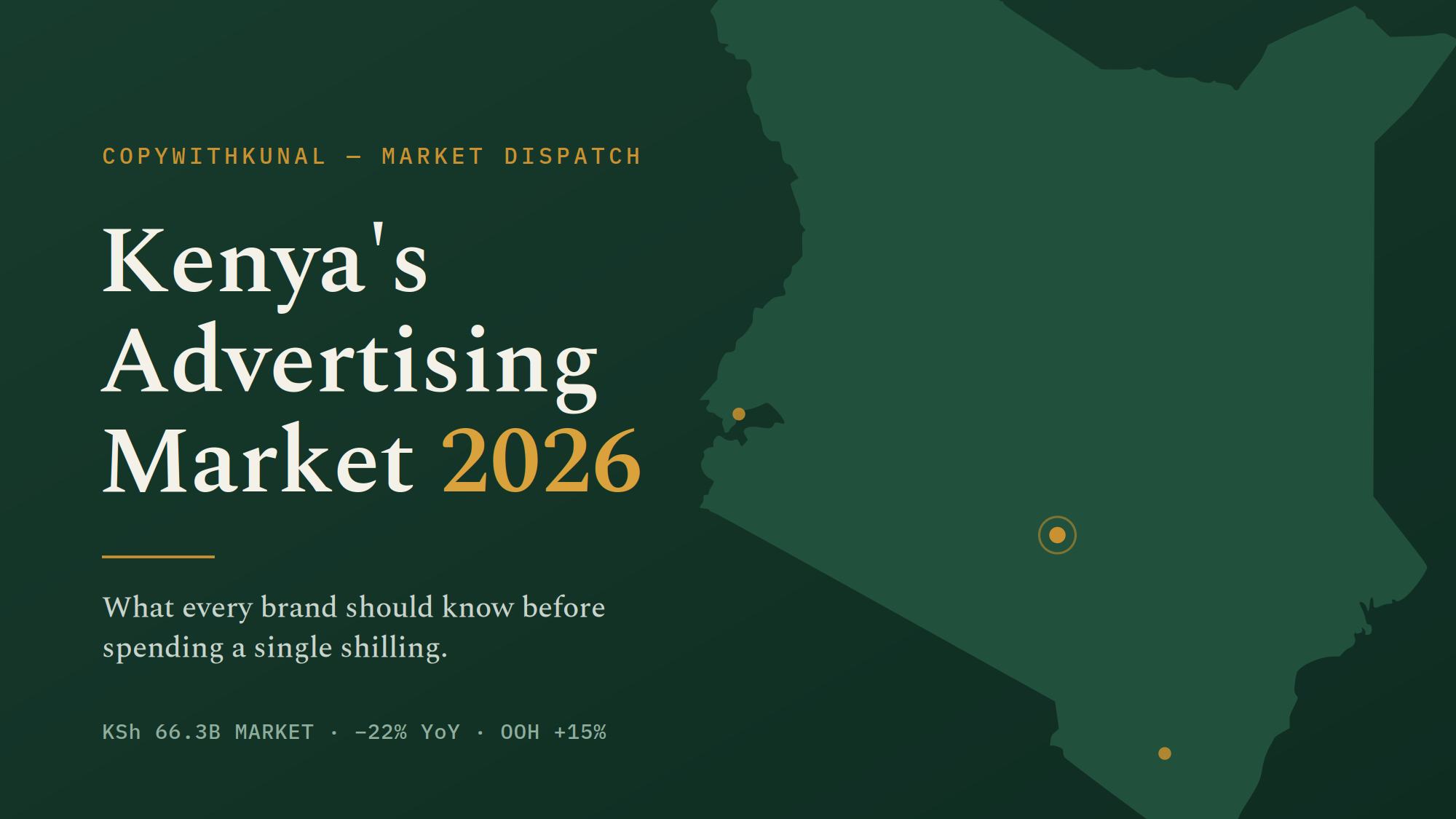
The market shrank by a fifth last year. Read that as a warning and you'll misread the most mispriced opportunity in East Africa.
Total ad market, 2025
KSh 66.3B ↓
−22% on 2024
Kenyans online
27.4M
48% penetration
Daily time on social
~4 hrs
among highest on earth
Out-of-home spend
KSh 6.37B ↑
+15% — the lone riser
Here is the headline most brands will plan around this year: Kenya's above-the-line advertising market shrank by 22% in 2025, falling from KSh 84.9B to KSh 66.3B. Most marketers will read that one of two ways — proof the market is cooling, or reason to wait. Both readings are wrong, and acting on either is the most expensive mistake you can make in this market right now.
A shrinking number can mean two completely different things. It can mean demand collapsed — people stopped buying, advertisers stopped advertising, the floor gave way. Or it can mean a single category was legislated off the air, and everyone is staring at the hole it left instead of the room that's still full. In Kenya, it was emphatically the second. The economy didn't fail in 2025. A regulator pulled a lever, and one very loud advertiser went quiet.
If you understand why the number fell, you can see what almost no one entering this market in 2026 can: that the spend didn't vanish, it relocated; that the centre of gravity of Kenyan advertising has shifted in a way that rewards a completely different kind of brand; and that the country's largest agency is on fire, leaving the most valuable client relationships in East Africa up for grabs. To see all of that clearly, it helps to know how this market was built in the first place.

A Short History
How Kenya built — and then bet — its advertising industry.
Modern Kenyan advertising has, for four decades, been told largely as one man's story. In 1982, Bharat Thakrar opened a small agency in Nairobi called Scanad with no clients and no university degree, doing every job himself. Through acquisition and sheer stubbornness he turned it into Scangroup — by far the largest marketing communications group in East and Central Africa, spanning advertising, media buying, PR, research and digital. It listed on the Nairobi Securities Exchange in 2006, sold control to London's WPP by 2013, and rebranded as WPP Scangroup in 2015. For a generation, if you were a serious brand in Kenya, you were almost certainly a Scangroup client.
Two things then reshaped the market underneath that order. The first was the betting boom: through the 2010s, sports-betting and gambling brands became some of the heaviest advertisers in the country, flooding television and radio with high-frequency, acquisition-hungry spend. The second was the slow erosion of the giant — Thakrar's acrimonious exit in 2021, followed by years of losses and client departures. By 2025, both stories reached their conclusions at once. The regulator came for betting, and the giant came apart. That collision is the 2025 reset.
- 1982Scanad is born. Bharat Thakrar opens a one-man agency in Nairobi.
- 2006Scangroup lists on the NSE — the only marketing group on Kenya's exchange.
- 2013WPP takes control, later rebranding the group WPP Scangroup in 2015.
- 2010sThe betting boom. Gambling brands become some of Kenya's biggest spenders on TV and radio.
- 2021Thakrar exits the company he founded after a board fallout.
- 2025The reset. A betting-ad ban guts the category; Airtel walks; Scangroup posts a KSh 713M loss.
- 2026Up for grabs. The market — and the agency order that ran it — is open in a way it hasn't been in 40 years.
The Misread
It wasn't the economy. It was a ban.
Kenya's macro picture in 2025 was, by any honest reading, fine. GDP grew around 4.5%. Inflation eased to a five-year low. Consumers kept consuming. None of that is the profile of a country whose advertising market should fall by a fifth.
What actually happened sits in one sector. In early 2025, Kenya's Betting Control and Licensing Board introduced sharply stricter rules — including a one-month outright ban on betting promotion, mandatory classification, and a prohibition on celebrity and influencer endorsements. Betting and gambling, which had been among the single largest spenders in Kenyan mainstream media, was effectively pulled off television and print overnight. By the following quarter, gambling ad spend had collapsed by 89%, to roughly KSh 131M, per Communications Authority data.
The footprint of that one exit is the whole story of the 22% drop. Television, the channel betting leaned on hardest, bore the brunt. Print fell with it. Radio — and out-of-home — barely flinched. Look at how unevenly the contraction landed:
Read that chart carefully, because it carries a lesson the headline buries: the audience never left. Radio's resilience proves it — the same Kenyans were still listening, still reachable, still in the market. What left was one advertiser, removed by law. This was a category exit, not a demand collapse. The room is still full. The loudest person in it just stopped talking.
The New King
Banking took the throne — and changed the rules of the game.
Into the space betting left walked the banks. By 2025, banking had become Kenya's single largest advertising category, overtaking the sector that dominated for years. Betting's share of total spend fell from 22% to 9%; banking rose to 16%, with finance, communications and media filling the tier behind it.
This is not a trivia point. It is the most important strategic fact in the market, because the dominant advertiser sets the tone for everyone. Betting money was a particular kind of money: impulsive, volume-hungry, acquisition-at-any-cost, indifferent to brand. Bank money is its opposite. It is institutional, measured, trust-led, allergic to anything that can't be tied to a return. When the biggest spender in a market is a bank rather than a bookmaker, the entire definition of "good advertising" quietly changes underneath you.
The centre of gravity moved from spending to acquire, to spending to be trusted. That changes what good creative even looks like.
For any brand entering Kenya in 2026, that shift is the brief. Loud, frequency-bombing, buy-attention-by-the-truckload campaigns were built for the betting era, and the betting era is over. The market that's left rewards credibility, measurability and a reason to be believed.
The Map
Where Kenya's money actually lives.
Spend in Kenya is not spread evenly across the country — it pools in three places, and overwhelmingly in one. Nairobi is the economic and media capital; with Mombasa, the two cities account for the lion's share of urban media consumption. Kisumu anchors the west. Almost every shilling of premium advertising is bought, planned and consumed along this short axis.
- Nairobi · the hubThe capital is the market. It concentrates the agencies, media owners, bank HQs and the bulk of premium ad budgets. Start here.
- Mombasa · the coastTourism, ports and trade. Kenya's second city and the gateway for hospitality and logistics brands.
- Kisumu · the westLakeside anchor. The third pole of urban reach, and a reminder that vernacular radio rules far beyond Nairobi.
- The corridorsOOH lives on the highways. Thika Road, Waiyaki Way, Mombasa Road and Uhuru Highway carry the billboards the whole market sees.
The Leaderboard
Who actually sets the weather.
Kenya's advertising market is concentrated to a degree that surprises most newcomers. A handful of institutions out-spend everyone else, and their choices ripple through the whole ecosystem.
For a challenger brand, concentration cuts two ways. The auction for mass attention is owned by deep pockets you will not outbid. But everything those giants are structurally too big to do well — the niche, the fast, the local, the culturally exact — is open territory. In a market this top-heavy, your advantage is rarely budget. It is precision.
Working / Not Working
What's pulling its weight in 2026 — and what isn't.
Strip away the noise and the market sorts cleanly into channels that are gaining and channels that are bleeding. The dividing line is not "old versus new" — it's "reachable and accountable" versus "exposed to the next regulatory or behavioural shock."
▲ Working
- Out-of-home. Up 15%, restriction-proof, and where regulated categories now go to be seen.
- Digital & mobile-first. 27.4M online, ~4 hours a day on social, video rising fast. Meta platforms alone take more than half of digital spend.
- Institutional brand-building. Trust-led work from banks and telecoms — the new centre of gravity.
- Vernacular radio. The most resilient mass channel, and the one that reaches Kenya beyond Nairobi.
▼ Not working
- The betting playbook. High-frequency, acquisition-at-all-costs spend — now banned and gone.
- TV-heavy mass buys. Down 22% and fragmenting as audiences scatter to mobile.
- Print. Down 25%, a structural decline the reset only accelerated.
- Agency incumbency. Big legacy logos are losing clients to faster, founder-led shops.
The digital side deserves a closer look, because it is where the displaced budget is quietly reassembling. Kenya is a mobile-first country with one of the highest daily social-media habits on the planet, and the money inside digital is highly concentrated: Meta's Facebook and Instagram together take well over half of digital ad spend, with YouTube a clear third as video consumption climbs.
The Exception
While everything fell, the billboards grew.
Here is the contrarian fact that should reframe how you think about the whole market. In a year when television, print and total spend all contracted, out-of-home advertising went the other way — growing 15% to KSh 6.37B, with prime large-format occupancy reportedly hitting 80% by December.
Why did OOH rise while everything around it fell? Largely for the same reason everything else fell: regulation. With alcohol advertising restricted during daytime broadcast hours, East African Breweries moved its visibility outdoors at scale — to the point that EABL alone accounted for roughly 13% of all out-of-home spend. The brands that read the betting ban as "the Kenyan market is closing" missed that the very same regulatory pressure was pushing money into the most resilient channel in the country.
Regulation rarely destroys spend. It relocates it. Follow where it's going.

If you are planning a 2026 entry, this is the practical takeaway: out-of-home and digital-out-of-home are where restriction-proof budget is consolidating, and they live along the same highway corridors that carry Nairobi to work every morning. It is the channel least exposed to the next regulatory surprise, and the one the market's smartest spenders have already moved toward.
The Vacuum
The giant that ran this market is collapsing.
For four decades, WPP Scangroup was the undisputed titan of East African advertising. In 2026, it is a cautionary tale — and a once-in-a-generation opening for everyone else.
The defining blow came in May 2025, when Scangroup's Ogilvy Africa lost Airtel Africa after fifteen years — a single relationship that had reportedly contributed close to a fifth of group revenue. Airtel moved its business to Publicis Groupe Africa and to The Partnership, a challenger shop founded by three former Scangroup executives. That last detail is the whole pattern in miniature: the talent isn't being beaten by outsiders, it's walking out the door and taking the clients with it.
The numbers around that loss tell the rest: revenue down more than 16% to roughly KSh 2.04B, a fourth profit warning in five years, three chief executives cycling through in a matter of months, and a share price that has fallen from above KSh 70 at its 2013 peak to under KSh 2. Over the years it has also shed KCB, Equity and NCBA, and by industry counts at least seven agencies now operating in Kenya are run by people who used to work there.
For any brand reviewing its agency in 2026, the lesson is blunt: incumbency is worth nothing here right now. The most valuable client relationships in the country are in motion, and the firms winning them are small, senior and fast. Stop paying for a logo. The people who actually did the work behind that logo keep leaving it.
Field Notes
Before you spend a shilling.
Pulled together, the 2025 reset leaves five things worth fixing in your head before any 2026 plan goes to budget:
- Don't price the market on the headline. The 22% drop is a category exit engineered by a regulator, not a recession. Demand is intact; budget moved, it didn't disappear.
- Win on trust, not noise. With banking setting the tone, measurable and credibility-led work beats spray-and-pray. The era of buying attention by the truckload ended with the betting ban.
- Follow the restriction. Out-of-home is the resilient channel, and regulated categories are already crowding into it. Plan your media where the next surprise can't reach you.
- Hire people, not logos. The agency tier is fragmenting and the talent has left the towers. Judge a partner on who is actually in the room, not whose name is on the door.
- Plan for 2027. An election year is coming, and Kenyan ad spend tends to wobble as one nears. Build the flexibility in now, while it's cheap to.
None of this is a reason to stay out of Kenya. It is the opposite. Markets are easiest to enter precisely when the incumbents are distracted, the leader is reeling, and everyone else is misreading a number. All three are true here at once.
But here is the part the data can't hand you. Numbers tell you where the money is. They don't tell you what to say once you've followed it — and in a market that is re-learning how to talk to people now that its loudest voice has been silenced, what you say is about to matter more than it has in years. That is the decision most brands will still get wrong in 2026. The shilling is the easy call. The sentence it buys is the hard one.
· · ·