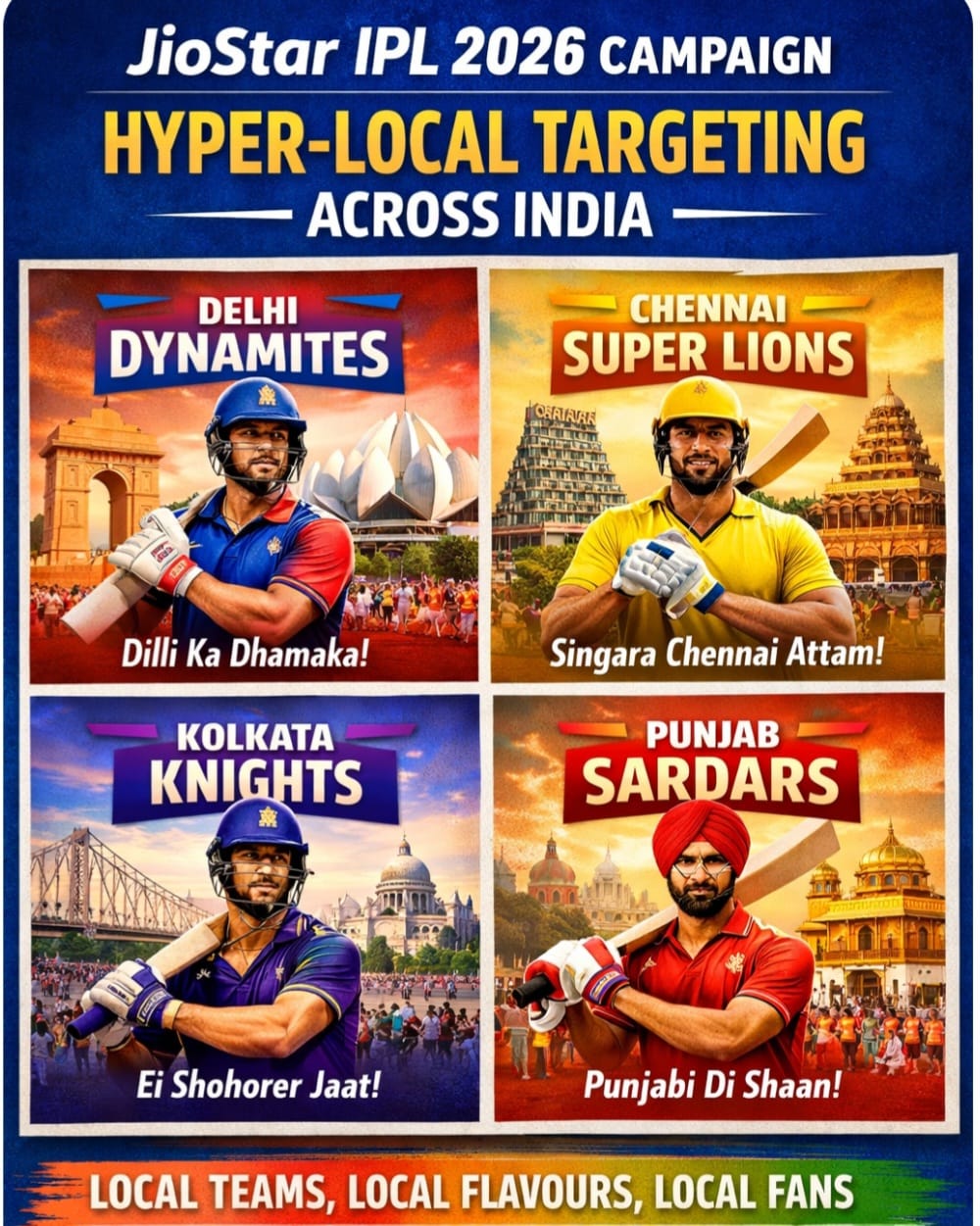
JioStar has rolled out a hyper-localised campaign for IPL 2026, tailoring messaging, creatives and language across regions to drive deeper audience relevance. The move reflects a clear shift from mass national storytelling to granular, market-specific communication during India’s biggest media event. With IPL continuing to command peak ad spends, this approach signals how platforms are rethinking scale — not as uniform reach, but as aggregated local relevance.
The strategy behind the shift
At its core, JioStar’s play is about aligning with India’s linguistic and cultural diversity while leveraging data-led targeting. By customising creatives across regions, the platform is optimising for engagement rather than just impressions. This is particularly significant in a digital-first IPL ecosystem, where consumption patterns vary sharply by geography, language and device usage. For advertisers, this opens up more precise inventory — regionally contextual, culturally tuned and potentially higher in conversion efficiency. It also reflects the growing importance of first-party data and dynamic ad delivery in live sports environments.
What this means for the industry
The IPL ad economy is moving from “one campaign fits all” to modular storytelling at scale. Broadcasters and streaming platforms are no longer just media owners; they are becoming full-stack distribution and targeting engines. This raises the bar for creative adaptability and real-time optimisation.
Our observation
Hyper-local is no longer a regional tactic — it is fast becoming the default operating model for national scale campaigns in India.