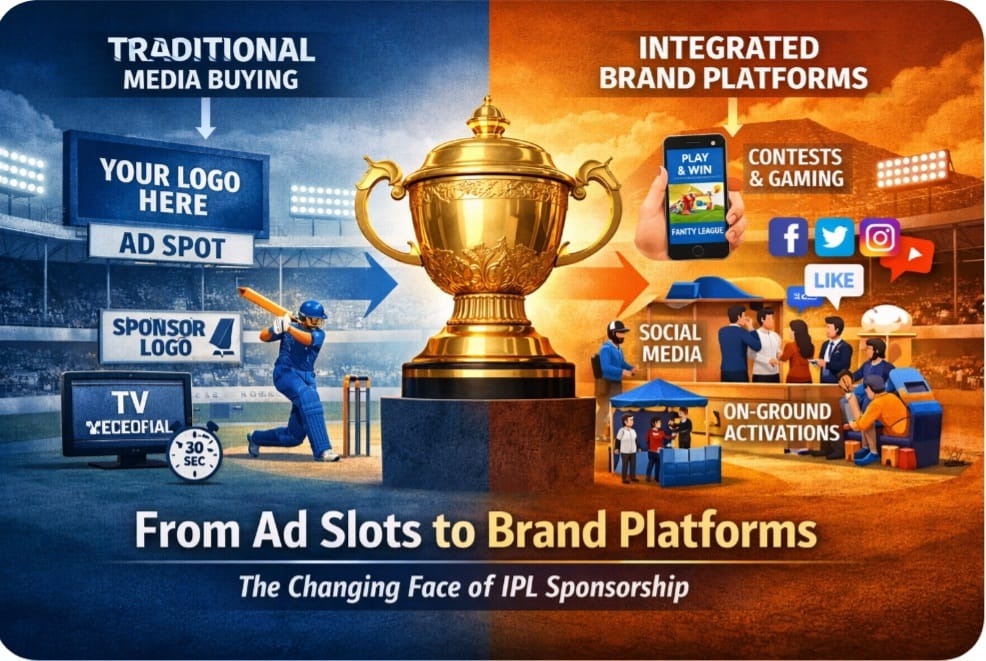
The Indian Premier League (IPL) is moving beyond traditional spot buying and static logo placements toward more integrated brand platforms. As newer categories enter and legacy advertisers recalibrate spends, the league is increasingly being used as a full-funnel marketing ecosystem rather than a high-reach media burst. This matters because IPL has historically set the benchmark for premium sports monetisation in India. From inventory to ecosystems Earlier, IPL’s commercial model was driven by on-air ad slots and team sponsorship visibility. Now, brands are seeking deeper integrations—content tie-ins, fan engagement layers, and digital-first extensions. This aligns with the fragmentation of media consumption, where TV alone no longer guarantees impact. The rise of categories like fintech, fantasy gaming, and D2C has also influenced this shift. These brands prioritise measurable engagement over passive visibility, pushing IPL stakeholders to offer more than just GRPs.
What this means for the industry
For broadcasters and rights holders, this signals a structural pivot: packaging IPL as a multi-platform marketing property spanning TV, OTT, social, and on-ground experiences. For advertisers, it raises the entry barrier—mere presence is no longer enough; activation depth determines ROI. It also indicates a maturing market where brand-building and performance objectives are converging within large-scale events.
One sharp observation
IPL is no longer being sold as media inventory; it’s being negotiated as marketing infrastructure—and that changes who wins and how.