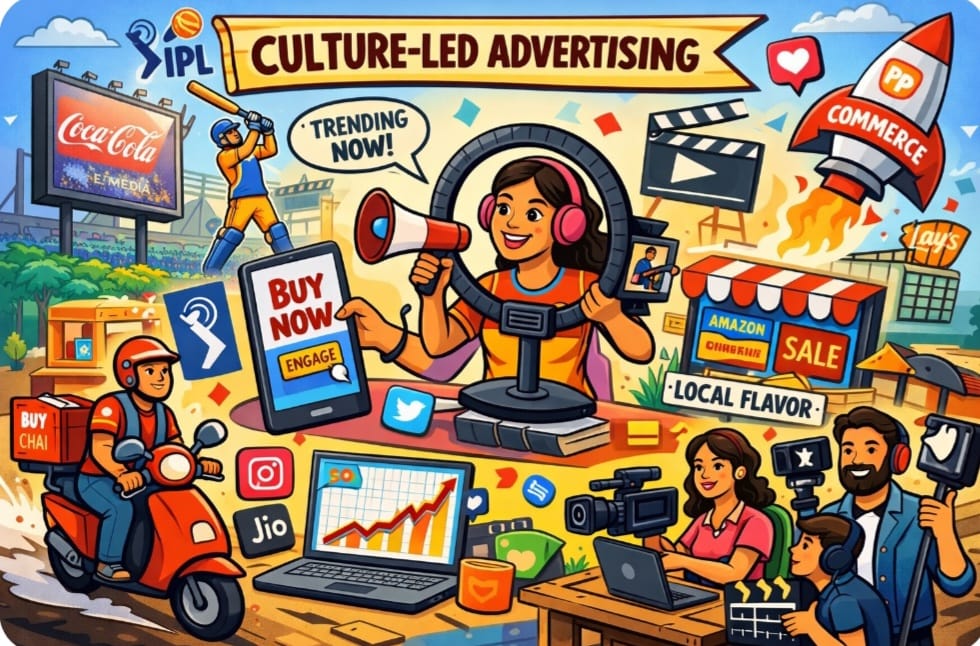
Here's a sentence no one in Indian advertising wants to say out loud: we're building the world's most complex consumer market, and most brand strategies are still reading it like it's 2019.
A billion-plus people. Twelve languages that matter. Forty distinct cultural calendars. Four hundred million social media users. Three hundred million online shoppers. And an influencer economy that generates more creative output per day than most Western markets do in a week. This isn't a challenge — it's a systemic, beautiful, maddening advantage. The brands winning right now are the ones who've stopped trying to simplify it. This week, Indian advertising is at an inflection point. Culture is doing the heavy lifting that media budgets used to. Creators are graduating from distribution channels to genuine brand co-owners. Commerce is collapsing the gap between inspiration and transaction. And AI is quietly making all of it faster, cheaper, and occasionally, embarrassingly generic.
Culture When the Festival Calendar Becomes Your Media Plan
India runs on festival energy. This isn't a metaphor — it's a media reality. The stretch from Holi through Eid into IPL season represents the single densest consumer attention window in the world. Brands that understand this aren't just timing their ads. They're engineering cultural moments. This week, Tanishq's "Navratri Threads" campaign is making the rounds for all the right reasons. Instead of a generic jewellery-meets-tradition spot, they commissioned six regional filmmakers to document Navratri as it's actually celebrated across Gujarat, Bengal, Maharashtra, Andhra Pradesh, Himachal Pradesh, and Tamil Nadu. Six distinct visual languages. Six emotional truths. One brand — present at all of them, not pretending they're the same thing. "The biggest mistake in Indian advertising is treating cultural diversity as a production problem. It's actually your most powerful creative brief." — Regional Campaign Intelligence
Meanwhile, Zomato's IPL pre-season push is doing something shrewder: instead of buying inventory, they're building an argument. Their "Order your cricket superstition" campaign taps into the deeply real phenomenon of fans believing their food ritual affects match outcomes. Dal makhani during India v Pakistan? Non-negotiable. It's behavioural insight dressed as comedy — and it converts. The pattern here is consistent. The brands winning culturally aren't the ones with the biggest budgets — they're the ones with the sharpest anthropology. They know that an Indian consumer in Jaipur and an Indian consumer in Kochi are watching the same Instagram reel with completely different cultural filters applied. Great cultural advertising meets both of them, simultaneously, without condescension.
Kunal's POV
Brands still running one "India" TVC and calling it a national campaign are burning money. The ROI on regionally-coded content is measurably higher — and with vernacular creator networks maturing, execution cost is dropping fast. This is the trade most CMOs haven't made yet.
Tanishq × Regional Filmmakers "Navratri Threads" — Six States, One Brand Truth A multi-filmmaker anthology format that respects cultural specificity rather than flattening it. Estimated organic reach: 40M+ across regional YouTube, Instagram, and OTT pre-rolls.
India Culture Ad Spend ₹8.2K Cr Festive season ad spend (Oct–Feb FY26) YoY growth +22% Regional language spend 41% Digital share 63% Vernacular video growth +67%
Creators The Creator Economy Grows Up — And Gets a P&L The Indian influencer economy passed ₹2,200 crore last year and is tracking toward ₹3,375 crore by 2027. More interesting than the size is the structural shift: creators are no longer just distribution channels. The best ones are media companies with equity in the brands they promote. This week's most discussed deal is boAt's co-creation arrangement with BGMI streamer Mortal (Naman Mathur). The structure isn't a brand endorsement — it's a product advisory relationship with revenue participation. Mortal co-designed a limited SKU, owns a corner of the aesthetic, and earns on sales. The result? Sellout in 72 hours, 11M YouTube views on the launch video, and zero media budget on the reveal. That's not a campaign. That's a business model. On the micro end, mCaffeine's nano-creator program deserves serious attention. Instead of chasing reach, they've built a network of 4,000+ skincare enthusiasts with under 10K followers each — people whose audiences are hyper-niche, hyper-trusting, and hyper-engaged. Average CPE (cost per engagement) is reportedly 83% lower than macro-influencer buys. The trade-off is coordination overhead, which is why AI-powered creator management platforms are suddenly the hottest startup category in Indian martech.
"Reach is a vanity metric. The creator economy's real value is manufactured trust — and trust is what converts." — Creator Economy Analysis
There's also a dark side worth naming. The ASCI (Advertising Standards Council of India) flagged over 1,200 undisclosed paid promotions in Q1 2026, a 34% jump year-over-year. The disclosure fatigue is real — audiences are getting savvier, and brands stuffing gratuitous paid partnerships into creator content are facing measurable credibility erosion. The authenticity premium is real, and it's about to get more expensive to fake.
What smart brands are doing differently Forward-thinking brands are mapping creator tiers to funnel stages — not just chasing celebrity reach. The playbook: Macro for awareness bursts, Mid-tier for category education, Micro for consideration, Nano for purchase triggers. It's not either/or. It's allocation logic.
Creator Economy Numbers 3.5M+ Active monetising creators in India (2026 est.) Market size FY26 ₹2,300 Cr+ Avg. brand deal growth +31% YoY ASCI flagged posts Q1 1,200+ Nano creator ROI advantage 83% lower CPE
Commerce The Scroll-to-Cart Era: When Advertising Becomes the Store
India's social commerce market is a moving target. Estimates range from $7B to $12B in annual GMV — and the spread tells you everything about how fast the lines between content and transaction are dissolving. What's clear is this: the distinction between an ad and a product page is collapsing, and the brands who've rebuilt their creative workflows to reflect this are printing money. Meesho's "Bazaar Live" format is the week's most instructive case study. Their live commerce sessions now average 200,000 concurrent viewers during primetime — comparable to mid-tier cable TV numbers — with average session duration of 34 minutes and an add-to-cart rate of 18%. For context, a well-optimised e-commerce PDP page gets 3–5%. The difference is social proof, urgency, and entertainment functioning as a unified conversion engine. Myntra's integration of AR try-on within Instagram story ads is another signal. The format — tap on a kurta, see it on a model who shares your skin tone and size, swipe up to buy — reduces the return rate on impulse purchases by approximately 23% according to their internal data. That's not a feature. That's a fundamental restructuring of what advertising is supposed to do.
The deeper tension in commerce advertising this week is the Quick Commerce vs. Discovery Commerce split. Blinkit and Zepto are perfecting last-mile fulfilment advertising — hyper-local, demand-driven, almost entirely performance-based. Meanwhile, platforms like Nykaa, Mamaearth's direct channels, and the crop of D2C brands emerging from Tier 2 cities are betting on discovery: building desire before need exists. Both models are valid. They require completely different advertising philosophies, and most brand teams are trying to run both simultaneously with the same creative team. That's a structural mismatch that's costing money.
"Quick commerce buys a transaction. Discovery commerce builds a brand. Confusing the two is how you end up with a declining NPS and a strong CAC." — Commerce Strategy Desk
The D2C Tier 2 Signal This week's most underreported story: vernacular D2C brands from Indore, Coimbatore, and Surat are outperforming metro-born counterparts on CPA metrics — because they're advertising to audiences they actually understand, in the language those audiences actually think in. The real competitive threat to HUL and P&G's dominance isn't another metro startup. It's 200 micro-brands you've never heard of yet.
Commerce Metrics 18% Live commerce add-to-cart rate (vs 3–5% PDP avg.) Social commerce GMV FY26E ~$10B AR try-on return rate reduction −23% Live commerce avg. session 34 min D2C brands launched YTD 1,400+
Artificial Intelligence AI in Indian Advertising: The Productivity Boom No One Wants to Admit Is Here
The most honest sentence a creative director said to me this week: "We're running AI-generated visuals for 60% of our performance campaigns and the CTR is indistinguishable from human-made assets. I'm not proud of it, but I'm not stopping either." Indian advertising's AI adoption curve is steeper than any other market for a simple reason: the volume demands are higher, the budgets are tighter, and the language complexity is enormous. When you need to run a campaign in Kannada, Odia, Punjabi, and Marathi simultaneously, AI localisation isn't a nice-to-have — it's an operational necessity. This week, Pidilite's Fevicol — a brand famous for some of India's most beloved advertising — tested an AI-generated campaign for its B2B line. The creative team used generative video to produce 47 variants of a single concept, adapted across five regional languages and four customer personas, in three days. Previously, a campaign at that scale took six weeks minimum. The output? Three of the 47 variants outperformed the human-crafted "hero" spot on engagement metrics.
But — and this is important — the category where AI is actively hurting brands is brand storytelling. The campaigns falling flat this week share a tell: they look like they were made by someone who described the brief to a machine and shipped the first output. Indian consumers, especially in Tier 1 cities, are developing aesthetic antibodies to AI-generic creative. The flatness. The impossibly symmetrical compositions. The Hindi voiceover that flows correctly but feels like it was written in English first. The smarter operators are using AI for speed and scale in performance creative while protecting their brand creative from it. Swiggy's creative team runs a two-track system: AI handles all A/B test variants for performance campaigns; human creative teams retain full control over brand-building work. The productivity gain is real. So is the brand protection logic.
The Prompt Economy The new competitive advantage in Indian advertising isn't the creative talent on your roster — it's the prompt library in your creative OS. The agencies building proprietary, brand-specific prompt systems for their clients are developing a moat that no pitch deck can replicate. Treat your prompts like IP. Because they are.
AI in Indian Ad Market 67% of Indian agencies using AI in creative production (FY26) Cost reduction (performance creative) −58% Production time (campaign variants) −80% AI brand creative satisfaction Low Vernacular AI localisation accuracy ~81%
Key Takeaways 5 Things Every Indian Marketer Must Know This Week
- Cultural specificity is your cheapest media buy
Regional campaign ROI is consistently outperforming national campaigns. The investment in cultural intelligence — a local creative lead, a vernacular writer, regional filmmaker partnerships — pays back in engagement rates that pan-India productions structurally cannot match
- Creator tiers are a funnel strategy, not a budget decision Stop thinking about creators as reach providers and start treating them as funnel instruments. Macro for awareness, micro for trust, nano for conversion. The brands building tiered creator programs are generating more efficient attribution than most paid media stacks.
- Your ad and your product page need to be the same thing If your creative workflow doesn't end in a shoppable format, you're losing the transaction window. The scroll-to-cart gap is collapsing — and your competition is already on the other side of it. AR, live commerce, and in-feed checkout are not experiments. They're table stakes.
- AI is your production team, not your creative director Use AI to generate scale, speed, and localisation in performance creative. Guard your brand-building work with human creative intelligence. The mistake is using the same tool for both jobs without changing the brief. Swiggy's two-track system is the model worth stealing.
- The real competition is in Tier 2, and you're probably underinvesting there The D2C brands eating category share right now aren't coming from Bangalore startups. They're coming from Indore, Nagpur, and Coimbatore — with local insight, lower CAC, and audiences who trust them implicitly. If your brand strategy doesn't have a Tier 2 chapter, you're writing tomorrow's case study about what you missed.