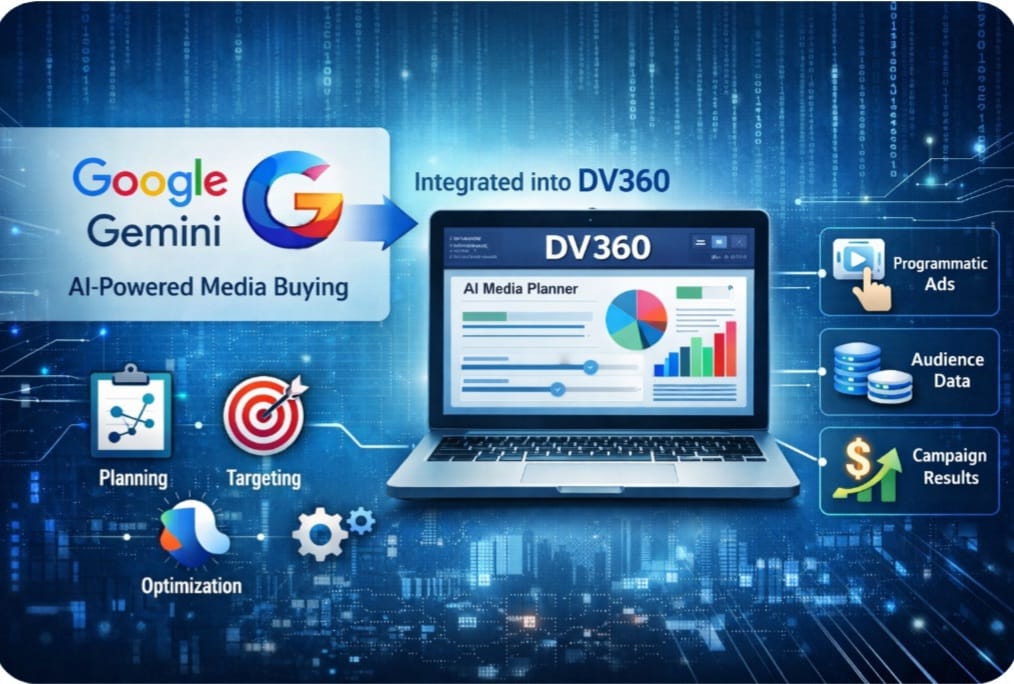
At its NewFronts presentation in Manhattan, Google announced a deeper integration of Gemini into Display & Video 360 (DV360), aiming to automate large parts of media planning and buying. The update allows advertisers to generate media plans, audience strategies, and performance optimisations using AI prompts—compressing what traditionally took days into minutes. This matters because DV360 is already one of the most widely used demand-side platforms globally. By embedding AI at the planning layer—not just optimisation—Google is shifting programmatic from execution efficiency to decision-making automation.
The strategic read for India: For Indian agencies and brands, this signals a structural shift. Media planning—long considered a high-value, human-led function—is now being productised. As AI begins to recommend channel mixes, audience cohorts, and budget allocations, the role of planners will move from creation to validation. Large agency networks may absorb this faster, integrating AI into workflows and reducing turnaround times. Independent agencies, however, could face margin pressure as planning becomes less labour-intensive. For brands, especially performance-led advertisers in e-commerce and fintech, this could accelerate in-housing of programmatic capabilities. There’s also a platform power play here. By tightening the loop between data, planning, and buying within its ecosystem, Google reduces dependency on third-party tools—something Indian advertisers have relied on for cross-platform neutrality. One sharp observation: When planning becomes automated, differentiation in media will no longer come from what you buy—but what data you feed the machine.