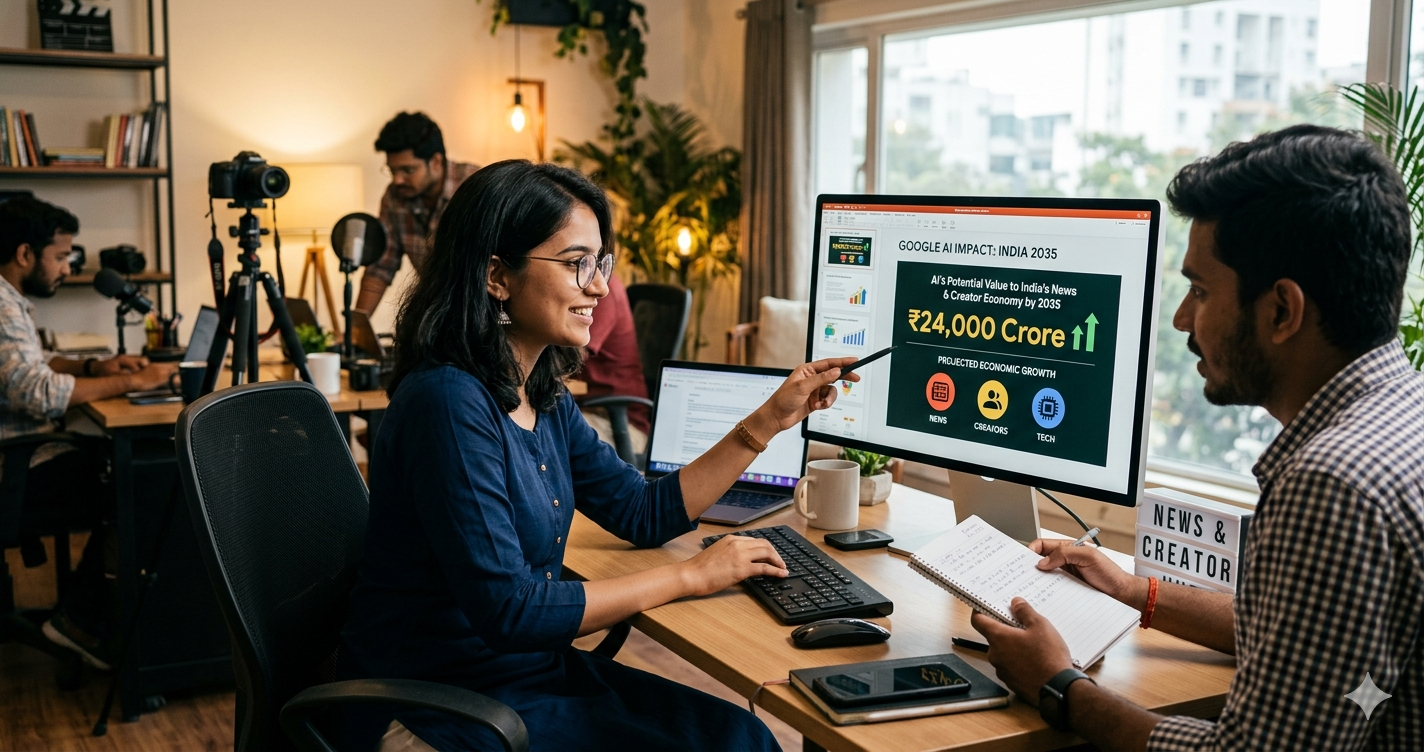
At the India AI Summit in February 2026, a Google executive stood up and offered the Indian media industry a number to reckon with. The economic potential of AI for India's news and creator ecosystem could exceed ₹240 billion before 2035, said Gail Kent, positioning AI not as a newsroom efficiency tool but as a structural growth driver for the country's entire content economy.
It is a large number. It is also, depending on where you sit, either a promise or a pressure.
What is already happening
The shift is not hypothetical. Indian newsrooms have spent the last two years moving from experimentation to integration. AI is now embedded in transcription, translation, video summarisation, content archiving, and audience analytics across major publishers. Journalists across more than 110 newsrooms are saving an average of eight hours per week by using AI tools, according to data from Google's AI Skills Academy. AI-powered translation is enabling regional stories to reach national audiences in ways that would have required dedicated teams just three years ago.
On the advertising side, the transformation is equally significant. Google has launched its full suite of AI-powered advertising tools in India following the repeal of the country's 6% digital advertising levy. The newly available tools include AI Max for Search Campaigns, Smart Bidding Exploration, YouTube's shoppable masthead and CTV, and Performance Max Retention-Only Mode — all supporting Hindi for improved local campaign compatibility. Early results from brand testing suggest meaningful performance gains: Cashify, the used electronics marketplace, reported a 15% increase in conversions and a 12% reduction in customer acquisition costs after deploying AI Max.
The complication
But the picture is not uniformly optimistic. Alongside the efficiency gains, AI is also threatening the traffic models that have sustained Indian digital publishers for a decade. If AI-generated responses disrupt search behaviour and drastically cut referral traffic from platforms like Google, publishers could face a major decline in ad revenue. The irony is sharp: the same platforms offering AI tools to help publishers are also building the AI search features that may make those publishers less necessary.
The 2026 reality for Indian advertisers
For brands and agencies, the practical question is no longer whether to use AI in campaigns. That debate is over. The real question is how to use all this power without brands losing their soul, as one industry leader put it at a recent roundtable — because efficiency and effectiveness are not the same thing, and AI is currently producing a great deal of content that is acceptable without being memorable.
The brands that will win in this environment are not the ones with the most sophisticated AI stack. They are the ones that use it to remove friction while preserving the human judgment that makes advertising worth noticing.
That, at least, is the hope. The ₹240 billion figure suggests the opportunity is real. What Indian media and advertising does with it is still being written.