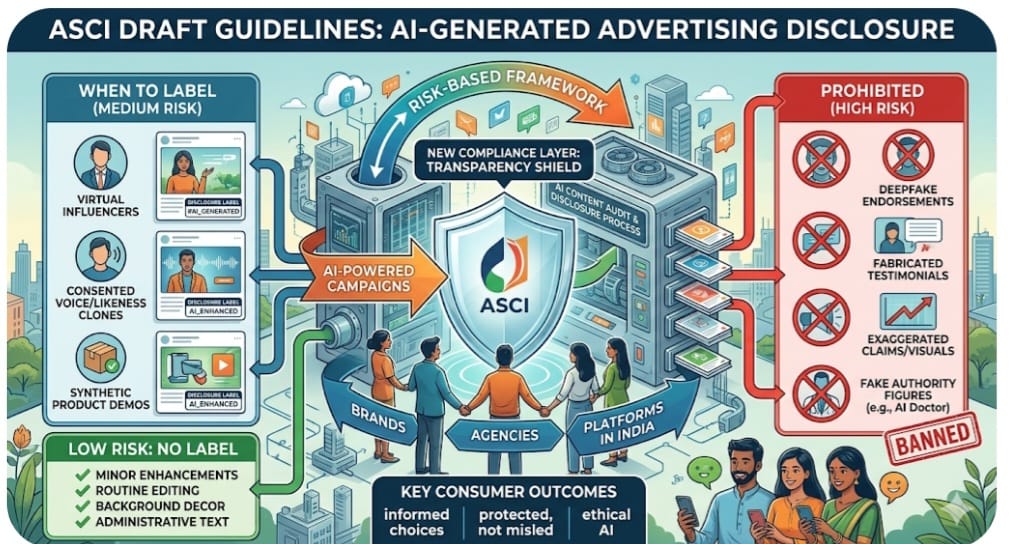
The Advertising Standards Council of India (ASCI) has released draft guidelines for responsible labelling of AI-generated content in advertising. The move comes as generative AI rapidly enters mainstream campaign production — from synthetic influencers and AI voiceovers to fully generated video creatives. Setting governance standards for New Tech The significance is less about disclosure tags and more about governance. Indian advertising has largely adopted AI faster than regulation has evolved around it. ASCI’s draft now attempts to establish a baseline: consumers should know when they are interacting with AI-generated or materially altered advertising content.
Why this matters now
AI has quietly become embedded across agency workflows. Production costs are falling, turnaround cycles are shrinking, and brands are increasingly testing AI-led creatives for performance marketing, vernacular adaptation and influencer simulations. But the absence of disclosure standards has also created grey zones around authenticity, manipulation and consumer trust. ASCI’s intervention effectively formalises a new expectation: if AI materially shapes advertising communication, brands may need to say so clearly and consistently.
The strategic read for the industry
For agencies, this shifts AI from an efficiency tool to a compliance-sensitive capability. Creative teams will now need internal governance frameworks alongside prompt engineering skills. Legal, brand safety and production teams are likely to become more involved in campaign approvals. For brands, the bigger risk is reputational rather than regulatory. AI-generated endorsements, synthetic likenesses or manipulated demonstrations without disclosure could trigger consumer backlash faster than formal penalties. Platforms and creator ecosystems may also face pressure to standardise disclosure architecture across formats, especially as AI-generated influencer content scales.
Our insight
The next phase of AI adoption in Indian advertising will not be defined by who uses AI fastest — but by who can use it credibly without weakening consumer trust.